Creola Police Ask Public’s Help Identifying Knife-Wielding Liquor Store Robber
Creola police want help identifying a suspect who used an apparent knife to rob Hwy 43 Package along Highway 43 in north Mobile County.
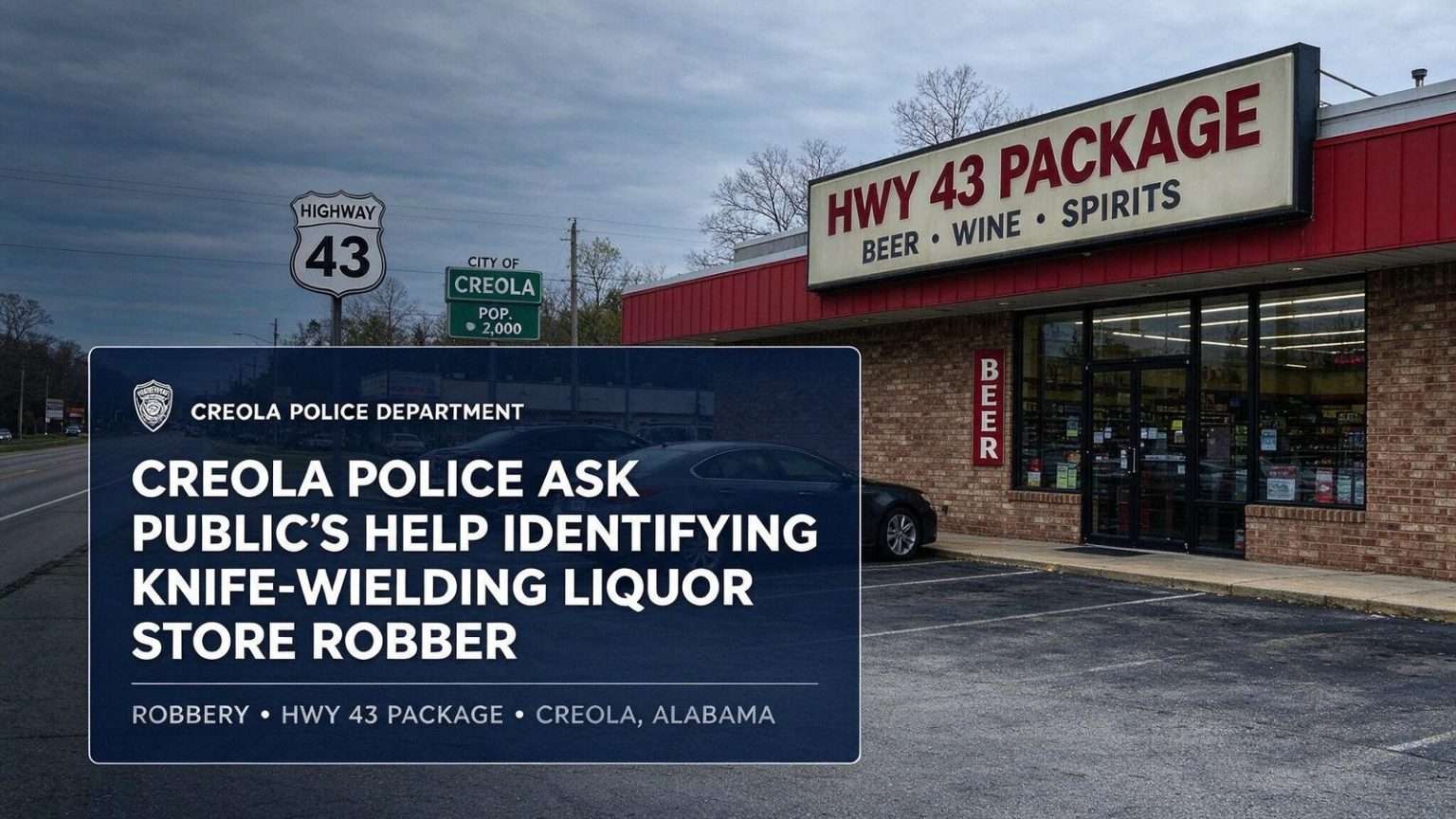
CREOLA, Ala. — Creola police are asking the public to help identify a suspect who walked into a Highway 43 liquor store armed with what appeared to be a knife and robbed the register. According to the Creola Police Department, surveillance footage from Hwy 43 Package shows the suspect entering the store with his face partially hidden by a jacket and approaching the counter with the blade in hand — a sequence the store’s cameras captured from the door to the register.
The cashier quickly opened the register and handed over an unknown amount of cash. No injuries were reported in the robbery, and the suspect fled on foot after taking the money. Investigators have not announced an arrest, and the case remains open as the department works to identify the man captured on the footage.
What the footage shows
Police shared images from the store’s surveillance system hoping someone will recognize the man. The stills show a suspect whose face is partially obscured by a jacket held up near his head — a deliberate concealment that limits what investigators can extract from the images, and the reason the department is counting on recognition of something other than a clear facial view: build, clothing, gait, or the circumstances of someone who was in the area that day.
Surveillance stills have become the workhorse of small-department investigations across south Alabama. Modern camera systems capture date- and time-stamped images that investigators can compare against other businesses’ footage along the corridor, building a timeline of a suspect’s movements before and after a crime. In a case like this one, where the getaway was on foot, the search radius is small — and any resident or business owner with a camera facing Highway 43 may hold the frame that completes the picture.
The store and the corridor
Creola sits along U.S. Highway 43 in north Mobile County, where the small department typically relies on tips from residents to close cases like this one. The city of roughly 2,000 people lies between Prichard and Saraland along a highway corridor that carries steady local traffic — service stations, convenience stores, package stores and family businesses that line the route through town. For a community that size, an armed robbery at a familiar business is not a distant crime story; it hits a store where neighbors work and shop.
The Hwy 43 Package store’s location on the main highway means the suspect approached and left along one of the most visible corridors in north Mobile County. Whatever direction he went on foot, the route passed homes and businesses where someone may have noticed him — before, during or after the robbery. That is the premise of the department’s public appeal: in a small city, the odds are good that more than one set of eyes saw this man.
Armed robbery under Alabama law
Under Alabama law, a robbery committed while armed with a deadly weapon or while the victim believes the perpetrator is armed constitutes first-degree robbery — a Class A felony carrying a potential sentence of 20 years to life. The presence of the weapon, even one the suspect never used, is what elevates the offense from theft to the state’s most serious robbery classification, and prosecutors treat the display of a blade during a register robbery as exactly that circumstance.
The charge also reflects the danger the cashier faced. Convenience and package store clerks work behind counters that separate them from armed customers by inches, and law enforcement guidance for such employees is consistent across the industry: comply with demands, avoid confrontation, and preserve memory of the details — height, clothing, direction of flight — that will matter to the investigators who arrive. The quick compliance that ended this robbery without injury follows that guidance precisely.
How tips close cases in small departments
Creola operates the kind of small municipal department common in north Mobile County — a compact force handling everything from traffic to major crimes, with investigative capacity stretched thin by the volume and variety of calls. In that structure, the public tip is not a supplement to investigation; it is often the engine of it. Department officials have consistently credited resident tips with resolving cases that a small agency could not have worked through footage and forensics alone.
Agencies like Mobile County Crimestoppers provide an anonymous channel for exactly this purpose, allowing tipsters to submit information without revealing their identity and, in eligible cases, to collect rewards when a tip leads to an arrest. The Creola Police Department has pointed residents toward both direct contact and the tip lines available across the county when cases like this one go public.
Anyone with information about the robbery or the suspect’s identity is asked to contact the Creola Police Department. Investigators will want specifics: any description of the man seen in the area of the store that day, details of vehicles or individuals seen leaving on foot, and any footage from private cameras along Highway 43 that might have caught the suspect’s approach or his departure.
What businesses can do
Robberies at package stores and convenience shops along Highway 43 follow patterns investigators know well: late-arriving or isolated staff, cash registers that accumulate through the day, and a counter position that leaves the employee face to face with whoever walks in. Security consultants who work with small retailers recommend a consistent set of practices — keeping registers visibly low on cash, posting that notice where the public can see it, maintaining camera coverage of the counter and the door, and training staff to comply and observe rather than resist.
The Hwy 43 Package footage shows that last principle working: the cashier quickly opened the register and handed over the cash, ending the encounter without injury. Surveillance captured the rest. For other businesses along the corridor, the episode is a prompt to check that cameras are recording and focused where they matter — the entrance, the counter and the register — since footage quality in the first minutes after an incident determines what investigators have to work with.
The department’s next steps
With the surveillance stills public, the Creola Police Department’s investigation continues along parallel tracks: comparing the images against footage from other businesses along Highway 43, canvassing the area for witnesses, and following up on any tips that come in. Investigators will also check whether the description matches incidents reported in neighboring jurisdictions, since suspects who rob a highway business often work a corridor rather than a single store.
The department has not released the amount taken or announced any arrest. When an identification does come — whether from a resident who recognized the jacket and the build, or from footage at another location — the case moves quickly into the arrest-and-warrant process that felony cases follow, with the surveillance evidence forming the backbone of the charging file presented to prosecutors.
A community’s role in its own safety
Creola’s request to the public rests on a simple arithmetic that plays out in small cities across south Alabama: a department of modest size cannot watch every business on a highway corridor, but the combined eyes of the community can. Neighborhood watch traditions remain active in north Mobile County, and residents along Highway 43 are accustomed to the department’s occasional appeals — for a suspect vehicle, a burglarized shed, a person of interest in a case like this one.
Anyone with information about the robbery or the suspect’s identity is asked to contact the Creola Police Department directly. Tips that seem minor — a description of someone seen walking away, a jacket discarded in a ditch, a stranger asking around about a business’s hours — are precisely the details investigators cannot generate themselves. In a case built on surveillance stills and a face partially hidden by a jacket, the community’s memory is the resource the department is asking it to spend.
The robbery also registers in the economics of a small city. A family-run package store on the main highway depends on regulars, and an armed robbery — even one that ends without injury — touches the sense of safety that keeps customers comfortable stopping in after work. Business owners along the corridor talk to each other, share footage when incidents occur and look out for one another’s closing shifts, a informal network that police in north Mobile County have cultivated through years of community policing in communities like Creola, Saraland and the county’s northern reaches.
For the cashier who faced the blade, the aftermath is the part of the story the cameras do not record. Employees who experience armed robberies commonly describe lingering effects — jumpiness at the sound of the door, reluctance to work closing shifts — and small-business employers rarely have formal employee-assistance resources to offer. In communities like Creola, the support comes informally, from coworkers and neighbors who knew exactly where that person was standing when it happened.
The case remains open, the stills remain public, and the Creola Police Department remains willing to take the call that identifies the man in the footage. Until then, the surveillance images stand as the department’s public appeal to the residents of north Mobile County: someone recognizes this man — the jacket, the build, the walk into a Highway 43 store with a blade in hand — and one call to the department could close the case.