Daphne Council Weighs 180 More Days on Garden Apartment Moratorium While Land-Use Rules Are Rewritten
An ordinance introduced Nov. 16 would extend Daphne's pause on new garden apartment applications by 180 days while the city finishes overhauling its Land Use and Development Ordinance.
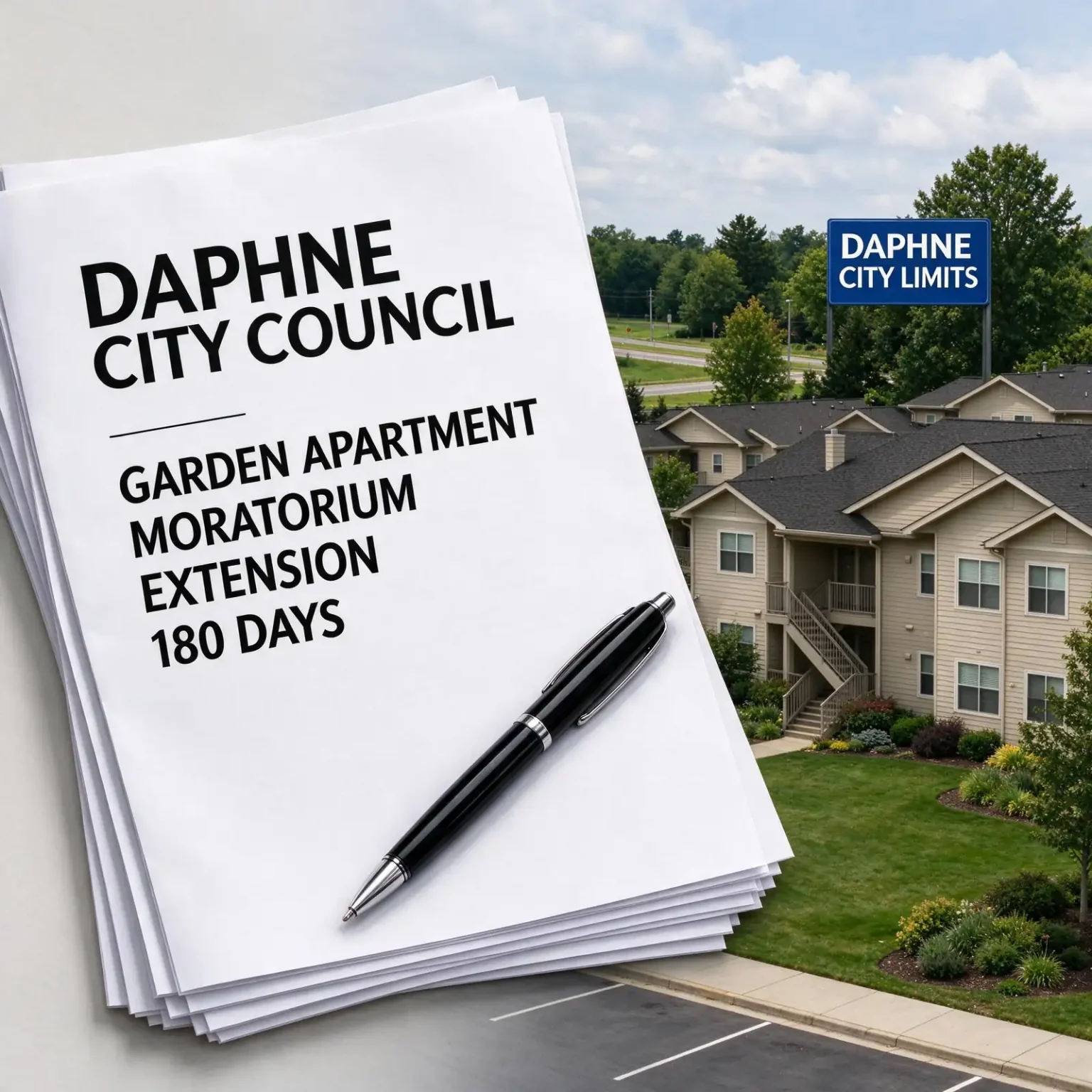
Daphne could keep its pause on new garden-style apartment projects in place for roughly six more months. An ordinance that would add 180 days to the city’s moratorium on certain multifamily development applications was introduced at the Daphne City Council meeting on Monday, Nov. 16, and council members are expected to vote on it at their next meeting.
City leaders say the additional time is needed to finish a rewrite of the rules that shape how land in Daphne can be developed.
What the extension would do
The council first adopted the moratorium in July. It limits the city’s acceptance, processing and approval of applications for multifamily garden apartment developments anywhere within Daphne’s city limits.
If council members approve the new ordinance, those restrictions would continue for another 180 days. The pause would remain in effect until it expires or until the council takes some other action, such as lifting it once updated rules are in place.
The moratorium does not reach backward. Apartment projects that city leaders approved before it took effect can move forward and are not affected by the extension.
Why the city wants more time
The driving force behind the request is an ongoing review and overhaul of Daphne’s Land Use and Development Ordinance. That document is the city’s main rulebook for growth. It sets out zoning classifications and development standards and addresses issues such as density, the strain new projects place on infrastructure, stormwater management, and whether neighboring land uses fit together.
A council member said during the meeting that the work on the ordinance is nearing completion but is not yet finished. The council member said city leaders believe it is important to have the time to be careful about how apartments and other multifamily housing are developed in Daphne, and that this is why the extension was proposed.
Next step: a council vote
The extension ordinance received its first reading on Nov. 16. A vote is expected when the council next meets.
Introducing an ordinance at one meeting and voting on it at a later one is a common practice for Alabama city councils. The gap gives council members and residents time to review the proposal before it is taken up for final action. Under state law, a council can also vote to suspend that waiting period and act on an ordinance immediately, but that requires unanimous consent of the members present. In this case, the council chose to hold the proposal over.
What a moratorium is, and how cities use one
A development moratorium is a temporary halt on accepting or approving certain kinds of projects. Local governments typically use them when they are revising zoning or land-use rules and want to avoid a wave of applications filed under the old standards while new ones are being written.
Moratoriums are meant to be short-term tools rather than permanent bans. They usually come with a fixed end date, and extensions generally require a new vote by the governing body, which is the step Daphne is now taking. Courts have generally upheld temporary moratoriums when they are reasonable in length and tied to a legitimate planning purpose, such as completing a comprehensive update of land-use rules.
What counts as a garden apartment
Garden apartments are a common form of suburban rental housing. The term generally refers to low-rise complexes, often two or three stories tall, with several buildings spread across a site and surrounded by parking, lawns and landscaping. Units are usually reached by exterior stairways or breezeways rather than interior elevators and long hallways. This style of development tends to cover a large amount of land compared with taller apartment buildings, which can bring it into discussions about traffic, drainage and density.
Daphne’s moratorium targets this specific category of multifamily housing. It is not a citywide stop on all residential construction.
The role of the Land Use and Development Ordinance
For property owners and developers, the Land Use and Development Ordinance determines what can be built and where. Zoning classifications spell out which uses are allowed in each district, from single-family homes to commercial centers to apartments. Development standards address details such as building setbacks, lot sizes, parking, landscaping and buffers between different uses.
The topics city leaders have highlighted for the rewrite all bear on multifamily housing:
- Density: how many housing units can be placed on a given amount of land.
- Infrastructure impacts: the demands new development places on roads, water and sewer service, and other public systems.
- Stormwater management: how runoff from rooftops, parking lots and other hard surfaces is controlled so it does not worsen flooding or harm nearby waterways.
- Compatibility of land uses: how different types of development fit alongside one another, such as apartments built near established neighborhoods.
Once a revised ordinance is drafted, it would generally go through the city’s planning process, which typically includes review by the planning commission and public hearings, before the council adopts it.
Growth on the Eastern Shore
Daphne sits on the Eastern Shore of Mobile Bay in Baldwin County, between Spanish Fort and Fairhope. Baldwin County has been one of the fastest-growing counties in Alabama for years, and communities along the Eastern Shore have seen steady demand for new homes and apartments.
That growth has prompted several Baldwin County cities to revisit their development rules in recent years, with discussions frequently centering on traffic along major corridors, drainage and the pace of new construction.
What residents and developers should know
- The moratorium applies only to applications for multifamily garden apartment developments within Daphne city limits.
- Projects approved before the moratorium took effect are not affected.
- If the extension is approved, the pause would last an additional 180 days, unless the council ends it sooner.
- A council vote on the extension is expected at the next council meeting.
- Residents can follow the issue through Daphne City Council agendas and meetings, which are open to the public.