Jackson Sends Yearly Alcohol Tax Revenue to Four Public Schools, Adds Gift for Coastal Alabama
Jackson’s City Council delivered its annual alcohol tax donation to four eligible public schools on Nov. 10, a practice dating to 2005, and added a gift to Coastal Alabama Community College.
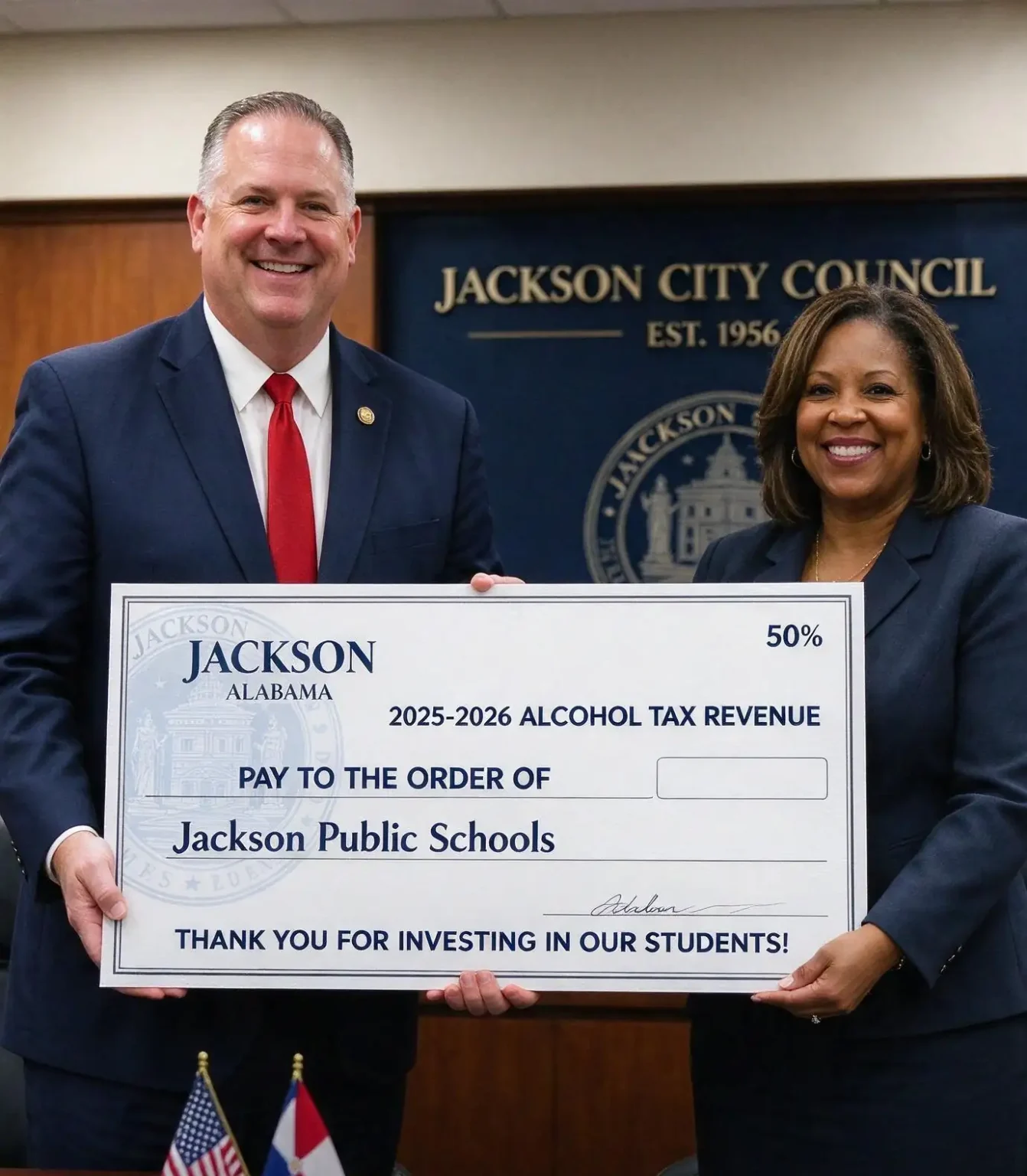
JACKSON, Ala. — A share of the tax collected on alcohol purchases in Jackson over the past year is now headed to the city’s public schools. On Nov. 10, the Jackson City Council handed over its yearly share of alcohol tax revenue to local schools, continuing a practice that dates back two decades to the city’s decision to permit alcohol sales.
The money arrives with no strings attached. City officials said the funds go straight to school principals rather than passing through the Clarke County Board of Education, leaving each school free to decide how to spend its portion.
Where Each Dollar Goes
The distribution follows a fixed formula. Once the city has collected all of the taxes on alcohol sales for a fiscal year, the total is divided among several community purposes, according to city officials:
- 50 percent to the city’s general fund
- 25 percent shared among Jackson’s four eligible county public schools
- 15 percent to the city’s recreation department
- 10 percent to the city’s senior nutrition center
This year included an addition to that formula. In 2026, the city took an extra 6.25 percent out of the general fund’s portion and directed it to a donation for Coastal Alabama Community College.
The checks presented at the Nov. 10 meeting reflect alcohol sales from the city’s previous fiscal year.
A Commitment Tied to the Wet Vote
The school donation is not a recent idea. City leaders said it has been made every year since 2005, when it was written into the arrangement the city adopted as it decided to allow the sale of alcohol within the city limits.
Over the roughly 21 years since then, the money has supported a wide range of projects at eligible schools. According to city officials, the alcohol revenue helped pay for construction at Gillmore Elementary School and at Jackson Intermediate School.
The decision to allow alcohol sales is one that many Alabama communities have faced. State law lets voters in counties and qualifying cities decide through local option elections whether alcohol may be legally sold, and a number of cities in otherwise dry or partially dry areas of the state have gone wet over the years. Local governments that permit sales can then collect their own taxes on beer, wine and liquor, which become a source of local revenue that councils can direct toward community priorities.
Why the Money Goes Directly to Principals
City leaders described their administration as strong supporters of helping students, and one city official said the structure of the donation is deliberate. Because the money is handed to principals directly and does not go through the county school board, the official said, schools can use it for the things they want to do, and the city places no conditions on how it may be spent.
That flexibility is unusual for school funding. Most money that reaches Alabama public schools arrives through state and federal channels, much of it earmarked for specific purposes such as salaries, transportation or particular programs. Discretionary dollars that a principal can apply to an immediate need, whether a building improvement, a classroom supply gap or a new program, are often harder to come by.
Private Schools Not Eligible
The donation is limited to public schools. City officials said Jackson cannot legally distribute these funds to private schools such as Jackson Academy, which is why the money is shared among the four eligible county schools.
A Faster Turnaround
The city has also changed the timing of the gift. A city official said Jackson’s fiscal year closes at the end of September and the new year begins in October. The donation used to be made in January, the official said, but the city now tries to roll the money over and get it to the schools in November, because officials know how much the schools rely on it.
How the Schools Plan to Use It
School leaders shared how this year’s money will be put to work, and the plans differ from campus to campus.
Jackson High School
An administrator at Jackson High School said the school’s share will pay for teacher training and for programs designed to help students raise their ACT scores.
The ACT is a college admissions exam that measures readiness in English, math, reading and science. In Alabama, public school juniors take the ACT as part of the state’s testing program, so efforts to lift scores can affect college admission and scholarship opportunities for a broad group of students.
Jackson Intermediate School
At Jackson Intermediate School, the funding came as a welcome surprise for a school leader who had spent money over the summer on improvements to the look of the campus.
Gillmore Elementary School
Gillmore Elementary plans to put its share toward outdoor recreation, a need driven by growth in its youngest grade. The school added a fourth pre-kindergarten class at the last minute, an addition school leaders had not expected to receive.
With 18 students in each class, the new classroom means more 4-year-olds on campus. A school leader said the expansion helps children academically while also providing a service to families in the community, and noted with a laugh that the school spends every bit of the city’s money each year.
The added class also brought new needs. The school leader said the school had to commit to building a playground for the 4-year-olds. Grant money left over was enough for the playground itself, the school leader said, but there was not enough left to build a sidewalk leading to it. That sidewalk is one of the items the city’s donation will cover.
The 18-student class size matches the limit used in Alabama’s state-funded First Class Pre-K program, which pairs a lead teacher and an auxiliary teacher in each classroom and is widely regarded as one of the strongest public pre-kindergarten programs in the country.
Community College Gift Supports Adult Learners
The additional donation to Coastal Alabama Community College is aimed at adults rather than children. A college adult education official said the money will be used for a GED instructor for night classes, workforce development skills and computer skills training.
The official said the funds will also support certification for operators of heavy equipment, specifically skid steers, mini-excavators and bulldozers.
Coastal Alabama Community College is part of the Alabama Community College System and serves southwest Alabama through several campuses, including one in Thomasville in Clarke County. Its adult education programs help people who did not finish high school prepare for the GED exam, which awards a high school equivalency credential, while its workforce programs focus on job-ready skills and industry certifications.
Equipment operator certifications are practical credentials in a region where timber, construction and industrial work remain important parts of the economy. Evening GED classes are designed for adults who work during the day and need a schedule that fits around their jobs and families.
The Rest of the Formula
While the school checks draw the most attention, the alcohol revenue reaches other parts of Jackson life as well. The 15 percent share goes to the city’s recreation department, and the 10 percent share goes to the senior nutrition center that serves Jackson’s older residents. The general fund portion becomes part of the money the city uses to run its government.
About Jackson
Jackson is the largest city in Clarke County, located in southwest Alabama along the Tombigbee River, north of Mobile. Its public schools are part of the Clarke County School District, which serves students across the county.
For the schools that receive it, the yearly donation has become a dependable source of flexible funding, one that city officials say they intend to deliver as quickly as possible each fall.