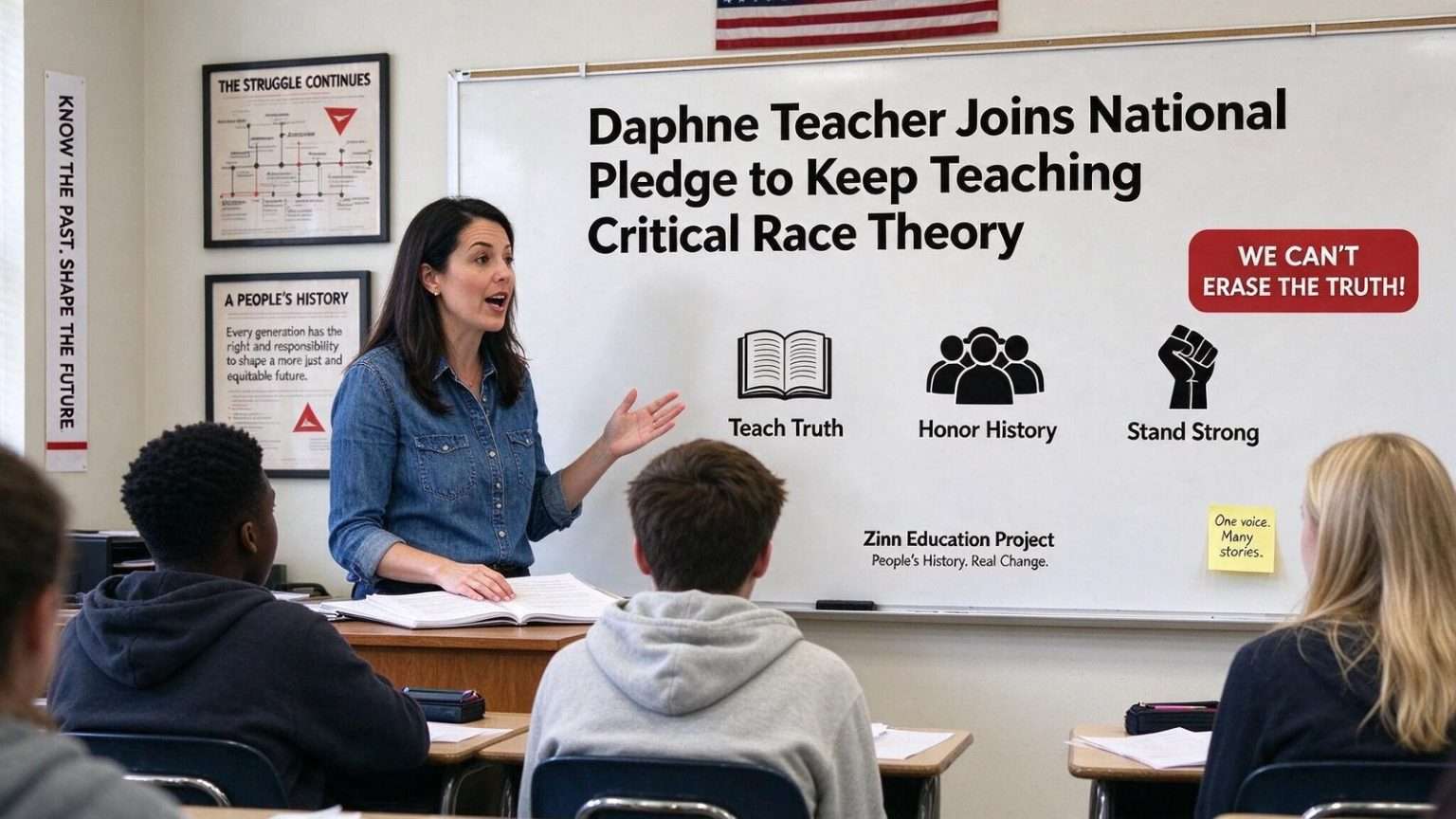
A teacher in Daphne has added their name to a national pledge organized by the Zinn Education Project, committing to continue teaching Critical Race Theory in the classroom despite a wave of state-level pushback against the concept nationwide. The signature, logged in the week ending Jan. 15, brought the running total of Daphne-area teachers who have signed the pledge to one, after no new signatures were recorded from the area the week before. In signing on, the Daphne teacher wrote simply: “We can’t erase the truth!”
The Zinn Education Project’s pledge has drawn thousands of signatures from teachers across the country who say they intend to keep teaching about the role racism has played in American history and institutions, regardless of new restrictions some states have placed on the topic. The organization takes its name from the late historian Howard Zinn, whose 1980 book “A People’s History of the United States” retold the American story through the eyes of workers, minorities and dissenters rather than presidents and generals, and it distributes lesson plans and teaching materials to social studies instructors nationwide. Its pledge campaign positions itself as a public stand by educators against what it describes as political interference in the classroom, and the running tallies it publishes by state and district have turned individual signatures into a barometer of how far the controversy has spread into smaller communities like Daphne.
What Critical Race Theory Actually Is
Critical Race Theory is an academic framework, first developed in legal scholarship in the late 1970s, that examines how racism has been embedded in laws, policies and institutions over time. Early figures in the movement argued that the civil rights gains of the 1950s and 1960s, while real, had not erased structural disadvantage, and that race needed to be examined as a durable feature of American law and institutions rather than a problem settled by a single generation of reform. Courses on the subject took root in law schools, and the framework spread gradually into graduate programs in education, sociology and history.
For decades it remained largely confined to law schools and graduate programs, but the term exploded into mainstream political debate over the past two years, becoming a flashpoint in school board meetings, state legislatures and local elections across the country — including in Alabama. In practice, the phrase is now used in two very different ways: narrowly, to describe the graduate-level academic framework, and broadly, by critics, to cover a wide range of diversity training, curriculum materials and classroom conversations about slavery, segregation and discrimination.
That gap between the academic definition and the political shorthand is a large part of what has made the fight so heated. School board meetings in suburban districts along the Gulf Coast and around the nation have stretched late into the night over library books, social studies standards and teacher training sessions, with parents, activists and elected officials often talking past one another about what is actually being taught in local classrooms.
A Pledge Born of Statehouse Battles
The pledge Daphne’s newest signer joined is, in part, a response to a growing list of state laws restricting how race and racism can be discussed in K-12 classrooms. Arizona, Idaho, Iowa, New Hampshire, Oklahoma, South Carolina, Tennessee and Texas have all passed legislation limiting or banning instruction that frames the United States as inherently racist. Other states, including Montana and South Dakota, have formally denounced the teachings through resolutions or guidance without enacting specific statutory bans.
The measures vary considerably in scope. Some take aim at required training sessions for students or employees, others at curriculum content, and others at particular concepts, such as assigning fault or guilt to individuals on the basis of race. Supporters of the laws say they draw a necessary line against ideology in public education and protect children from being made to feel responsible for historical wrongs. Opponents, including the educators who sign the pledge, argue that the language is often vague enough to chill honest classroom discussion of slavery, Jim Crow and the civil rights movement, leaving teachers unsure of what they may say without risking a complaint.
The debate has sharply divided commentators and advocacy groups. In an interview with the Washington Free Beacon, Ashley Varner of the Freedom Foundation criticized the Zinn Education Project’s pledge campaign, accusing the organization of providing what she called “left-leaning propaganda to teachers.” The Freedom Foundation is a conservative advocacy organization that has made public-sector accountability a signature issue, and its critique of the pledge frames the campaign as an attempt to push political positions into classrooms under the banner of history.
Supporters of the pledge counter that removing discussion of systemic racism from history and social studies instruction amounts to whitewashing the historical record. From their standpoint, the documentation of slavery, segregation and discriminatory policy is not ideology but established fact, and a pledge to keep teaching it is a defense of accuracy rather than a partisan act. The two sides rarely agree even on what counts as a fact in these disputes, which is one reason the conflict has proved so durable.
For teachers, the practical stakes are professional as much as philosophical. Signing the pledge is a public declaration that an educator intends to keep teaching contested material even if restrictions tighten, and in states with enforcement mechanisms the decision carries genuine risk. That risk is precisely what gives the tally its symbolic weight: each name represents an individual decision, made openly, in a climate where many teachers prefer to avoid the subject altogether. Some signers describe the pledge as a matter of professional conscience; others see it as a practical shield, a way of showing that a teacher acted deliberately rather than carelessly if a complaint ever arrives. Either way, the act is public by design, which is what separates it from the thousands of ordinary curriculum decisions made quietly every school year.
Where Alabama Stands
Alabama has not passed a statewide law explicitly banning Critical Race Theory instruction, though lawmakers in Montgomery have introduced bills targeting how race-related concepts can be taught in public schools, mirroring similar legislative pushes in neighboring states. The proposals have followed the general pattern seen elsewhere: restrictions on instruction that assigns fault or blame to individuals because of race or sex, and debates over race-related training in public agencies. None of the measures has produced the kind of outright statutory ban on the books in the eight states listed above, which is what keeps Alabama’s position distinctly unsettled.
That leaves individual teachers, principals and local school boards — including those overseeing Baldwin County’s public schools — to navigate the debate largely on their own, weighing curriculum decisions against a politically charged national conversation that shows little sign of cooling off. Baldwin County Public Schools serves one of the fastest-growing student populations in the state, spanning communities from Fairhope and Daphne on the Eastern Shore to Foley, Gulf Shores and Bay Minette, and its board sets local curriculum within the course-of-study framework adopted by the Alabama State Board of Education.
Alabama’s state social studies standards already require instruction on slavery, segregation and the civil rights movement, meaning the core historical content at the center of the national dispute is part of the mandated curriculum rather than an optional addition. How that material is presented, and how much contemporary framing accompanies it, is where the local discretion — and the local controversy — lives.
Daphne itself is one of the oldest cities on Mobile Bay, perched along the bay’s eastern shore a short drive from the U.S. 98 and Interstate 10 corridors, and its classrooms draw families with a wide range of views on the subject. In a community that size, a single public pledge signature can travel quickly through parent networks and local social media, which is one reason tallies of this kind draw attention out of proportion to their numbers.
The dispute has also become a recurring fixture of local governance. Boards of education across the region have fielded public comments on the topic, and candidates for school board office increasingly find themselves asked to state a position on it during campaigns that once turned almost entirely on budgets, bus routes and building programs. The question has moved from the seminar room to the campaign flyer, and it is not likely to retreat from either.
For a single-district count like Daphne’s, one additional pledge may seem like a small data point. But taken alongside similar tallies compiling nationwide, it reflects how a once-obscure academic term has trickled down to individual classroom decisions in communities across South Alabama, with teachers, parents and administrators all weighing in on where the line should be drawn between teaching history and what critics call ideological instruction. The week-over-week changes the Zinn Education Project logs — no new signatures one week, one the next — are a quiet measure of a debate still moving, one classroom at a time, with no resolution in sight in Montgomery or in the districts along the Gulf.