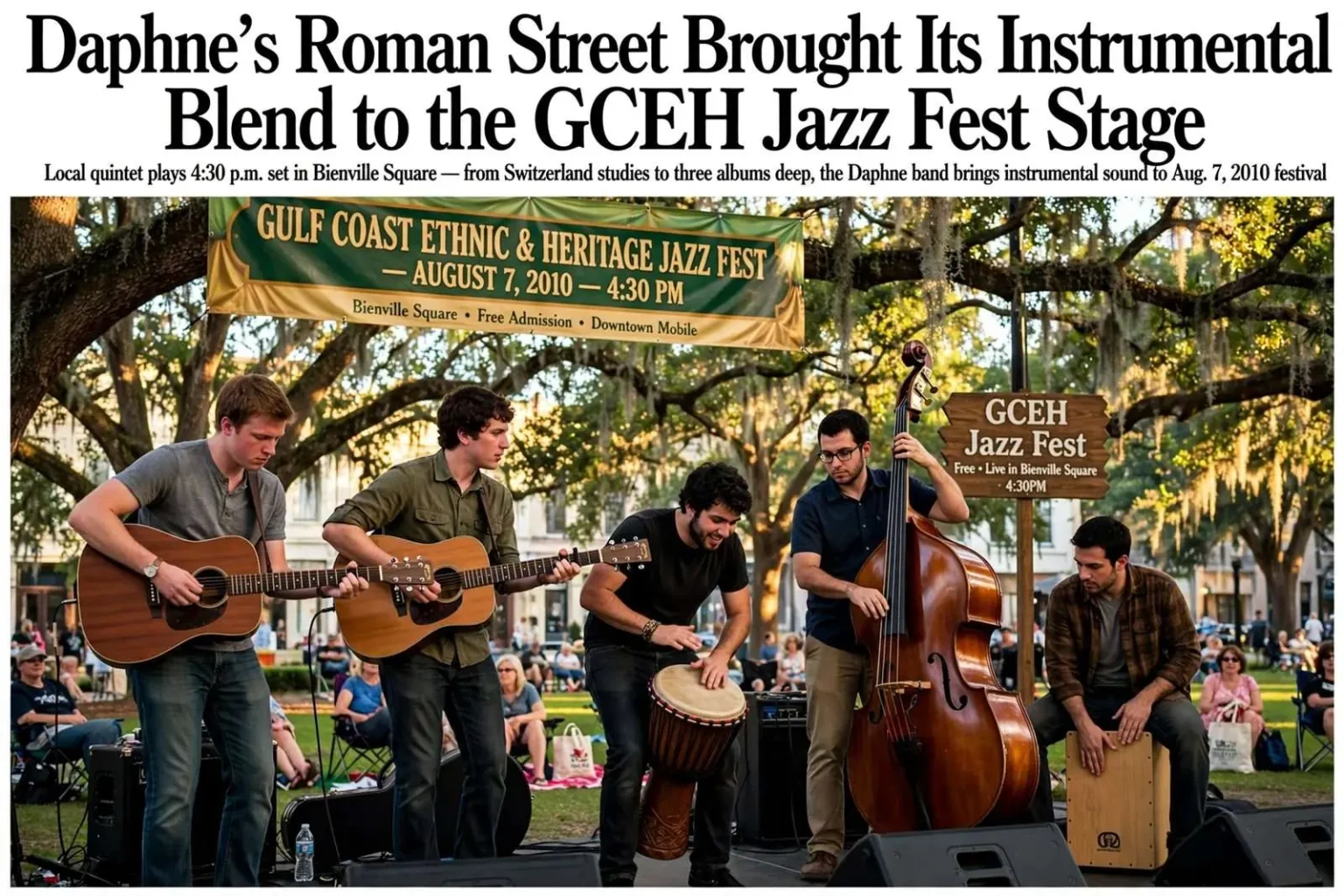
The Daphne-bred instrumental group Roman Street played the 4:30 p.m. slot in Mobile’s Bienville Square — rain location 351 Water Street — on August 7, 2010, for the Gulf Coast Ethnic & Heritage Jazz Fest.
From Switzerland Lessons to Local Stages
The band grew around brothers Noah and Josh Thompson of Daphne. After time in Switzerland studying with teachers and friends in the group Tonic Strings, the brothers began playing around their hometown, then steadily expanded: longtime friend Nik joined on djembe, Dan came aboard a few months later, and Jason eventually completed the lineup.
The members’ varied influences fused almost instantly into the band’s signature sound — energetic live shows and passionate instrumental music that earned them strong regional success.
Roman Street’s story is one of the Gulf Coast’s more unlikely musical journeys. The Thompson brothers grew up in Daphne, the Baldwin County city across Mobile Bay from the port city, in a household where music was a daily presence. Their path to formal training ran through an unusual detour: Switzerland, where the brothers spent time studying with teachers and with friends in the group Tonic Strings, absorbing European approaches to acoustic guitar that would shape everything they wrote afterward. The experience gave the brothers a technical foundation and, just as importantly, the conviction that instrumental music could carry a live show without a vocalist out front.
Back home in Daphne, the brothers began playing wherever they could — coffeehouses, restaurants, festivals around the Eastern Shore — and the early lineup grew organically from there. Nik, a longtime friend, brought the djembe, the West African hand drum whose percussive voice gave the band’s acoustic sound its pulse. Dan joined a few months later, and Jason completed the group. None of it was engineered; the band’s chemistry, by their own account, fused almost immediately.
The Gulf Coast Ethnic & Heritage Jazz Fest
The festival that brought them to Bienville Square has been a fixture of Mobile’s summer cultural calendar since the mid-1990s, founded to celebrate the jazz tradition and the ethnic heritage that produced it. Over the years its stages have hosted touring jazz artists, blues acts, gospel choirs, and local players from across the Gulf Coast, and its signature format — free daytime performances in downtown parks — has made it one of the most accessible music events in the region. The August 7 date placed Roman Street in the middle of the festival’s summer run, with the 4:30 p.m. slot giving the young band a showcase as the afternoon light started to ease over the square.
Bienville Square, the park at the foot of Dauphin Street named for the French colonial founder of New Orleans, is one of downtown Mobile’s most beloved outdoor venues. Live oaks shade its perimeter, and its central lawn has hosted everything from political rallies to Christmas tree lightings. For a jazz festival, it offers exactly what an August afternoon requires: space, shade at the edges, and the urban hum of Government Street as a backdrop. The listed rain location — 351 Water Street — stood ready in case summer storms rolled in off the bay, an ever-present possibility during a Mobile August.
Three Albums Deep
By festival time Roman Street had recorded three albums: Tribute, Amore and the newly released Shorelines.
The three records trace the band’s development from promising acoustic duo to full ensemble. Tribute and Amore established the band’s melodic, guitar-forward identity, while Shorelines — released just as the summer festival season arrived — captured the group’s expanding sound, with the full lineup’s percussion and rhythm sections filling out the brothers’ acoustic core. The titles alone tell the story of a band rooted in its geography: a band named for a Mobile Bay neighborhood street, recording albums with names that evoke both romance and the water that defines the Gulf Coast.
The band’s regional success came not from radio play — instrumental acoustic music rarely commands commercial airtime — but from the stage. Word of mouth about their live shows spread across Baldwin and Mobile counties, filling venues on both sides of the bay and earning them festival slots that introduced them to wider audiences. By the summer of 2010, they had become one of the region’s reliable draws, a band that could anchor a bill or hold a festival crowd on its own.
What the Set Meant
For the festival audience in Bienville Square, the 4:30 slot offered something distinctive: a hometown-adjacent favorite playing one of the city’s biggest summer music stages, in a program otherwise heavy with touring jazz and heritage acts. Festival bookers prize exactly this blend — names that draw crowds and local artists who prove the region’s own talent — and Roman Street fit both bills at once. Their instrumental style, drawing on jazz harmonies, Latin rhythms, and acoustic guitar traditions, sat comfortably inside a jazz festival program while sounding like nothing else on the bill.
The rain plan never had to be tested. August skies over Mobile always carry that threat, but the set went forward in the square, with the band playing beneath the oaks to an audience that had come downtown for an afternoon of music and stayed for a band that grew up thirty minutes across the bay.
From Switzerland lessons to Daphne coffeehouses to Bienville Square, the road Roman Street traveled to that stage was entirely their own — a testament to the Gulf Coast’s habit of producing musicians who sound like somewhere else and belong, unmistakably, to here.
The Eastern Shore Music Scene That Raised Them
Roman Street’s rise cannot be separated from the Eastern Shore scene that produced them. Daphne, Fairhope, and Spanish Fort have long supported a live music culture disproportionate to their size — coffeehouses that book original acts, restaurants that give young players their first paying gigs, and festivals that put regional artists on real stages. For a band of teenagers and twenty-somethings, that circuit offered something invaluable: nightly reps in front of audiences who would forgive a rough set and come back next weekend. The Thompson brothers and their bandmates logged exactly that apprenticeship, playing around Daphne and the surrounding towns until the band’s sound and confidence caught up with its ambition.
The bay itself shaped the music. The band’s instrumental palette — airy acoustic guitar lines, hand percussion, a breezy pulse — sounds like the shoreline it came from, and local audiences responded to music that felt like their own landscape. Booking agents and festival programmers across the Gulf Coast noticed the same thing: Roman Street delivered a sound that fit any coastal stage, from Mobile’s Bienville Square to venues further along the coast.
Instrumental Music Without a Safety Net
Playing instrumental music in public demands a particular kind of nerve. Without lyrics to carry a casual listener’s attention, every passage must hold the crowd on its own terms — melody, rhythm, dynamics, and interplay doing the work a vocalist would normally do. Roman Street built its reputation precisely there. The brothers’ guitar work carried the melodic weight, Nik’s djembe gave the music its physical drive, and the full band’s arrangements gave each song an arc that rewarded attentive listening without ever losing the casual festivalgoer.
That versatility explains the band’s busiest asset: its calendar. The same trio-plus-lineup that could hold a listening-room audience could also score a festival afternoon slot, and programmers on both sides of Mobile Bay kept calling. By August 2010, festival slots like the Gulf Coast Ethnic & Heritage Jazz Fest’s 4:30 hour had become the band’s proving ground of choice — big enough to matter, relaxed enough for a band still expanding its catalog.
The 2010 Festival Season Context
The summer of 2010 was a strange and difficult season along the Gulf Coast. The Deepwater Horizon oil spill dominated headlines through the spring and early summer, and its economic shadow stretched across the coast’s tourism and music industries — festivals scrambling to reassure crowds, venues watching attendance waver. Against that backdrop, a strong free festival in downtown Mobile carried weight beyond entertainment: it signaled that the region’s cultural life was proceeding, that audiences still came downtown, and that local artists still had stages. Roman Street’s set belongs to that story too — a young Gulf Coast band playing a Gulf Coast festival in a summer when the coast needed the music.
The festival’s organizers had built their reputation on exactly this kind of programming for more than a decade: jazz in its broadest sense, heritage in its fullest meaning, and free admission that kept the audience as wide as the music. Bienville Square on an August afternoon, live oaks overhead and Government Street humming nearby, has hosted few afternoons that fit the mission more cleanly than a Daphne band three albums deep, playing instrumental music born a bay away.
By the time the set ended and the crowd dispersed toward Dauphin Street, the band had added another entry to the argument it had been making since the Switzerland years: that instrumental music, played with passion and precision, needs no interpreter — and that the Gulf Coast produces artists who can prove it anywhere, including at home.