
Dauphin Island Begins the Long Cleanup After Hurricane Sally
Dauphin Island residents begin cleaning up widespread damage from Hurricane Sally; the island stays closed to non-residents.
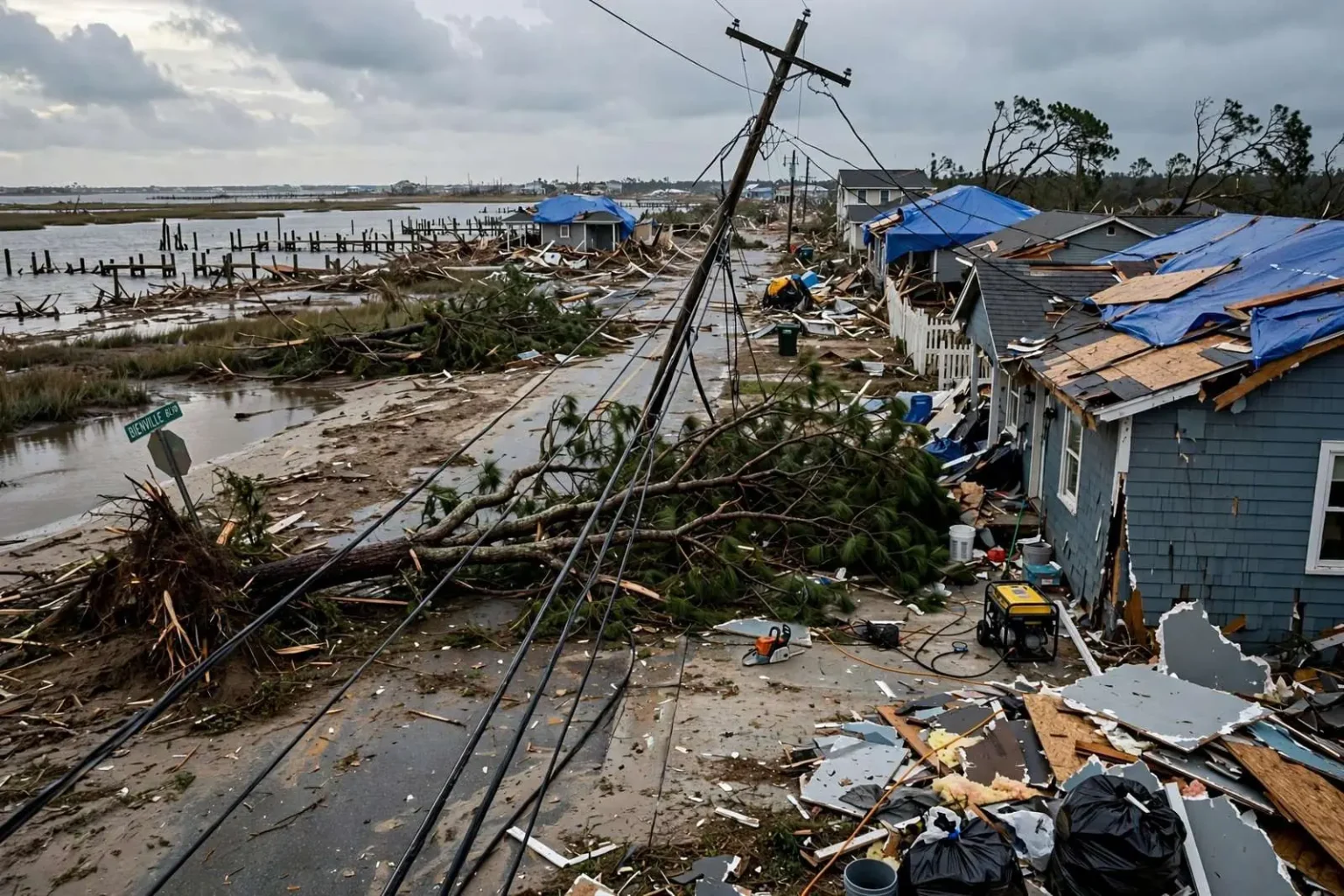
The soundtrack of Dauphin Island right now is chainsaws, hammers and generators, as residents start digging out from Hurricane Sally’s blow. The storm toppled trees and power poles, dropped live lines across roads, tore apart docks, ripped siding off homes, peeled open roofs and flooded streets across the barrier island community, leaving the town to begin one of the longest recoveries on the Alabama coast.
Sally came ashore in September 2020 near Gulf Shores as a slow-moving Category 2 hurricane, and its crawl across the northern Gulf Coast proved as punishing as a stronger storm’s punch. Hours of sustained winds and storm surge piled water into communities east of the landfall point, and Dauphin Island — the low-lying barrier island that stands between Mobile Bay and the open Gulf — took the storm’s worst from both directions: surge from the Sound and the Gulf, and wind that lasted long enough to strip the town apart piece by piece.
Resident Carol Merkel counted ceiling damage, a brand-new dock destroyed and a break in her seawall among her losses.
“This is one of the worst I’ve ever seen,” she said. “I’ve not seen it where I could not get gasoline, where any of the stores are open.”
Her account captured what made Sally’s aftermath different from a passing blow: with power out and the island closed, even the basics of daily life — fuel, groceries, ice — were unavailable, and every repair job started with a generator and ended at dusk.
An island cut off from the mainland
For now the island remains closed to everyone except permitted residents, with town officials keeping the gates shut until roads and services can safely handle normal traffic again while the cleanup proceeds. The closure is a familiar tool for Dauphin Island, whose single highway link to the mainland concentrates every arrival and departure through one route, and whose small permanent population is quickly overwhelmed by sightseers and storm chasers whenever damage makes the news.
That link — the Dauphin Island Bridge carrying State Route 193 across the Mississippi Sound — is the island’s lifeline, and its history shapes every recovery. An earlier bridge was destroyed by Hurricane Frederic in 1979, leaving the island isolated for years before a new high-rise bridge opened, and islanders have never forgotten what isolation means. After Sally, keeping the road open for utility crews, insurance adjusters and residents while shutting out everyone else became the town’s first and most urgent management task.
Utility restoration moved in the rhythm that barrier island work always follows: crews first clear downed lines and debris from the road corridors so buckets and trucks can pass, then work street by street. With power poles snapped and lines lying across yards and canals, the island’s grid had to be rebuilt in stretches, and the hum of private generators became the town’s unofficial meter of how far recovery had reached on each block.
What Sally did to the island
The damage inventory on a barrier island reads differently than on the mainland. Docks and piers — many of them built new after previous storms — were torn apart by surge and wave action in the Sound. Roofs peeled open by sustained winds exposed interiors to hours of driving rain, so wind damage quickly became water damage. Seawalls, the low walls that line the island’s streets and yards against tide, cracked and broke under the weight of water pushing from both sides. Streets that flood in a strong summer thunderstorm stayed underwater through the storm and deposited sand, silt and debris that had to be cleared before assessments could even begin.
For a town of roughly 1,300 permanent residents, the scale of that work is enormous relative to the labor available. Every able resident became a cleanup crew: cutting trees off roofs, hauling wet insulation and carpet to the curb, tarping what could be tarped before the next rain. Neighbors who rode out previous storms — Frederic in 1979, Ivan in 2004, Katrina in 2005, Isaac in 2012 — guided the newer ones through the sequence of a coastal recovery, from the first insurance call to the long wait for contractors.
Life behind the gates
Under the access controls, life on the island ran on its own schedule. Residents with permits could come and go across the bridge to buy fuel and supplies on the mainland, then return to neighborhoods where the stores were dark and the gas pumps dead. Merkel’s observation — that she had never seen a storm where she could not get gasoline or find an open store — reflected how thoroughly Sally’s approach to the east had disrupted the island’s normal supply chain, which depends on mainland services just minutes away across the Sound.
Town officials urged patience and safety in the days after the storm: beware of downed lines, treat every generator as a carbon monoxide hazard, watch for weakened trees and compromised structures, and photograph everything for insurance. Those warnings repeat in every Gulf hurricane, but on a barrier island they carry extra weight — with stores closed and medical services across the bridge, an injury or illness is a longer, slower problem than it would be on the mainland.
The town’s experience has made it a case study in barrier island vulnerability. Dauphin Island sits at the mercy of every hurricane entering the Gulf’s northern rim, and the federal and state investment that follows each storm — beach renourishment, sand bypassing at the ship channel, road repairs, home elevations — has become a permanent part of the island’s economy and identity. After Sally, the familiar cycle began again: assess, document, apply for assistance, and rebuild better where the money allows.
The long arithmetic of recovery
The cleanup residents were starting was measured not in days but in seasons. Debris removal alone — vegetative, construction and demolition, white goods and e-waste, each sorted to its own haul — typically takes months on a barrier island, with contractors staging mountains of storm waste for pickup by barges and trucks. Insurance inspections follow, then adjusters, then contractors, whose schedules across the entire Gulf Coast were already crowded by Sally’s damage from Louisiana to the Florida Panhandle.
Through it all, the island’s reason for being stays constant. The same geography that makes Dauphin Island vulnerable — a slim strip of sand between the Gulf and the Bay — is what makes it beloved: the fishing piers, the Audubon bird sanctuary that anchors the island’s eastern end, the public beach at the west end, and the quiet streets where families have built for generations. Residents digging out after Sally were, in the most literal sense, rebuilding the place they refuse to leave.
The gates will reopen when the town says the roads and services can handle normal traffic, and the sightseers will return as they always do. Until then, the chainsaws and hammers and generators carry on the work — street by street, dock by dock, roof by roof — of putting the island back together after one of the worst storms its longtime residents say they have ever seen.
Storm history shapes the recovery
Dauphin Island’s storm memory runs deep. Hurricane Frederic’s 1979 landfall destroyed the original bridge and much of the town, Hurricane Georges flooded the island in 1998, Hurricane Ivan’s 2004 surge tore through streets on the island’s west end, and Katrina’s 2005 blow scattered houses and sand across the island. Each storm added a layer to the town’s rules and habits: elevated construction, stricter building standards, storm-ready emergency plans and the access-control system now keeping the island closed to all but permitted residents.
Sally added a new chapter to that history in a different way than her predecessors. The storm’s slow movement meant extended hours of tropical-storm and hurricane-force conditions rather than a fast pass, and its surge pushed water into the Sound and against the island for multiple tide cycles. Longtime residents measured Sally not only by what it destroyed but by how long it lasted — a storm that gives a community time to be afraid, then leaves it a long night and a longer morning.
The recovery will be tracked the way island recoveries always are: by when the power comes back street by street, when the stores reopen, when the bridge reopens to everyone, and when the first rebuilt dock appears over the water. Neighbors compare notes at the gate and on the ferry dock each morning, trading word of which streets have crews and which are still waiting. For now, residents say the measure of each day is simpler — another tree cleared, another tarp nailed down, another yard hauled to the curb — and another reminder that on Dauphin Island, rebuilding after a hurricane is not an interruption of life on the island. It is part of it.


