
Dauphin Island Considers Restricting Short-Term Rentals to the West End
Dauphin Island considers a plan to ban short-term rentals on the east end, limiting vacation rentals to the west end amid island growth.
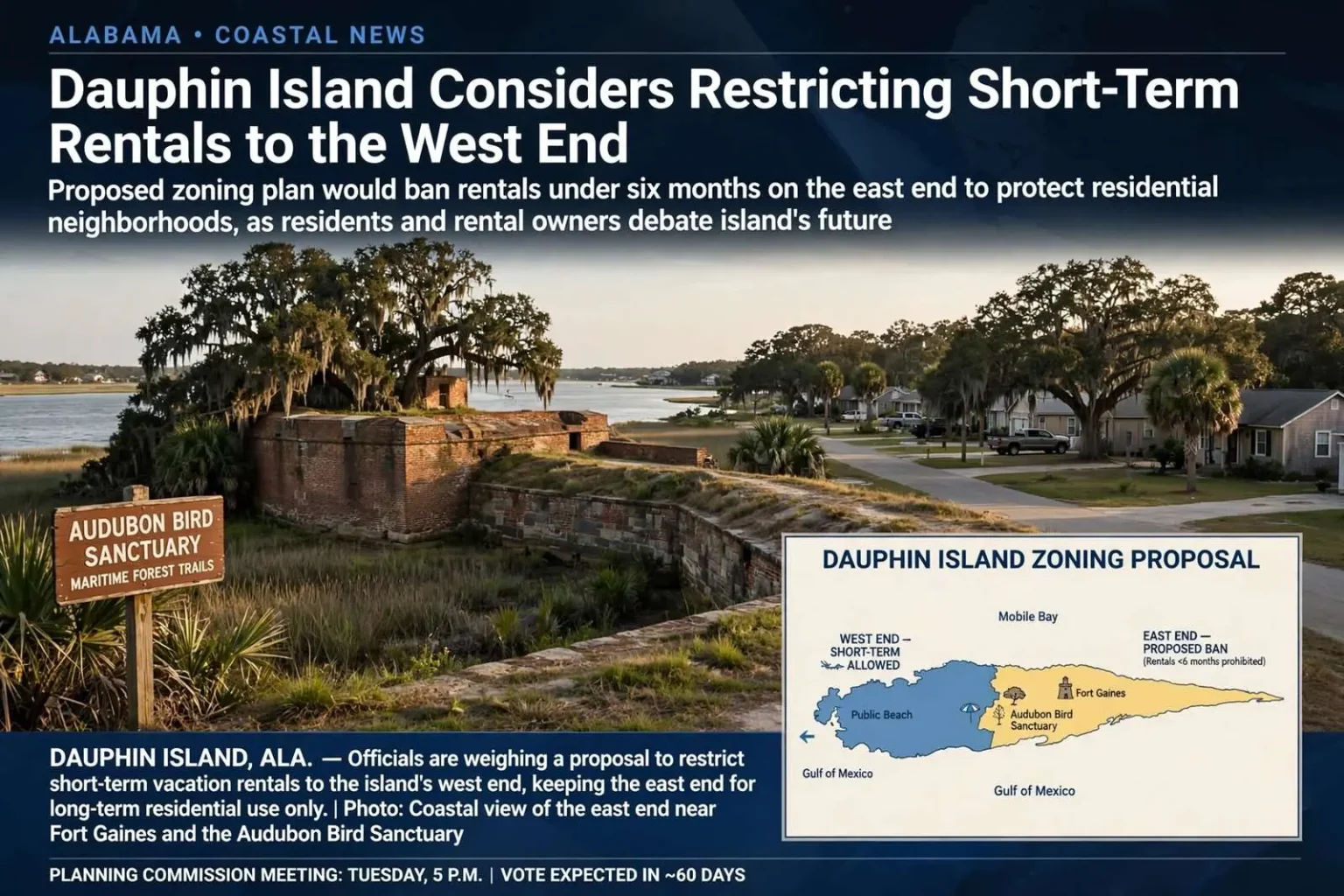
DAUPHIN ISLAND, Ala. — Dauphin Island officials are weighing a proposal that would effectively ban short-term vacation rentals on the east end of the island, confining them to the west end if approved. The idea has set the town’s two identities — quiet residential community and Gulf Coast vacation destination — against each other in a debate that has been building for more than a year.
The planning commission has been discussing the idea for roughly a year and a half. The length of that discussion reflects how consequential the question is for a town of Dauphin Island’s size, where rental income and residential character are not abstract concepts but the twin pillars of the local economy and way of life.
Under the draft plan, any rental of less than six months would be prohibited in the areas shaded yellow on the town’s zoning map, isolating short-term rentals to the west end. The zoning approach would make the restriction a matter of law rather than informal practice, enforceable through the town’s permitting and code enforcement processes.
The goal is to keep visitors on the west end and preserve quieter residential character on the east end for full-time residents. The east end of the island holds the community’s historic anchor points — the grounds surrounding Fort Gaines and the Audubon Bird Sanctuary’s maritime forest trails — along with established neighborhoods where year-round residents have watched visitor traffic grow with the island’s popularity.
Homeowners Push Back
The proposal has drawn pushback from homeowners who rent to vacationers. Justin Warren, who owns three east-end homes, said property owners bought under one set of rules with the expectation they could rent, and that changing course creates a financial burden — particularly for those who purchased future retirement homes counting on rental income to finance them.
That objection is the one that surfaces in nearly every coastal short-term rental fight: owners who made investment decisions based on existing zoning argue that a retroactive change amounts to the town rewriting the terms of their purchases. For owners who rent east-end properties seasonally and plan to retire in them, rental income is often the mechanism that makes ownership possible at all.
Rental operators also point to the island’s tourism economy. Vacation rentals supply the lodging that ferry riders, anglers, birders and beachgoers need, and the spending by those visitors supports restaurants, the marina, tackle shops and other businesses that could not survive on the year-round population alone. Restricting where guests can stay, operators argue, does not simply move tourism — it risks shrinking it.
A Mayor’s Frame: Managing Growth
Mayor Jeff Collier, who also sits on the planning commission, framed the debate around growth. He noted the island has been building about 60 to 80 houses a year for the past seven or eight years, and that the population rose roughly 400 in the last census — about a 35 percent increase.
Those figures describe an island in transition. A barrier island community that for decades drew a modest, largely repeat crowd of visitors and a stable base of year-round residents has become one of the region’s fastest-growing coastal addresses, with new construction climbing along its length. Growth of that pace brings tax base and vitality, but it also brings the friction that zoning exists to manage: more cars on the causeway, more demand on the water and sewer system, and more of the island’s housing stock serving visitors rather than residents.
The proposal remained in its early stages. A meeting was scheduled for 5 p.m. on the Tuesday after the announcement to discuss it, and if the planning commission signed off, the plan would head to the town council for a vote roughly 60 days later.
That sequence gives both sides a defined runway. Property owners who oppose the map will have the commission meeting and the weeks before the council vote to make their case, and supporters of the restriction will have the same window to press for it. Zoning changes in Alabama municipalities follow a public process, with published notices and hearings, so the final shape of the plan could still change considerably before any vote.
Dauphin Island occupies a distinctive position on the Alabama Gulf Coast. It is the barrier island that guards the entrance to Mobile Bay, connected to the mainland by a single three-mile causeway across the Mississippi Sound, and it markets itself deliberately as a quieter alternative to the high-rise resort strips farther east. The town has no condo towers and few commercial strips; its draw is the beach, the birds, the fishing and the fort.
Why the Island’s Geography Shapes the Fight
That geography also explains why the rental debate splits along east-west lines. The east end holds the island’s historic and natural landmarks — Fort Gaines, the site of the 1864 Battle of Mobile Bay, the Audubon Bird Sanctuary with its miles of trails, and the ferry landing that connects the island to Fort Morgan across the bay entrance. The west end holds the town’s public beach, its largest stretch of gulf-front lots and most of the vacation rental inventory that has grown in recent years.
Full-time residents on the east end have described the quality-of-life concerns that drive the proposal: homes that sit empty most of the year and fill with rotating groups of guests on weekends, trash and parking pressures on narrow streets, and a neighborhood rhythm that changes when a majority of houses on a block are rentals. Those concerns mirror short-term rental debates playing out in coastal towns across the country, from the Carolinas to Florida’s Panhandle, where communities are experimenting with caps, zones and phase-outs.
What makes Dauphin Island’s version notable is the town’s size and its single road. With one route on and off the island, growth pressures are felt acutely and evenly, and the town government — a small council and commission structure — makes policy with a directness that larger cities cannot. Decisions made in the meeting room at Town Hall land on the island’s residents within a season.
The economics cut both ways as well. Short-term rentals generate lodging tax revenue that funds the island’s tourism promotion and contributes to town coffers, and they support the service jobs that keep the island’s restaurants and shops open through the season. But the town also must house the teachers, first responders and tradespeople who serve the community, and a housing stock tilted toward visitor lodging makes that harder every year.
Whichever way the council votes, the outcome will shape what kind of community Dauphin Island is for decades. The town has an opportunity rare in coastal development — to set its course while the island still has open land and a manageable scale — and both sides of the debate describe the stakes in exactly those terms.
For east-end rental owners, the 60-day runway before a potential council vote is where their case will be made. Experience in other Alabama beach towns suggests the most persuasive arguments tend to be practical rather than principled: data on how many existing east-end rentals would be affected, what the loss of that inventory would do to town lodging tax, and whether a compromise — a cap, a registration system, or a grandfathering provision for current owners — could deliver the peace the east end wants without erasing investments made in good faith.
How the Process Works From Here
The meeting scheduled for 5 p.m. on the Tuesday after the announcement gives the planning commission its forum to hear from the public and decide whether to advance the draft map. If the commission signs off, the zoning amendment moves to the town council, where another public hearing typically precedes a vote — in this case expected roughly 60 days after the commission’s decision. Residents who want to weigh in can attend either meeting, and comments made at the commission stage become part of the record the council considers.
Collier’s dual role — mayor and planning commission member — puts him at the center of the process, and his growth framing signals how the town’s leadership is inclined to see the issue: less as a fight between tourists and residents than as a question of how much change the island can absorb. Towns across the Gulf Coast have spent the last several years discovering that the answer to that question does not stay constant as visitation climbs.
Whatever the final map shows, the yellow-shaded east end would remain open to long-term rentals of six months or more, the arrangement that has traditionally housed seasonal workers, snowbirds and families settling in for a school year. The six-month line is a common regulatory threshold in coastal zoning, distinguishing visitor lodging from the residential leases that communities consider part of their housing stock.
The town has not said what enforcement would look like if the restriction passes, though zoning violations of this kind are typically handled through the town’s code enforcement process, with penalties escalating for repeat violations. Owners of affected properties would face a transition period, and grandfathering questions — whether existing rentals could continue — are likely to be among the central issues debated before any council vote.
For now, both the island’s full-time residents and its rental owners are watching the same calendar: the commission meeting, the weeks of comment that follow, and the council decision expected about two months later that will determine where the line between Dauphin Island’s two identities is finally drawn.


