
Dauphin Island Residents Recover From Sally While Bracing for Hurricane Zeta
Dauphin Island residents recovered from Hurricane Sally while preparing for Hurricane Zeta, with 4-6 feet of surge expected on the west end.
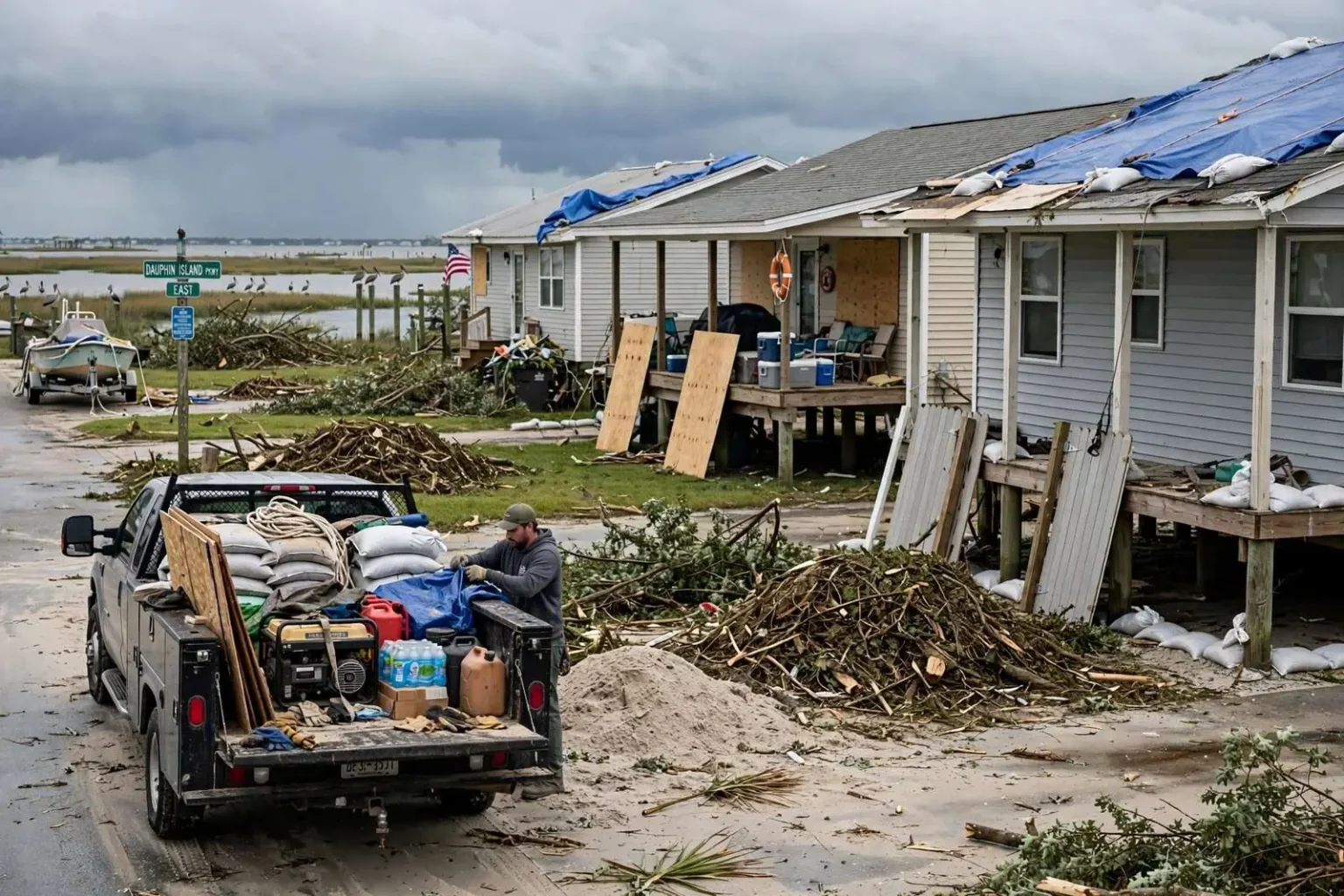
As Dauphin Island residents and officials prepared for potential impacts from Hurricane Zeta, they were still deep in recovery from Hurricane Sally — and on the low-lying barrier island, the two efforts were happening at once. With Zeta’s track shifting east and the system becoming a hurricane, preparations were a given on an island prone to flooding and storm effects. The overlap of a fresh recovery mission with a new round of boarding-up and tie-downs captured the reality of the 2020 hurricane season on Alabama’s Gulf Coast, where the calendar seemed to leave almost no room between one storm’s aftermath and the next storm’s approach.
Resident Trey Snowden, who had moved to the area only months earlier, said he could still see plenty of work from the last storm and wasn’t sure who was prepping versus repairing. “I’m just down here seeing what I need to put up and tie down,” he said. For newcomers to the island, the weeks after Sally had offered a crash course in coastal living: tarps on roofs, piles of vegetative debris along the streets, and the slow, methodical work of drying out homes that took on water. Snowden’s remarks reflected a sentiment repeated across the island as Zeta churned in the Gulf — a sense that the distinction between storm preparation and storm recovery had blurred into a single, continuous effort.
Flying debris was a real concern. Sand still covered some roads, with debris, hanging limbs and loose siding on homes — all of it capable of becoming dangerous projectiles in tropical-storm-force or hurricane-force winds. On a barrier island where wind-blown sand is a fixture of everyday life, leftover storm material takes on added significance when a new system approaches. Anything loose — a piece of siding, a limb dangling from a stressed oak, a pile of brush awaiting pickup — becomes a hazard the moment sustained winds build. Residents spent the days before Zeta’s arrival clearing yards, securing boats and trailers, and checking on neighbors along the island’s east-west corridors.
Mayor Jeff Collier said the worry was that material would get displaced again by wind or flowing water. The concern speaks to how storms compound one another on Dauphin Island: debris scattered by one system can be pushed into canals, onto roads or into yards by the next, restarting cleanup cycles that already strain small-town resources. The town’s public works crews had been working through Sally’s debris stream when Zeta’s forecast cone began to include the central Gulf Coast, forcing a rapid pivot from cleanup logistics back to pre-storm readiness.
For a municipality with a small year-round population, the operational demands of back-to-back systems test everything from staffing to stormwater infrastructure to the patience of residents still waiting on repairs. Dauphin Island’s government operates with a modest crew, and its budget depends heavily on tourism revenue that storms can interrupt without warning. Each new system in the Gulf forces officials to balance the immediate needs of recovery — debris contracts, damage assessments, insurance documentation — against the urgent checklist of preparation, often within the span of a few days.
An island built around the water
Dauphin Island sits at the mouth of Mobile Bay, guarding the entrance to one of the busiest natural harbors on the Gulf of Mexico. The town’s geography — a narrow strip of sand bounded by the Gulf on the south, the bay on the north and Mississippi Sound to the west — makes it one of the most flood-exposed communities in Alabama. Even routine heavy rain can pond water in low-lying streets, which is why storm surge forecasts are watched so closely there. The island’s history is written in storms: Hurricanes Frederic, Georges, Ivan and Katrina each left their marks, and Sally’s landfall in September 2020 added a new chapter, striking the Gulf Coast with destructive winds and a prolonged surge event that damaged homes, piers and the island’s public beaches.
Cara Johnston, whose family owns several island restaurants, said they were putting things away, getting ready to move easily and hooking up generators. For the island’s small business community, storm preparation is a familiar rhythm — pulling outdoor furniture and signage inside, securing propane tanks, testing generators and arranging for staff to shelter safely before conditions deteriorate. Restaurants along the island serve both locals and the visitors who cross the bridge in summertime, and a sustained closure after a storm means lost revenue on top of any physical damage. Hooking up generators in advance is standard practice in a place where power outages can stretch for days after a landfall or even a passing tropical system.
Zeta was projected to be a low-end Category 1 storm, with Dauphin Island expecting roughly four to six feet of storm surge on the west end — on top of the flooding the island sees even in heavy rain. For a community where much of the land sits only a few feet above sea level, that range was significant. Surge of that magnitude can push Gulf water across the western end of the island, overtop low roads, undercut foundations and leave behind the sand deposits that residents were already shoveling out from Sally. Forecasters emphasized that even a “low-end” hurricane can produce dangerous water levels, particularly when it arrives on top of a coastline still reshaped by a previous storm.
Snowden’s hope was simply that the flooding would be the worst of it. That measured expectation — accepting water in the streets but wishing to be spared wind damage and injury — is a common outlook among longtime coastal residents, and one that newcomers like Snowden were quickly adopting. The west end of the island, where the surge forecast was highest, is historically the most vulnerable stretch, with homes raised on pilings and streets that routinely disappear under Gulf water during significant events. Residents there track each forecast update closely, knowing that a small shift in track or intensity can mean the difference between a nuisance flood and serious damage.
As Zeta approached the Gulf Coast, the island’s preparation looked much as it always does: boats trailered or tied down, windows boarded, loose items stowed, generators staged and fueled, and neighbors checking on one another while the recovery from Sally continued in the background, pile by pile and street by street. The town’s emergency notifications urged residents to finish preparations early and to stay off the roads once winds built. Whatever Zeta ultimately delivered, the island’s experience in 2020 made one thing plain — on Dauphin Island, recovery and readiness are no longer separate seasons, but two halves of the same coastal life.
What residents can expect from recovery programs
For islanders still working through Sally damage, the arrival of a second system complicates the paperwork as much as the physical work. Federal and state disaster assistance programs generally require documentation of damage, and separate storm events must be distinguished from one another when claims are filed. Homeowners are advised to photograph conditions before and after each storm, keep receipts for repairs and materials, and report new damage promptly so that insurers and assistance programs can attribute losses correctly. On a barrier island where many homes are second residences or rentals, those requirements add another layer of coordination between owners who may live far away and neighbors who keep an eye on properties in their absence.
The back-to-back storms of 2020 also highlighted the role of the island’s infrastructure in recovery. The Gordon Persons Bridge is the island’s only land link to the mainland, which means that preparations — and any evacuation — must be completed before winds reach levels that close the span to traffic. Fuel, groceries, building supplies and contractors all arrive over that single route, and after a storm the same bridge carries the insurance adjusters, utility crews and supply trucks on which recovery depends. Residents who lived through previous storms know to fill vehicles with fuel, charge devices and stock several days of essentials before a system arrives, because resupply can be interrupted without warning.
Environmentally, overlapping storms strain the island’s natural buffers as well. The dunes and maritime forest that absorb wave energy and wind take months to recover from a significant event, and a second system before vegetation re-establishes can undo what little regrowth occurred. Sea turtles nesting on the island’s beaches in summer and the bird sanctuaries that make the island a stop on the Alabama Coastal BirdFest trail both depend on habitat that storms reshape. Local conservation groups routinely organize post-storm cleanup efforts, and residents were expected to add Zeta debris to the already long list of material collected after Sally.
For now, the island’s focus remained the same as it has been all season: secure what can be secured, look out for neighbors, and take the storms one at a time. Mayor Collier and town staff were expected to continue updating residents through official channels as Zeta’s forecast firmed up, and utility crews from across the region stood ready to move in behind the storm. On a barrier island that has rebuilt after every major hurricane for generations, the work of recovery and the work of preparation had become, in the autumn of 2020, a single unbroken routine — and residents like Trey Snowden were learning it from the ground up.


