Dauphin Island Sea Lab Director Says Media Overstated Health Risks of Oil Spill Dispersants
Dauphin Island Sea Lab director George Crozier says media coverage overstated health risks from 2010 oil spill dispersants.
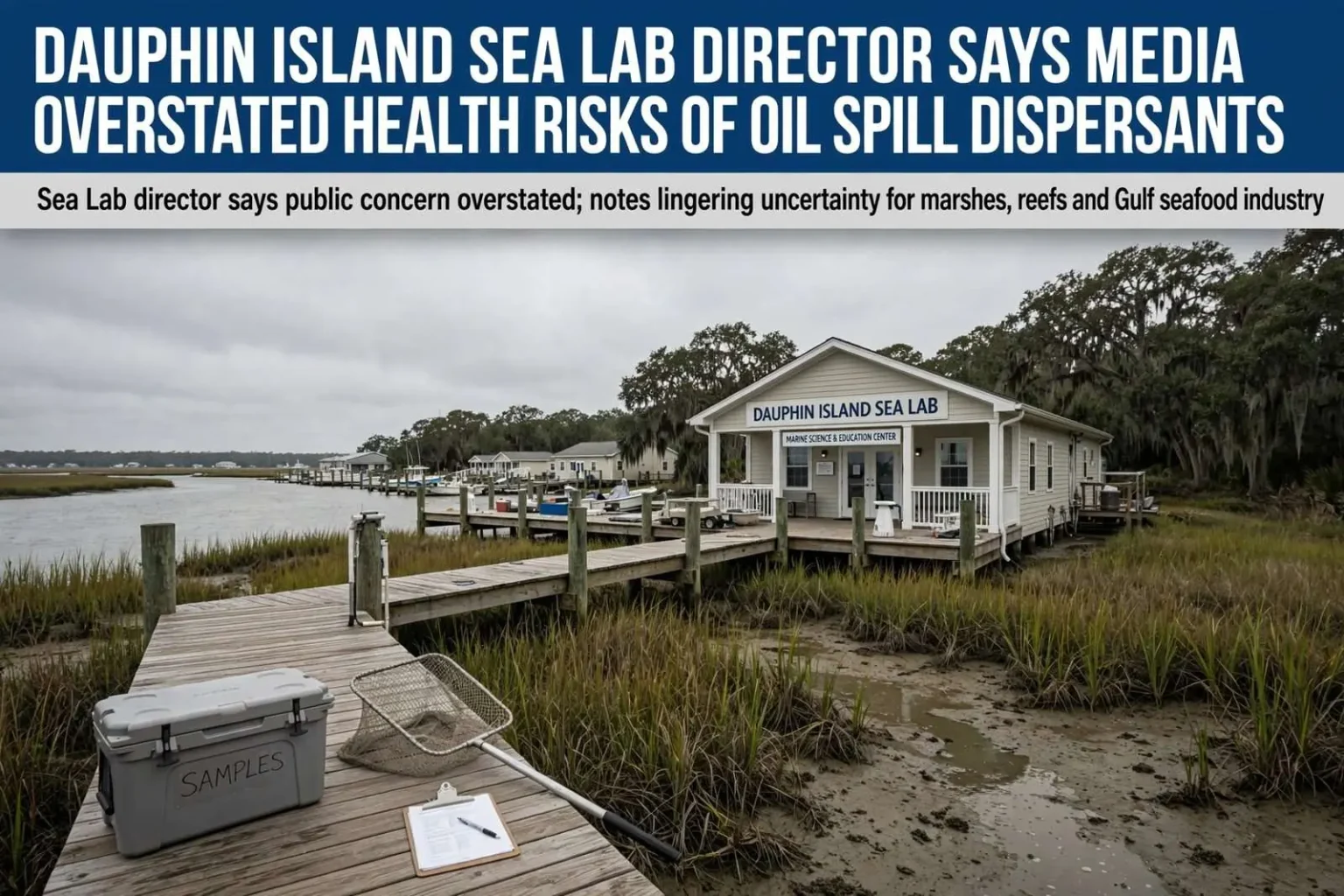
The director of the Dauphin Island Sea Lab told a local audience that concerns about the health effects of oil and chemical dispersants used during the 2010 Deepwater Horizon spill response have been overstated, even as he cautioned that the spill’s environmental impact on Gulf Coast ecosystems remains harder to predict.
Dr. George Crozier, who leads the marine research and education center on Dauphin Island, said much of the public alarm over the spill traced back to how it was covered in the press rather than the underlying science. His remarks came as coastal Alabama continued to reckon with the aftermath of the largest offshore oil spill in American history, an event that dominated the region’s news for months and upended its summer tourist season.
“The first thing that contributed to the problem was the media,” Crozier said. “They exaggerated because that’s what they do.”
Crozier argued that inflated public perception of the disaster could end up doing more lasting damage than the spill’s actual ecological toll, particularly to how consumers view Gulf seafood. For a coastal economy in which commercial and recreational fishing, seafood restaurants and tourist dining are woven together, the gap between perception and reality carries real financial consequences — a restaurant does not sell the catch it has, it sells the catch customers believe is safe to eat.
“How are we going to restore the image of the Gulf’s seafood?” he asked. The question captured the dilemma facing Gulf Coast marketers and fisheries officials even after the well was capped: oil that never reached a shoreline, and contamination that never appeared in a sample, can still depress demand for a region’s products when consumers simply stay away.
The Science Behind the Health Claims
On human health, Crozier pointed to Food and Drug Administration testing indicating that the chemical dispersants used to break up spilled oil were no more toxic than common household dishwashing liquid or some cosmetics. He said he believed those health concerns, too, had been overblown in public discussion of the spill.
The dispersant issue had become one of the most contentious threads of the spill response. The chemical mixture known as Corexit was applied to the Gulf in unprecedented volume, both at the wellhead more than a mile below the surface and on the surface slick, as responders tried to break floating oil into droplets small enough for natural bacteria to consume.
Federal regulators defended the practice as a trade-off: dispersants keep oil from reaching sensitive marshes and beaches, but concentrate it in the water column. Critics, including some independent scientists and Gulf Coast residents, argued too little was known about what happens when dispersant and crude oil mix in deep water and whether the combination becomes more toxic to marine life than either substance alone.
The Deepwater Horizon spill, which began after an April 2010 rig explosion off the Louisiana coast, prompted the use of the dispersant Corexit across large areas of the northern Gulf of Mexico. The explosion killed eleven workers and touched off a 87-day struggle to cap the runaway well, during which millions of barrels of crude flowed into waters that supply a large share of America’s domestic seafood catch.
Against that backdrop, federal agencies built a multi-layered testing program for seafood safety, combining sensory testing — trained inspectors who smell and taste samples for hydrocarbon contamination — with chemical analysis against thresholds set far below levels believed to cause harm. The FDA and the National Oceanic and Atmospheric Administration reopened fishing areas in stages as those tests cleared, though the reopening headlines traveled less widely than the original closure news.
Uncertainty Remains for Marshes and Reefs
Despite his skepticism about the human health alarm, Crozier acknowledged that scientists still lack definitive answers on how the oil and dispersant mixture affected sensitive coastal habitats, including marshes, seagrass beds and oyster reefs. Those ecosystems sit at the base of the coastal food web, nursery grounds for the shrimp, crabs and finfish that define the Gulf’s commercial species, and damage to them can take years to surface.
Marsh grasses fringing Mobile Bay and the Mississippi Sound, oyster reefs that filter enormous volumes of water, and the seagrass meadows in the quieter shallows all faced different exposures during the spill. Oil that washes into a marsh can settle into the sediment and persist, while submerged vegetation and reef communities depend on water quality that changed, in ways scientists are still working to measure, as dispersed oil moved through the system.
He was joined in raising concerns about the marine food chain by University of South Alabama marine biologist Bob Shipp, who said the spill’s most significant long-term impact could fall on fish eggs and larvae — the foundation of future fish populations in the Gulf.
Shipp’s point underscores a peculiarity of fisheries science: the true measure of a spill’s damage to fish populations may not appear until the affected year-classes reach harvestable size, several seasons after the event. Eggs and larvae drifting in surface waters during the spill had no ability to avoid contaminated water, and a bad year for reproduction in a given species can echo through catches and management quotas for years.
Shipp, a longtime professor at the University of South Alabama whose career has included influential roles in Gulf fisheries management, has been a prominent local voice on the health of Gulf fish stocks. His emphasis on the early life stages of fish aligned with what many fisheries biologists flagged during the spill: the disaster struck the Gulf at the peak of spawning season for many commercially important species.
The Sea Lab’s Role on the Coast
Crozier’s institution occupies a distinctive position in coastal Alabama science. The Dauphin Island Sea Lab serves as the marine education and research campus for a consortium of state colleges and universities, hosting graduate students and visiting researchers while operating public programs, including its aquarium, that interpret the Mobile Bay estuary for tens of thousands of visitors each year.
The lab’s scientists study everything from the barrier island itself — a migrating sand system constantly reshaped by storms — to the plankton, fish and turtles that move through the bay’s mouth. That institutional vantage point gave Crozier’s audience something rare during the spill: a local scientist speaking candidly, on the record, about both what the region knew and what it did not.
Dauphin Island itself sat close to the spill’s Alabama frontline. Oil reached the island’s beaches during the summer of 2010, and tar balls continued to surface on Gulf-facing shores long after the well was capped, keeping the disaster visible to coastal residents long after national attention moved on.
An Economy Riding on Perception
The stakes of the seafood-image question were never abstract for Mobile Bay and the surrounding coast. Commercial landings of shrimp, oysters, blue crab and finfish support working waterfronts from Bayou La Batre to Bon Secour, and the region’s restaurants market Gulf seafood as a point of identity. When consumers elsewhere in the country hear “Gulf shrimp” and hesitate, the damage lands on docks, processing houses and dining rooms alike.
During the spill, fishing grounds across a huge expanse of the Gulf were closed by order of federal managers, and Alabama’s own oyster harvest areas in Mobile Bay were among the casualties of the response era. Even after waters reopened, industry representatives described consumers asking whether the seafood on the menu had come from the Gulf — a question that would have seemed strange a year earlier.
State marketing campaigns and restaurant promotions followed, built around testing data and the argument that Gulf seafood reaching the market was among the most heavily tested food in the country. Crozier’s remarks placed him in sympathy with that effort: in his view, the narrative of a poisoned sea had outrun the chemistry.
At the same time, his acknowledgment that habitat impacts remain uncertain reflects the genuine scientific difficulty of the spill. The deep sea plume, the dispersed oil clouds, the effects on marsh sediments and the fate of the oil that sank to the seafloor are all still subjects of active research, and the long-term record will be written by monitoring that continues year after year.
What Comes Next for the Gulf
The natural resource damage assessment process that follows a spill of this scale will eventually translate science into restoration, directing funds from those responsible toward projects that rebuild marshes, restore oyster reefs and strengthen coastal ecosystems. For Alabama, that process is expected to shape the coast’s environmental agenda for a generation, funding work on habitat, fisheries and water quality.
For fisheries, the near-term question Shipp raised is whether the coming seasons’ catches reveal a weak year-class, and whether management agencies adjust accordingly. The longer question — what dispersed oil did to the base of the food web in the open Gulf — is one scientists will answer only gradually, through continued sampling of plankton, sediments and fish stocks.
For now, Crozier’s message to his audience amounted to a two-part verdict. On the question of whether Gulf seafood endangers the people who eat it, he stood with the testing data: the evidence pointed to safety, and public fear had exaggerated the risk. On the question of what the spill did to the Gulf itself, he declined to offer false comfort, conceding that the most consequential answers — for marshes, reefs and the young of the Gulf’s fish — remain out at sea, still being measured.
Both messages matter for a coast learning to live with the aftermath of the disaster. Confidence, where the data support it, helps bring back the customers that sustain the seafood industry. Patience, where the science is unfinished, keeps the region’s attention on the monitoring and restoration work that will determine what the Gulf looks like decades from now.