
Dauphin Island Sea Lab Monitors Algae Bloom as Mississippi Beaches Stay Closed
The Dauphin Island Sea Lab is sampling coastal waters as a harmful blue-green algae bloom forces Mississippi beach closures near Alabama.
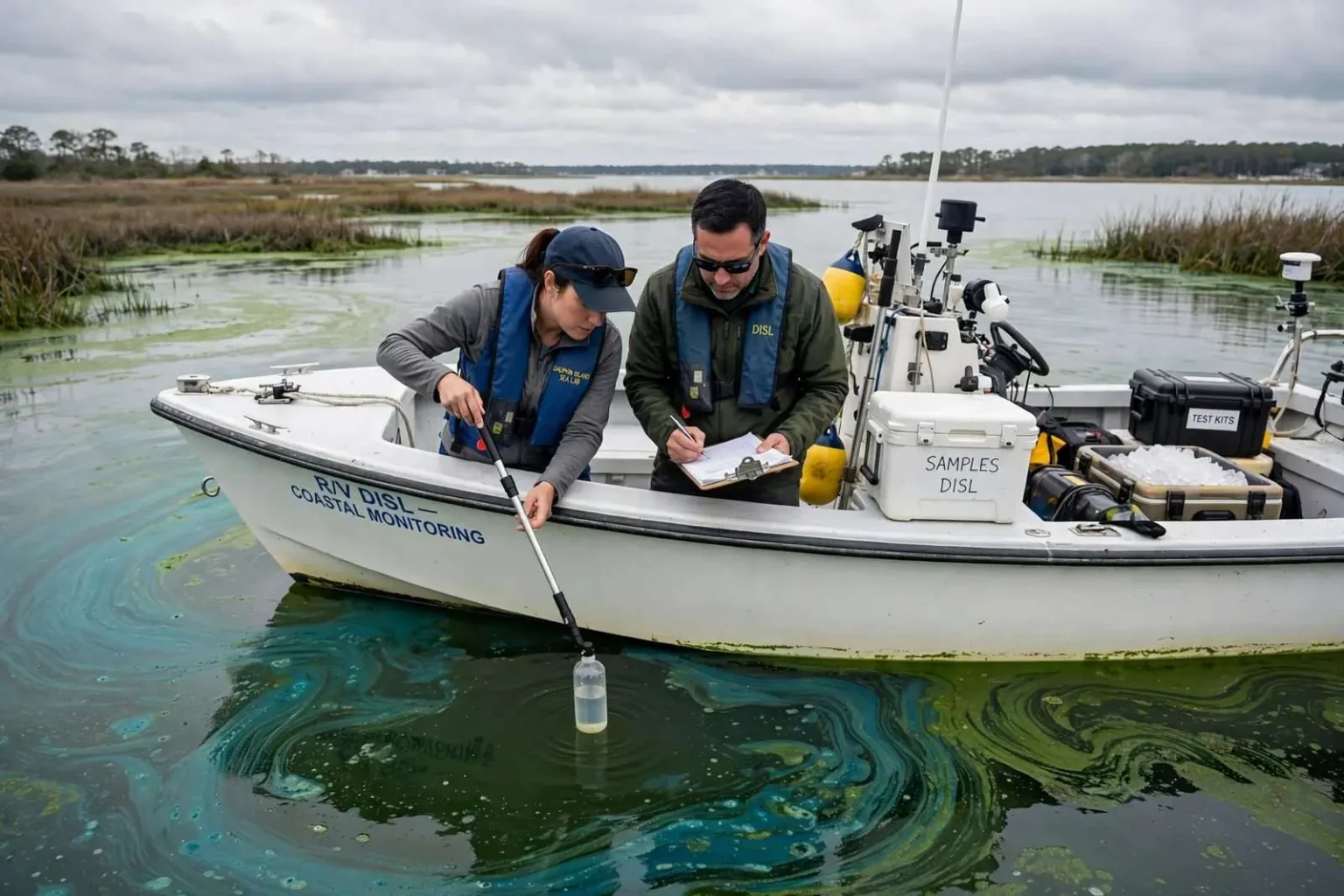
Scientists with the Dauphin Island Sea Lab are keeping a close watch on coastal water as a harmful algae bloom drifts toward Alabama from Mississippi.
On Tuesday, researchers headed out early to collect water samples from nearshore and offshore locations along both the Mississippi and Alabama coastlines. Dr. Alison Robertson’s lab is running a battery of tests to identify the species of algae present, whether they are producing toxins, and how the bloom is moving.
Why testing takes time
Those analyses take several days to ensure accurate, reproducible results, so DISL said it had no new findings to report immediately. Some data was expected by the end of the week, with sampling continuing in the meantime.
The pace reflects the science. Identifying an algae species under a microscope is only the first step; confirming whether it is actively producing toxin requires laboratory work that must be repeated to be trusted. Officials who issue warnings based on partial results risk both overreacting and underreacting, and the labs doing this work build in the repetition precisely so their answers hold up.
The lab also addressed questions about tropical weather. Dr. Brian Dzwonkowski, a physical oceanographer, noted that a storm tracking east to west would likely push the freshwater blue-green algae away from local waters. He stressed that detecting the algae does not automatically mean it is producing harmful toxins at levels that threaten human health, which is why careful handling and thorough testing matter.
That distinction — presence versus danger — is the heart of the scientific work. Blue-green algae, known to researchers as cyanobacteria, are common in warm, nutrient-rich freshwater, and their presence in coastal water is not by itself a health emergency. The toxin the bloom can produce is the concern, and toxin levels vary with the algae’s condition, the salinity of the water and factors researchers are still working to predict.
The physical oceanography side matters just as much. Where the bloom goes depends on winds, currents and the flow of freshwater from rivers and flood-control structures into the sound, and researchers like Dzwonkowski track those forces to forecast whether Alabama’s waters will see the algae at all. A storm moving the wrong way — or the right way, from the coast’s perspective — can scatter or concentrate a bloom more decisively than any treatment could.
Beach closures already in effect
The bloom can produce a toxin dangerous to people and pets, and Mississippi has already closed all of its beaches. Coastal Mississippi tourism officials reported fewer visitors on the sand as warnings spread, and economists said it could be weeks before any financial impact of the closures becomes clear.
The warning signs went up along the coast in stages. Beaches that draw swimmers, anglers and families through the summer season were posted with advisories telling visitors to stay out of the water, and pet owners were urged to keep dogs out as well — animals that swallow affected water or lick it from their coats face the same risks, and often faster.
The timing compounds the damage. The closures arrived at the height of the coastal tourism season, when beaches generate the revenue that carries resort communities through the rest of the year. Even a short closure season leaves a mark on lodging, restaurants and charter fishing, and economists watching the situation said the full picture would take weeks to form.
How the closures began
The closures were first ordered in late June, when the Mississippi Department of Environmental Quality shut down beaches in Hancock and Harrison counties after spotting a harmful blue-green algae bloom in the area. At the time, officials warned the algae could cause stomach cramps, nausea, vomiting and diarrhea, and urged visitors and their pets to stay out of the water. Anyone who did come into contact with it was advised to wash exposed skin with soap and water, and MDEQ also cautioned a wider closure could follow if conditions changed.
Those first county-by-county closures soon spread until every Mississippi beach was posted — a full-coast shutdown that turned a water-quality problem into an economic one. The blooms behind it were fed by an extraordinary influx of freshwater into the Mississippi Sound, which pushed the brackish conditions that cyanobacteria prefer far down the coast.
What Alabama is watching for
For Alabama’s coast, the question is whether the bloom crosses state lines in any meaningful concentration. The two coastlines share the same waters in practical terms — the Mississippi Sound flows toward the Mobile Bay estuary, and currents, tides and winds move water freely between them — which is why researchers here sample both sides rather than waiting to see a problem arrive.
The Dauphin Island Sea Lab is well positioned for that work. The state’s marine science laboratory sits on the eastern end of Dauphin Island, at the mouth of Mobile Bay, where its researchers run year-round monitoring of the northern Gulf and Mobile Bay estuary in partnership with universities across Alabama. Its faculty includes specialists in phytoplankton, toxins and coastal oceanography — the exact combination a bloom investigation requires.
Alabama’s own beaches remained open through the monitoring period, but state officials and the Sea Lab have emphasized that the situation is being watched daily. Beaches from Dauphin Island to Gulf Shores anchor a tourism economy that parallels Mississippi’s, and any change in the bloom’s track would be met quickly with testing and, if necessary, advisories of Alabama’s own.
Cyanobacteria in a changing coast
The bloom follows a pattern that coastal scientists have watched with growing concern. Freshwater inflow into the sound — driven by river flooding and the operation of flood-control structures upriver — lowered salinity across wide areas of the coast, creating conditions in which blue-green algae, which thrive in fresh and brackish water, could multiply in waters that are normally too salty for them.
The result stretched the definition of the problem. Cyanobacteria blooms are usually a freshwater issue — ponds, lakes and river reaches — but a coast flooded with river water for months at a time can grow them at scale, and the closures in Mississippi showed what follows. Scientists at the Sea Lab and elsewhere have pointed to the episode as an example of how far upstream decisions, from levees to spillways, can reach into coastal economies.
The health guidance that officials issued remains the practical advice for anyone near affected water. Avoid contact with water where advisories are posted, keep pets out, rinse off after any accidental exposure and pay attention to updates from environmental agencies, which retest and re-post advisories as conditions change.
Waiting on the data
For now, the Gulf Coast is waiting on laboratory results. The Sea Lab’s samples will answer the questions that matter most — which species are present, whether toxin is being produced and in what amounts — and continued sampling will show whether the bloom is growing, fading or moving. Findings expected by the end of the week will give officials their first solid basis for judging Alabama’s exposure.
Until then, the advice from scientists is patience with the process. Water conditions change daily, early answers can be wrong and the labs doing the work are building conclusions meant to be acted on. The bloom that closed Mississippi’s beaches developed over weeks; understanding where it goes next will take days measured just as carefully.
The monitoring network behind the warnings
Beach advisories along the Gulf Coast rest on a monitoring system that most visitors never see. Environmental agency staff sample swimming beaches on a schedule, test for the bacteria and algae that trigger warnings and post or lift advisories based on results. When a bloom develops, the frequency of sampling increases and the geography of testing widens — from swimming beaches to boat launches, bayous and passes — to map the extent of the problem.
The Sea Lab’s role adds research depth to that routine surveillance. Academic labs can run the specialized analyses — species identification, toxin confirmation, genetic testing — that agency monitoring budgets do not always cover, and the collaboration between the two is what turns a sampling trip into a picture of the bloom as a whole.
Researchers also watch for what comes after. A bloom’s collapse sends organic material to the bottom, where its decay can strip oxygen from the water and create conditions fish flee or die in. Scientists tracking the bloom are therefore tracking its full arc — growth, drift and decay — because each stage carries its own consequences for the coast.
Advice for coastal residents and visitors
While the testing continues, residents and visitors along both coastlines have practical decisions to make. Water that looks discolored — green streaks, paint-like films, scum lines — should be avoided on principle, and children and dogs especially should be kept out of it. Fish caught in affected areas should be handled carefully, and anyone with questions about a specific beach should check the latest advisories from environmental agencies before going in.
Reports from the public matter as well. Agencies tracking blooms rely on sightings from boaters, anglers and beachgoers to direct sampling, and a call about discolored water can send a testing crew to a spot the regular route missed.
The Alabama coast’s stake in the outcome is straightforward. The same waters that carry the bloom toward Dauphin Island carry the fish, shrimp and tourism dollars that sustain coastal communities on both sides of the state line, and the Sea Lab’s daily sampling is the early warning system they all depend on. The results expected by week’s end will show whether Alabama’s beaches face the closures Mississippi has already endured — or whether the bloom drifts past, pushed along by the same winds and currents the researchers are measuring.


