
Dauphin Island Sea Lab Officially Named Alabama’s State Aquarium
Alabama lawmakers named the Dauphin Island Sea Lab the state's official aquarium, a move expected to unlock new grants and funding.
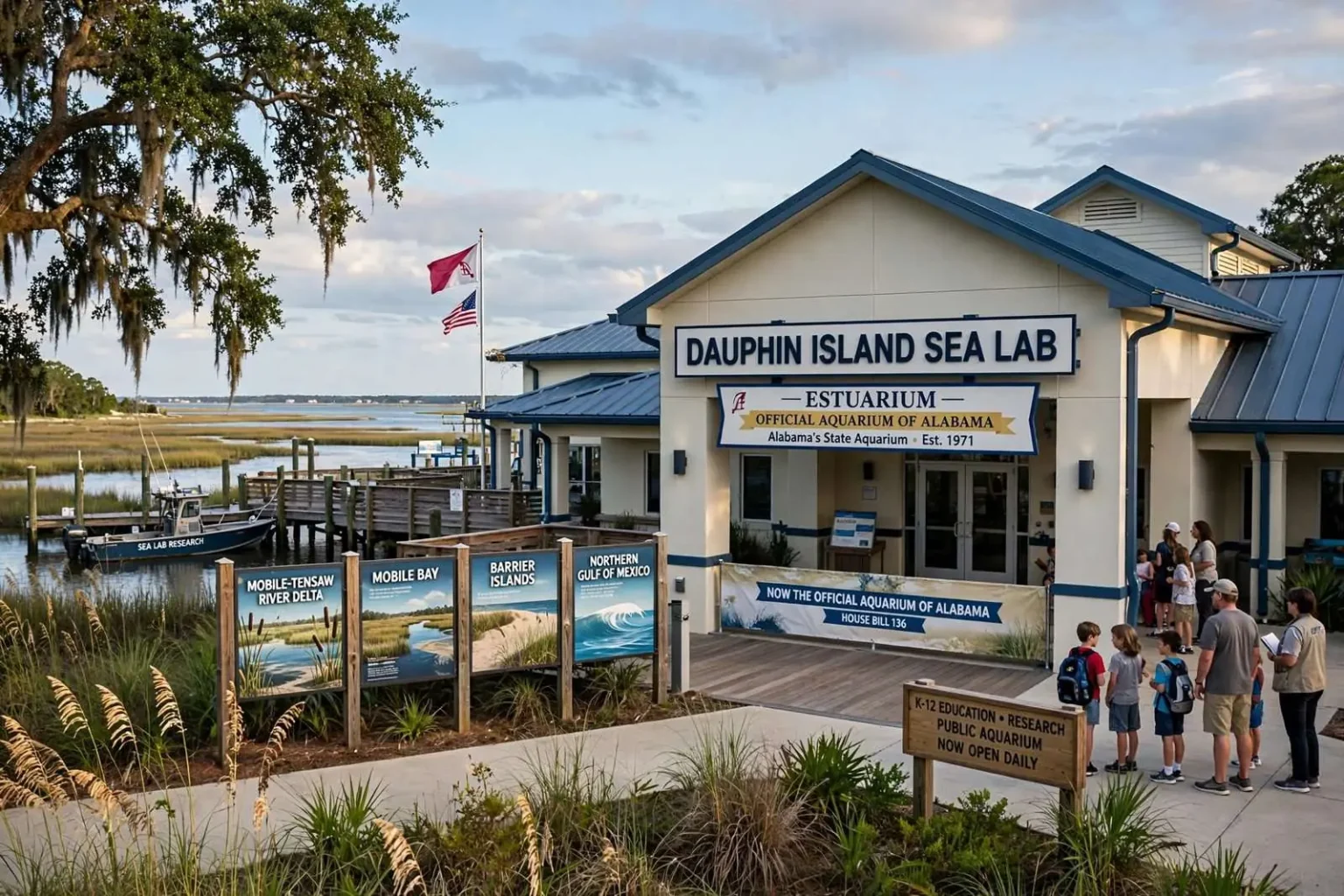
The Dauphin Island Sea Lab has a new title: the Official Aquarium of Alabama. The Legislature passed the designation this week and sent House Bill 136 to Gov. Kay Ivey’s desk to sign into law, formally writing the coastal facility’s standing into state statute and giving Alabama an official aquarium identity for the first time.
State Rep. Chip Brown, R-Mobile, sponsored the measure, which he said does more than add a line to the facility’s letterhead. “The official designation also opens the door for the Sea Lab to receive new research grants and other funding from a variety of available sources,” Brown said. He called the facility “among the state’s greatest tourism treasures.”
The distinction matters in practical terms for an institution that has always operated at the intersection of research, education, and public engagement. Official state recognition puts the Sea Lab on firmer footing when competing for grants that favor designated institutions, and it gives the state’s tourism apparatus a labeled anchor attraction on the coast — one that has been drawing visitors, students, and scientists to Dauphin Island for more than fifty years.
A Legislative Founding From 1971
The Legislature founded the Sea Lab in 1971 to provide marine science programs for Alabama colleges, and 23 member institutions now partner on undergraduate and graduate studies. That consortium model — a shared coastal campus where students from campuses across the state take courses, conduct research, and work alongside resident faculty — remains the heart of the organization, even as its public-facing role has grown.
The arrangement gives Alabama something few states its size can claim: a single place where a college student from anywhere in the state can spend a semester learning estuarine science on the water, taught by researchers whose work on the northern Gulf feeds directly into the classroom. Generations of Alabama scientists, resource managers, and educators trace their careers to semesters spent at the Sea Lab, and the member-institution structure keeps the facility tethered to every corner of the state’s higher education system.
From Classroom to Estuarium
Its role has since grown to include K-12 education, teacher training and the public aquarium that opened in 1998 and has drawn more than one million visitors. The public face of the campus, known as the Estuarium, was built to do for visitors what the classrooms do for students: explain how the northern Gulf’s waters work, from the river delta to the open sea, and why the strip of coast where Dauphin Island sits is among the most productive ecosystems in North America.
The aquarium holds 31 tanks with more than 30,000 gallons of water showcasing roughly 100 species from four coastal Alabama habitats: the Mobile-Tensaw River Delta, Mobile Bay, the barrier islands and the northern Gulf of Mexico. That four-habitat organization is the Estuarium’s defining idea. Rather than arranging exhibits by species, the facility walks visitors down the water’s journey — from the swampy upper delta, through the brackish bay, across the island chain, and out to open Gulf — showing how each habitat feeds the next.
Why Dauphin Island Matters
The Sea Lab’s location is not an accident of geography but the point of the institution. Dauphin Island, the barrier island guarding the entrance to Mobile Bay, sits at the crossroads of the four habitats the Estuarium displays: delta water flowing south, bay water trading with the Gulf through passes on either side of the island, and the open Gulf beyond. Scientists can launch a research day that touches every one of those systems without leaving sight of the campus, which is why the island has housed the state’s marine programs for over half a century.
Barrier islands are moving targets, and Dauphin Island has taken more than its share of hurricane strikes over the decades — a reality that has shaped both the research done there and the case for studying it. The Sea Lab’s scientists have documented coastal erosion, storm impacts, and the slow reshaping of Alabama’s island chain, work that informs how the entire Gulf Coast plans for the storms to come. An institution dedicated to understanding the coast is, by necessity, also an institution that studies how coasts survive.
The surrounding waters supply the research material. Mobile Bay is one of the largest estuarine systems in the United States, fed by the Mobile-Tensaw River Delta — a sprawling wetland complex often called Alabama’s Amazon for the depth and diversity of life it supports. The delta, the bay, and the barrier islands together form a nursery system for shrimp, blue crabs, redfish, and dozens of other species that anchor the Gulf Coast’s commercial and recreational fisheries, and the Sea Lab’s researchers have spent decades measuring how that system works.
Education at Every Level
The K-12 programs have made the Sea Lab a fixture of Alabama science education. School groups board buses from across the state for field programs on the island, where students seine in the surf, dissect squid, and watch the Estuarium’s feeding sessions — often their first direct contact with the marine world their state borders. Teacher training extends that reach: educators who spend a week at the Sea Lab return to their classrooms equipped to teach coastal science they have personally experienced, multiplying the institution’s audience far beyond the island.
The graduate and undergraduate consortium continues to supply the state’s professional workforce as well. Resource agencies, environmental consultancies, and research institutions across the Gulf South employ alumni of the 23-member partnership, giving the designation signed by Gov. Ivey a stake that runs through Alabama’s economy as well as its classrooms.
What Official Status Changes
The Official Aquarium of Alabama title formalizes what coastal visitors have long treated as fact. For grant-making bodies — state programs, federal agencies, and private foundations — a statutorily designated state aquarium answers a basic eligibility question before it is asked, and Brown’s stated expectation of new research grants and funding flows from exactly that. Institutions that hold official designations appear in more funding channels, and the Sea Lab’s mission spans precisely the areas — research, education, conservation, and tourism — that such programs exist to fund.
Tourism officials gain a labeled destination as well. The more than one million visitors who have passed through the Estuarium since 1998 came from the Gulf Coast’s existing tourist stream; an official state aquarium designation gives that attraction a place in statewide marketing that a campus facility would otherwise lack. Combined with the island’s beaches, Fort Gaines, and the ferry link to Fort Morgan, the Sea Lab now carries a credential matching what it has been for fifty years — one of Alabama’s most important windows onto the water.
Inside the Estuarium Experience
Visitors who walk the Estuarium’s exhibits move through the state’s coastal geography in miniature. The delta displays introduce the swamp and marsh systems where Alabama’s rivers meet their first salt water; the bay exhibits show the brackish mixing ground that makes Mobile Bay one of the nation’s great estuaries; the barrier island exhibits explain the moving sands and surge protection the islands provide; and the Gulf tanks present the open water beyond the passes, from reef fish to the large predators that patrol deeper water. The 31 tanks and their roughly 100 species are arranged to make that journey legible, which is why the facility has become a teaching tool as much as an attraction.
The living exhibits also serve the research mission. Husbandry staff maintain animals collected under scientific permits, and the same species visitors see in the tanks — from seahorses to stingrays to the small sharks that cruise the larger displays — are the ones Sea Lab scientists track in the bay’s waters. A family that spends an afternoon at the Estuarium is seeing, in display form, the exact ecosystems the campus studies from its boats and docks year-round.
For many Alabama families, the aquarium is also a bargain day trip. The island setting keeps the visit manageable — a campus-scale walk rather than a full-day trek — and the surrounding island offers beaches, fishing, and Fort Gaines within minutes of the parking lot. That combination has sustained more than a million visits since 1998 and gives the state’s tourism promotion a destination that educates while it entertains.
The Legislature’s Long Partnership
House Bill 136 is the latest act in a legislative relationship that began with the Sea Lab’s creation. The 1971 founding by the Legislature made marine science education a state commitment, and the consortium’s growth to 23 member institutions is the result of that continued investment. The new designation continues the pattern: rather than building something new, lawmakers formalized something that works, giving a fifty-year-old institution the statutory recognition its scale and audience already merit.
Coastal lawmakers have particular reason to champion the facility. The Sea Lab anchors year-round activity on Dauphin Island beyond the summer beach season, bringing students, educators, and researchers to the island in every month of the year. Rep. Brown’s sponsorship reflects the district’s interest in an institution that draws visitors, supports the local economy, and produces the science that protects the coast his constituents live on.
With the governor’s signature, the Official Aquarium of Alabama becomes more than a title — it is the state’s way of saying that its marine research and education flagship will keep its place at the front of the funding line. For the scientists, teachers, and students who have worked the island’s waters since 1971, and for the million-plus visitors who have met the Gulf through its tanks, the designation simply makes official what the coast has always known.


