DEA Drug Take Back Day offers Gulf Coast residents a safe way to dispose of meds
The DEA's Drug Take Back Day returns to the Gulf Coast on Saturday, giving residents a safe, anonymous way to dispose of old prescription medications.
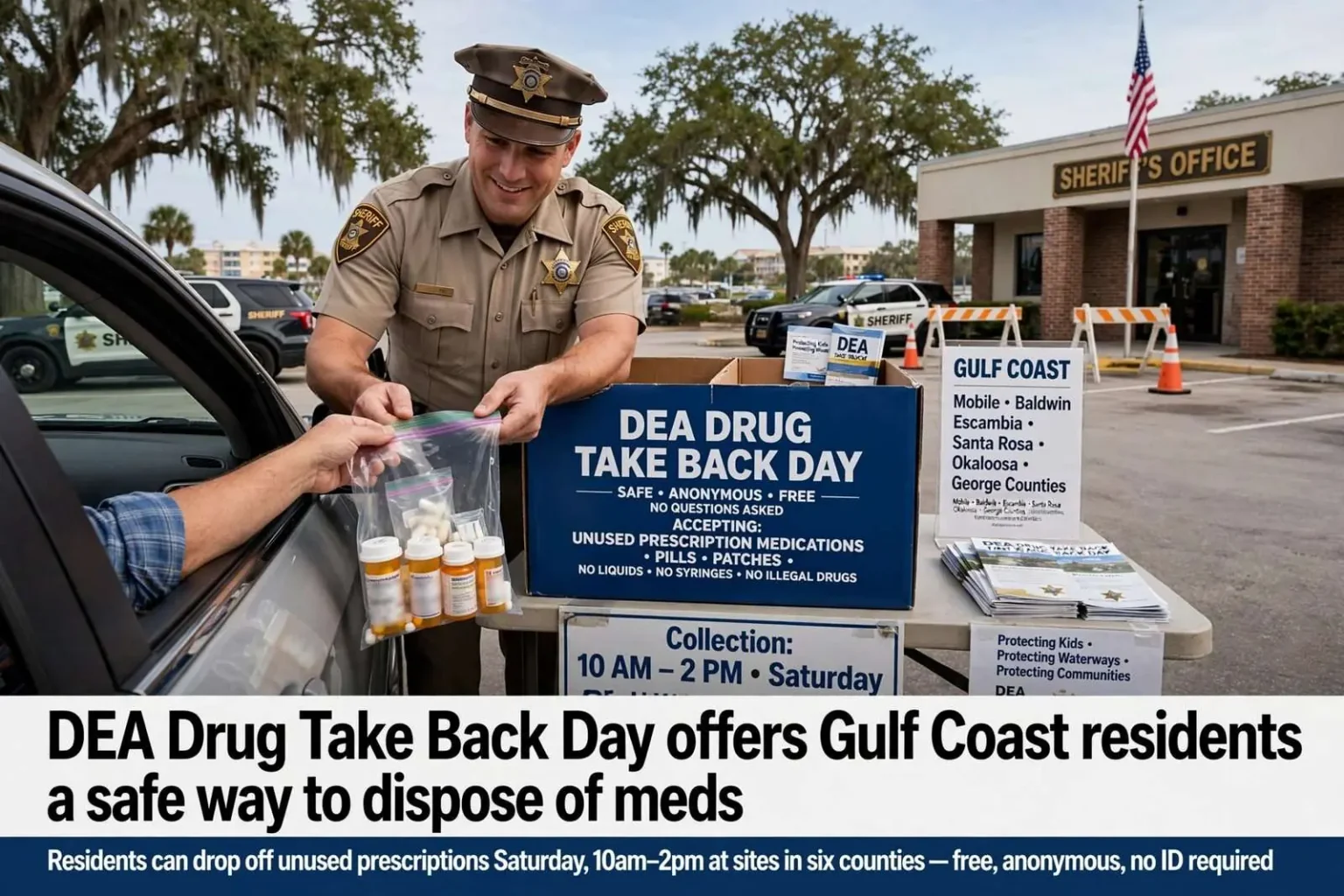
Residents across the Gulf Coast can drop off old and expired prescription medications this Saturday during the Drug Enforcement Administration’s Semi-Annual Drug Take Back Day, a national effort that gives households a safe, anonymous way to clear out medicine cabinets.
Law enforcement agencies will collect unused drugs for safe disposal from 10 a.m. to 2 p.m. at sites throughout the region, including locations in Mobile, Baldwin, Escambia, Santa Rosa, Okaloosa and George counties. The service is free, no questions are asked and no identification is required, a deliberate design meant to remove every excuse for hanging on to medications that are no longer needed.
Liquids, syringes and illegal drugs will not be accepted at the collection sites. Officials ask that participants keep medications in their original containers or seal them in plastic bags, and remove or black out any personal information on prescription labels before handing them over.
The take back program exists because the alternatives all carry risk. Flushing medications down a toilet or drain sends trace pharmaceuticals into wastewater systems and, ultimately, into rivers, bays and groundwater. Throwing pills into household trash leaves them available to children, pets and anyone willing to dig through a garbage bag. And keeping unneeded prescriptions in the home keeps them in circulation for misuse.
Why the Program Matters Locally
Prescription drug misuse remains one of the most persistent public health problems along the Gulf Coast, as it is nationwide. Opioid painkillers, anti-anxiety medications and other controlled substances prescribed legitimately to one family member are a common starting point for misuse by another. Health officials in both Alabama and Florida have spent years urging households to treat leftover prescriptions the same way they treat loaded firearms or toxic chemicals — as hazards to be stored securely or disposed of promptly.
The DEA’s take back events give residents who may never visit a pharmacy drop box a convenient, one-day option. Sheriff’s offices, police departments and community organizations staff the sites, and the collected medications are transported by the DEA to licensed incinerators for destruction. Nothing collected is reused, resold or repurposed.
The scale of the effort is considerable. The DEA said its previous October collection brought in more than 372 tons of prescription drugs at nearly 5,000 sites nationwide. Each event since the program began in 2010 has removed hundreds of tons of medications from bathroom cabinets and kitchen drawers across the country, and the semi-annual cadence — typically once in the spring and once in the fall — has made it a fixture on the regional calendar.
Local participation has grown steadily with each round. In past events, deputies and officers across the six-county region have reported steady lines of cars throughout the four-hour window, with many participants cleaning out a decade or more of accumulated prescriptions in a single stop. The anonymity is a selling point: people disposing of a deceased relative’s medications, or their own, do so without forms, names or explanations.
How Disposal Sites Work
Collection sites are typically set up in parking lots of police departments, sheriff’s substations, pharmacies, hospitals and community centers, with deputies or officers standing by to receive items directly from drivers or walk-ups. Participants do not leave their vehicles in many locations, and no paperwork, forms or questions are involved.
Because the events are run with law enforcement present, controlled substances — including opioid pain relievers, stimulants and sedatives — can be accepted, something ordinary pharmacy drop boxes may restrict. That legal distinction is the heart of the program: only officers can lawfully take custody of controlled drugs from the public, which is why the DEA partners with local agencies rather than simply encouraging people to mail medications back.
Items that cannot be accepted include liquids, intravenous solutions, injectables and syringes, which require separate medical-waste handling, and illegal drugs, which are outside the program’s purpose entirely. Needles and sharps should be taken to household hazardous waste facilities or sharps kiosks, and many pharmacies in the region maintain permanent drop boxes for non-controlled medications year-round.
Pet medications and over-the-counter drugs — vitamins, cough syrup in original sealed pills, ibuprofen, antihistamines — are generally accepted alongside prescriptions, though participants with questions about a specific item are encouraged to ask at the site. Vitamins and supplements in pill form can go in with the rest; only liquids and injectables are screened out.
Protecting Children, Waterways and Neighbors
Public health agencies point to three main reasons to clear out unneeded medications. The first is accidental poisoning: children find pills in purses, nightstands and cabinets, and a single brightly colored tablet can be dangerous to a toddler. Emergency rooms along the Gulf Coast treat pediatric medication exposures every year, many of them traceable to drugs a household no longer needed.
The second is misuse and diversion. Adolescents and adults who misuse prescription opioids or sedatives most often obtain them from family medicine cabinets rather than from street dealers. Removing the supply removes the opportunity, which is why the DEA’s message centers on households rather than on any particular drug.
The third is environmental. Studies of rivers and coastal waters have repeatedly detected trace concentrations of pharmaceuticals, and wastewater utilities are not designed to filter them out. The Mobile Bay estuary, the Perdido watershed and the coastal dune lakes of the Panhandle all sit downstream of thousands of homes, making proper disposal a matter of regional water quality as well as household safety.
Coastal researchers have flagged pharmaceutical contamination as a growing concern for fish and shellfish populations in shallow estuaries, where tidal exchange dilutes pollutants slowly. While a single bottle of expired pills flushed down a toilet is a small contribution, multiplied across hundreds of thousands of households it becomes a measurable one — which is why environmental groups along the Gulf Coast routinely promote take back day alongside their water-quality campaigns.
Between Take Back Days
Residents who miss Saturday’s event are not without options. Permanent medication drop boxes operate at many law enforcement offices across Mobile, Baldwin and Escambia counties in Alabama and Santa Rosa and Okaloosa counties in Florida, and some pharmacies accept non-controlled medications for disposal at any time. Federal guidance also allows certain dangerous medications — powerful opioids among them — to be disposed of in household trash after mixing them with coffee grounds or cat litter and sealing them in a bag, when no take back option is available.
Permanent boxes follow the same rules as the one-day events: pill bottles and sealed packets only, no liquids or sharps, and no questions asked. Many of the region’s drop boxes were installed with help from state opioid-response grants and public health coalitions, and they are emptied regularly by the sheriff’s offices or departments that host them.
A Habit Worth Keeping
Officials encourage households to make a twice-yearly habit of checking medicine cabinets alongside the DEA’s schedule, disposing of anything expired, discontinued or no longer being taken, and keeping current prescriptions locked away from visitors and children. The spring and fall events were timed for a reason: spring cleaning instincts and the back-to-school season both prompt families to go through cabinets, and the DEA has leaned on those rhythms since the program’s first event.
For households that keep strong pain medications after surgery or injury, the advice is simpler still: once the prescription is finished, the remainder should go to a drop box or take back site promptly rather than waiting for the “just in case” scenario that never comes. Emergency physicians note that the strongest medications in a home are frequently the ones most likely to be found by a child or offered to a friend.
Saturday’s event runs from 10 a.m. to 2 p.m. at sites throughout the six-county region. Residents unsure of their nearest location can contact their county sheriff’s office or local police department, most of which post take back sites in the days before each national event. Directions, hours and accepted items are also listed through the DEA’s public take back locator in the week leading up to the collection.
Officials say the goal is not simply volume — the tons collected matter as a statistic — but the steady reduction of risk, one cabinet at a time. Every bottle turned in Saturday is one that cannot poison a child, fuel an addiction or seep into a coastal waterway, which is precisely the point of the program.
Volunteers and agency staff who work the sites describe them as community events as much as collections, with deputies answering questions about drug storage, naloxone availability and local treatment resources while cars file through. Several area coalitions against substance abuse use take back day as a springboard for their outreach calendars, distributing information about counseling, recovery programs and prescription lock boxes alongside the collection bins.