Gulf Coast Counties Lag Well Behind the Nation in COVID-19 Vaccinations
CDC data showed Gulf Coast counties in Alabama, Florida and Mississippi trailing the 35.4% national COVID-19 vaccination rate in May 2021.
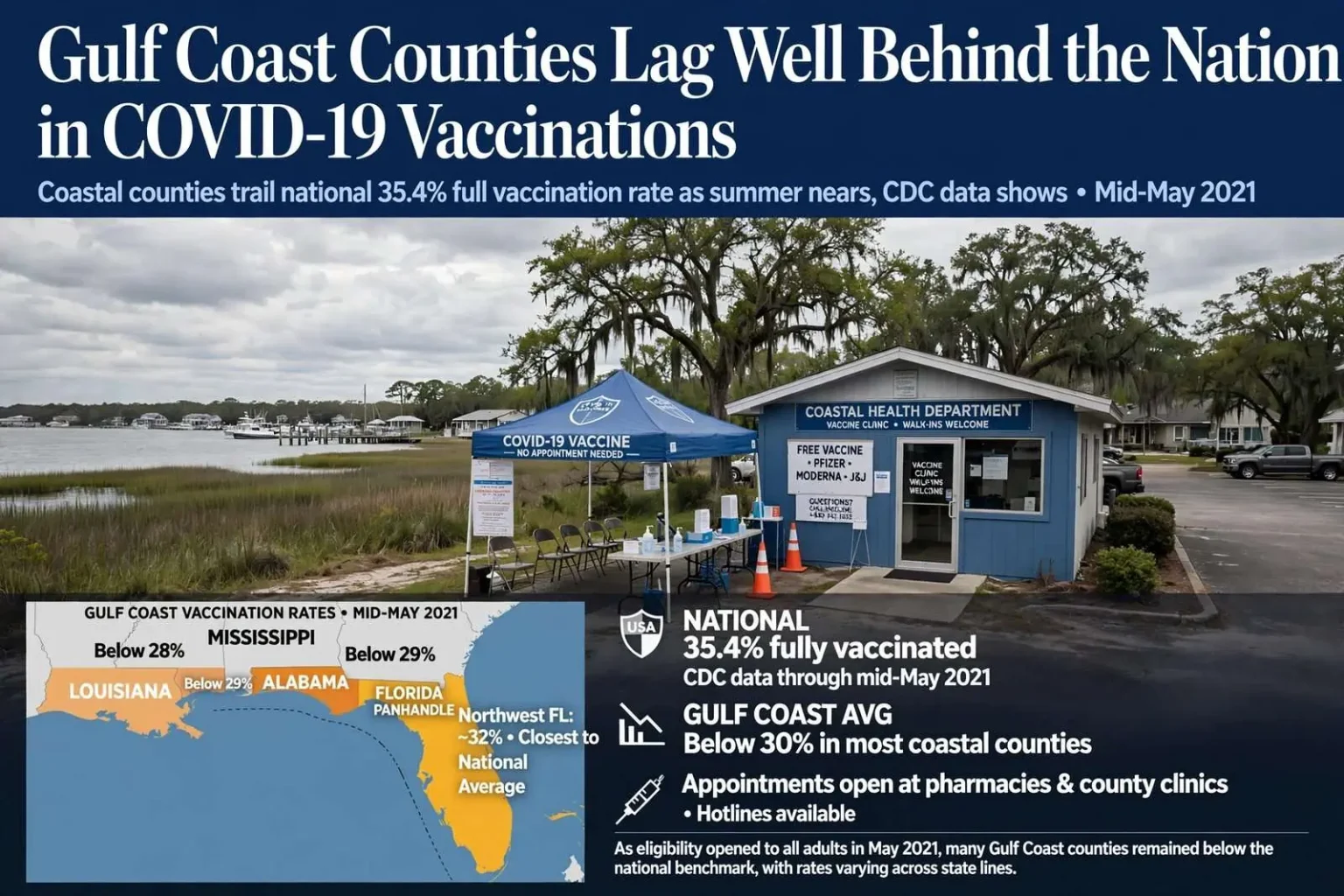
Gulf Coast communities were trailing well behind the rest of the country in the race to get vaccinated against COVID-19 in spring 2021, according to federal health data reviewed as the national rollout passed its sixth month. The numbers told a clear regional story: while vaccination sites across the United States had by then administered full vaccine series to a growing share of the population, most counties along the Gulf Coast from Mobile Bay to the Mississippi Sound remained below the national mark, leaving one of the country’s most medically underserved stretches of coastline on the wrong side of a widening gap.
CDC figures through mid-May 2021 showed that nationwide, 35.4 percent of the total population had been fully vaccinated against COVID-19 — meaning they had completed either the two-dose series of the Pfizer-BioNTech or Moderna vaccines or received the single-dose Johnson & Johnson shot. That national figure represented a remarkable pace for a campaign that had only begun in December 2020, when the first vaccines were authorized for emergency use and initial doses were reserved for health care workers and residents of long-term care facilities. By mid-May, eligibility had opened to every American adult, and adolescents ages 12 to 15 had just become eligible for the Pfizer vaccine under a new authorization.
The Regional Gap in the Numbers
Along the Gulf Coast, however, most local counties remained below that 35.4 percent national benchmark. The three-state coastal region — Southeast Louisiana, coastal Mississippi and Lower Alabama, running eastward into the western Florida Panhandle — lagged the national pace nearly across the board. Within the tri-state coastal region itself, there was a discernible ranking: Northwest Florida counties led the tri-state region in vaccination rates, ahead of Lower Alabama and coastal Mississippi. The differences between neighboring counties on either side of a state line were sometimes striking, reflecting in part the differing priorities, allocation systems and outreach campaigns that each state’s health department ran during the rollout.
Health officials continued urging residents to take advantage of widely available vaccine appointments as the region worked to close the gap with national rates. By May 2021, the supply problems that had defined the early months of the campaign — scarce doses, crashed scheduling websites, hours-long lines — had largely given way to the opposite challenge: abundant appointments and unfilled slots. Walk-in availability had expanded at pharmacies, county health department clinics and mass vaccination sites across the Gulf Coast, and public health messaging shifted accordingly, from racing to secure a dose to simply persuading the hesitant that the shot was worth taking.
Why the Coast Lagged
Public health officials pointed to a familiar set of factors when explaining the region’s slower uptake. Vaccine hesitancy ran high in parts of the rural South, shaped by political attitudes, distrust of institutions and a steady stream of misinformation on social media. Rural counties had fewer pharmacies and clinics per capita, making access harder even when supply was plentiful. And along the Gulf Coast specifically, older residents — the group eligible earliest and most eager to be vaccinated — had in many counties already been vaccinated by spring, leaving the remaining unvaccinated population younger and, generally, harder to reach with traditional outreach.
Transportation and work schedules played a role as well. In counties where many residents commute long distances to jobs in shipbuilding, tourism, agriculture and the seafood industry, getting to a vaccination appointment during operating hours was a genuine obstacle, not an excuse. Health departments responded with extended hours, mobile clinics and workplace outreach, though the effect of those efforts would show up in the data only gradually.
County Health Departments on the Front Line
On the ground in Lower Alabama, the vaccination campaign ran largely through the county health departments of the Alabama Department of Public Health, supplemented by hospital systems, federally qualified health centers and the growing network of retail pharmacies drawn into the federal pharmacy partnership. County health departments across the area also maintained COVID-19 hotlines to answer questions and help residents schedule shots — a service that proved especially important for older residents without reliable internet access, for whom online scheduling portals were often the only alternative.
The hotlines doubled as an educational resource. Callers could ask about side effects, eligibility, second-dose scheduling and the differences among the three authorized vaccines, and staff could direct residents to the nearest open appointment. In counties along the Gulf Coast, where questions about vaccine safety circulated widely through churches, workplaces and social media, having a local phone number to call was a modest but meaningful tool for cutting through the noise.
What Was at Stake for the Region
The stakes of the vaccination gap were not abstract along the Gulf Coast. The region’s economy leans heavily on tourism, and the summer season was weeks away when the mid-May figures were compiled. Beach towns from Biloxi to Gulf Shores to Destin were preparing to welcome crowds at pre-pandemic scale, and health officials understood that every point of difference in community vaccination rates translated into risk — both of outbreaks in crowded seasonal workplaces and of the emergence of variants spreading more easily through unvaccinated populations.
The mid-May timing also fell just ahead of a sobering turn in the pandemic. Even as national vaccination rates climbed through the summer of 2021, the Delta variant arrived in the South and drove a wave of hospitalizations that hit low-vaccination communities hardest. The counties that lagged in spring 2021 — including much of the Gulf Coast — would bear a disproportionate share of that surge, a pattern that made the spring gap in the CDC data look, in hindsight, like a warning that went substantially unheeded.
Reading the CDC Numbers
The CDC’s county-level vaccination data became one of the most closely watched public dashboards of the pandemic era, updated daily and broken down by doses administered, people fully vaccinated and demographic detail where states reported it. The 35.4 percent national full-vaccination figure of mid-May 2021 stood in sharp contrast to where the country had been in January, when less than 1 percent of Americans were fully vaccinated. Against that steep national curve, the Gulf Coast’s flatter trajectory was easy to see — county by county, the region’s rates clustered below the national line while Northwest Florida’s outperformed their neighbors to the west.
For local officials, the numbers served as both a scoreboard and a planning tool: counties could see where they stood relative to the nation and to the counties next door, and direct outreach to the areas and age groups falling furthest behind. Health departments urged residents who had not yet scheduled a vaccination to use the county hotlines, pharmacy appointments or health department clinics — emphasizing, as they had all spring, that appointments were widely available and that the simplest way to close the region’s gap with the rest of the country was one completed vaccine series at a time.
How the Coast Compared Across State Lines
The mid-May figures also illustrated how differently the rollout had unfolded under each state’s approach. Florida’s decision to open eligibility broadly and early, along with its large network of retail pharmacies, helped push its Panhandle counties ahead. Alabama’s phased rollout, which reserved early supplies for priority groups before opening to all adults in early April, meant its counties had less time at universal eligibility by the mid-May snapshot. Mississippi, working under similar phasing with a smaller public health infrastructure, faced comparable constraints along its coastal counties. Residents near state lines sometimes crossed borders to get vaccinated, a practice health officials tolerated but which complicated the county-level picture in the data.
The Road Ahead for the Coast
As spring turned to summer, the region’s public health agencies kept up the push: appointment reminders, mobile vaccination units at community events, and continued coordination between the county health departments, hospital systems and pharmacies that together formed the vaccination network along the coast. Officials’ message remained consistent — the vaccines were free, widely available, and the most reliable protection available against a virus that had already disrupted life along the Gulf Coast for more than a year, closing schools, emptying beaches in the spring of 2020 and straining hospitals in every county along the shore.
The gap in the mid-May data was, in the end, a snapshot of a region at a decision point. Northwest Florida counties had shown that coastal communities in the tri-state region could match or beat national vaccination rates; the counties of Lower Alabama and coastal Mississippi faced the task of catching up before the highly transmissible conditions of summer put the difference to the test. For residents, the practical takeaway was unchanged from what health officials had been saying all spring: vaccine appointments were available across the Gulf Coast, county health department hotlines were standing by to answer questions and book shots, and the region’s distance from the national vaccination rate would only close if residents took advantage of both.