
Dinner and a Movie: Congealed Chicken Salad and the Story of ’42’
A Mobile couple's Dinner and a Movie column served up a summertime congealed chicken salad and a warm review of 42, the film about baseball pioneer Jackie Robinson.
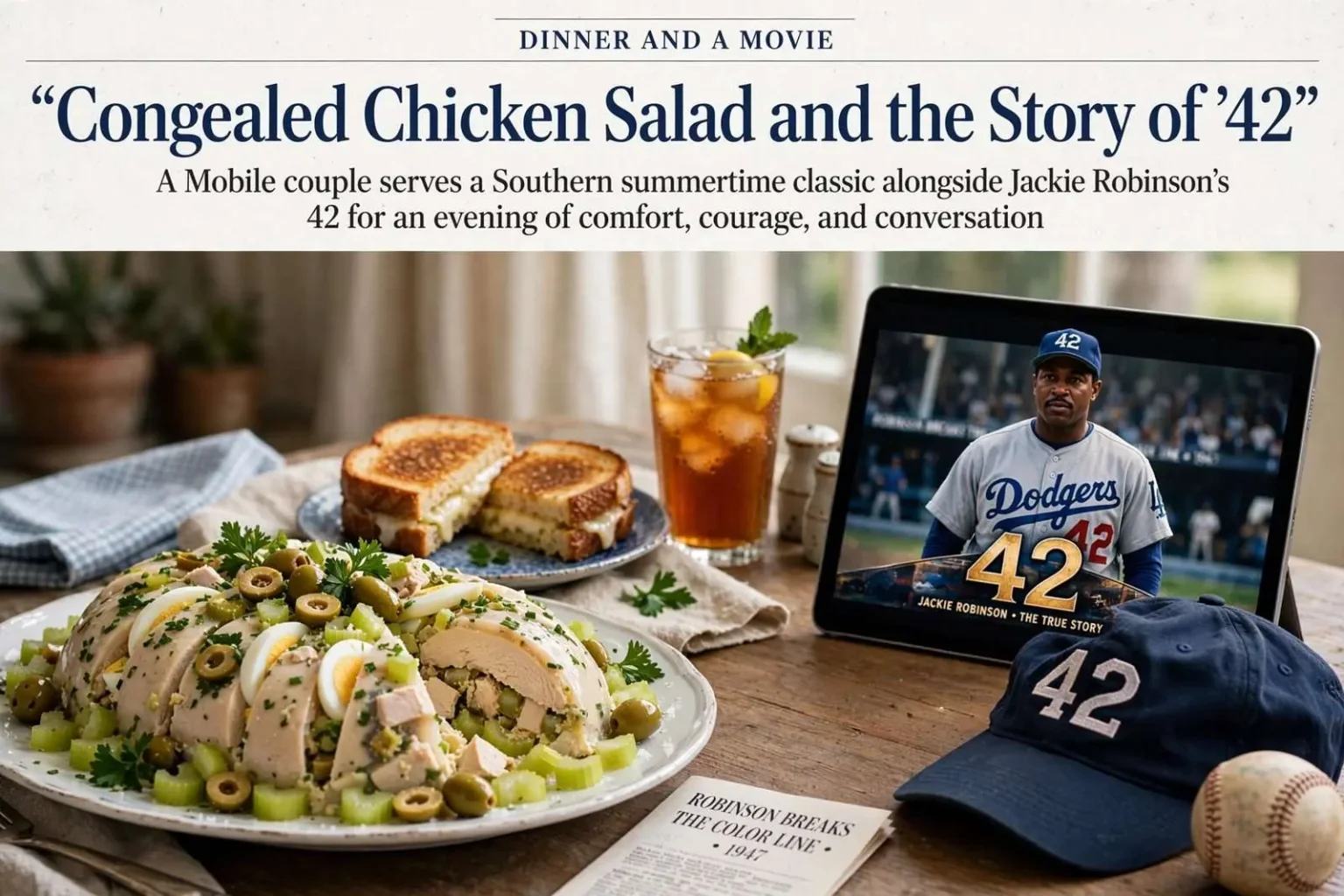
For the latest installment of their food-and-film feature, a Mobile couple served up a Southern summertime classic at the table and put a story that reached well beyond baseball on the screen. The pairing balanced the comforts of home cooking with a film the writers found both uplifting and sobering, and it made for one of the more thought-provoking combinations in the series so far. One half of the evening came straight out of the community-cookbook tradition that generations of Gulf Coast families have relied on for covered-dish suppers, church potlucks and family reunions. The other was a Hollywood treatment of one of the most consequential chapters in American sports history. Together, they made for a night that was equal parts comfort food and history lesson.
Congealed chicken salad with grilled cheese
The recipe was a molded, chilled chicken salad well suited to a hot Mobile day. Congealed salads have held a cherished — and occasionally good-naturedly teased — place in Southern cooking for decades, appearing on church supper tables and holiday sideboards across Alabama long before they became a nostalgic curiosity elsewhere. Built around chicken, mayonnaise and gelatin, this version follows the classic mold: savory rather than sweet, sturdy enough to slice, and best served cold straight from the refrigerator.
The assembly began with four chopped, salted chicken breasts and two chopped hard-boiled eggs. To those went a cup of chopped stuffed olives, a teaspoon of chopped onion or chives and three-quarters of a cup of minced celery, giving the salad the crunch and brine that keep a molded dish from turning heavy.
The binding came from an envelope of gelatin, softened in cold water and then dissolved over hot water. That mixture was stirred gradually into two cups of mayonnaise, and the resulting blend was folded into the chicken mixture until everything was evenly coated.
From there, the salad was poured into a casserole dish and refrigerated overnight, or for at least an hour or two, until it set firmly. The couple said the finished dish served eight generously, making it a practical choice for family meals or casual entertaining.
They recommended pairing it with grilled cheese, and pronounced the combination good eating, especially in summer, earning the recipe two thumbs up. The hot, crisp sandwich alongside the cold molded salad is exactly the kind of unpretentious pairing the feature has become known for — food that a home cook can actually produce on a weeknight rather than a restaurant-style production.
The feature presentation: 42
On the screen came 42, the story of Jackie Robinson, the first Black player in the modern major leagues. The writers called the film uplifting and painful at once, a reminder that not so long ago the country was rigidly divided, with returning Black veterans of World War II treated as second-class citizens under a separate-but-equal system.
Robinson, played by Chadwick Boseman, comes home from the war wanting only to play ball, and signs with the Brooklyn Dodgers after general manager Branch Rickey, portrayed by Harrison Ford, chooses him to break baseball’s color line. Rickey warns him that he will have to turn the other cheek to succeed, absorbing insults, pitches thrown at his head and spike-down slides without retaliating, and Robinson accepts that difficult, dangerous path toward baseball immortality.
The historical setting is handled with unflinching directness. When Robinson takes the field for the Dodgers in 1947, he carries the weight of segregation in every ballpark he visits, from segregated lodging on road trips to opposing managers and players who heckle him without consequence. The film does not soften what that era demanded of the man who lived it, and the writers noted that the cruelty depicted on screen was ordinary, everyday conduct within recent memory.
The couple praised the acting and direction throughout, singling out Boseman and Ford for particular mention and noting a strong supporting cast around them. It was, they concluded, a movie worth watching: a great story about courage, dignity and the price of being first, told through the lens of a sport that many fans follow without thinking about how it became open to every player.
The man behind the story
Part of what makes 42 land with viewers is how faithfully it follows Robinson’s improbable road to Brooklyn. Born in the segregated South and raised in California, Robinson was a four-sport athlete in college before military service interrupted any thought of a professional career. He played his way through the Negro Leagues, where the talent was undeniable but the pay, travel conditions and recognition were shaped by the same segregation the film depicts. Branch Rickey, scouting the country for the right player, was looking for more than ability — he wanted a man with the competitive fire to endure and the self-control to survive it without striking back.
The film dramatizes that selection as a conversation of startling honesty, with Rickey laying out in plain terms the abuse Robinson would face and making clear that sympathy alone would not be enough. Once Robinson signs, the story follows him through the minor leagues and up to Brooklyn, where teammates circulate a petition against playing alongside him and opposing pitchers aim at his head. Through it all, the movie keeps its focus on the man rather than the myth — a competitor who wanted, as the writers noted, nothing more than to play ball.
Boseman’s performance gives that fight a quiet, coiled intensity, while Ford plays Rickey with a showman’s relish that keeps the institutional side of the story from turning dry. The supporting cast rounds out the Dodgers clubhouse and Robinson’s family life, giving the film room to show what the experiment cost the people around him as well as Robinson himself.
Why the pairing worked
The couple’s format — a tested recipe on the table, a film worth discussing afterward — turns each installment into a small evening of hospitality, and this one had a natural arc. The congealed salad is the kind of dish that invites a crowded table and a long meal, and 42 is the kind of film that leaves people talking once the dishes are cleared. Comfort on one side, conviction on the other: readers looking to repeat the evening at home can serve the salad chilled from the refrigerator with grilled cheese hot from the skillet, and let the movie carry the conversation into the night.
For viewers in Mobile and across the Gulf Coast, the film also serves as a reminder of how close that history remains. Many residents remember grandparents’ stories of segregated ballparks, schools and waiting rooms, and the separate-but-equal system the film evokes was not ancient history but living memory for much of the region. Seeing it dramatized — the insults, the travel indignities, the daily arithmetic of danger — gave the writers’ recommendation real weight for a Southern audience in particular.
The movie treats its villains and bystanders with the same realism. Some characters torment Robinson openly; others stay silent, and the film is careful to show that silence carried its own cost. The writers found that honesty to be one of the production’s strengths: this is not a story where the hero is rescued by institutional goodwill, but one where goodwill is built, slowly and at a price, by people who decided to act.
By the final innings, the film has turned the question it opened with — whether one man could carry the abuse of an entire system — into an answer that reshaped professional sports. Every roster in every dugout today is the quiet epilogue, and that is the note the writers said they kept returning to as the credits rolled.
It is, in the end, an easy film to recommend alongside a plate of cold chicken salad on a July evening in Mobile. The recipe asks little and rewards patience; the film asks a great deal and rewards attention. Readers who take the couple’s suggestion will find both halves of the pairing worth the trouble — a good meal, a better story, and a reminder of how far the game, and the country, have traveled since the day Robinson first trotted out to first base in Brooklyn.
A story that hits home in Mobile
For a Mobile audience, the subject carries special resonance. This city has produced more than its share of baseball greatness — Hank Aaron, Satchel Paige, Willie McCovey, Billy Williams and Ozzie Smith all have Mobile roots, a record few cities of any size can match. Aaron, who grew up in the Toulminville neighborhood and later broke Babe Ruth’s career home run record, came up through the same post-segregation era the film depicts, and the Connection between Mobile and baseball’s integration story runs deep on the Gulf Coast.
Local fans can catch that heritage in person at Hank Aaron Stadium, and the city’s baseball history is preserved in exhibits and markers across Mobile, a reminder that the game’s integrated era was built by players who came from places exactly like this one. That backdrop made 42 an easy film for the couple to recommend to Gulf Coast viewers, and it gave the evening’s conversation a local dimension beyond the screen.
Robinson’s number 42 has since been retired across all of Major League Baseball, and every April the sport marks Jackie Robinson Day, when players wear the number in his honor. For viewers who know the game only in its modern, integrated form, the film is a corrective — a picture of how recently the door was closed, and how much courage it took to open it.
The pairing of a chilled Southern classic with a film about a man who changed the country made for an evening the writers could recommend on both counts: a recipe worth keeping for the next hot stretch of summer, and a movie worth watching for anyone who cares about where the national pastime — and the nation — has been. Both the table and the screen delivered, and the two thumbs up applied to the whole affair.


