Downtown Mobile Apartment Fire Displaced 17 People in 2008
A March 2008 fire at the Garden District Apartments in downtown Mobile displaced 17 people, though all tenants escaped safely, according to WKRG.
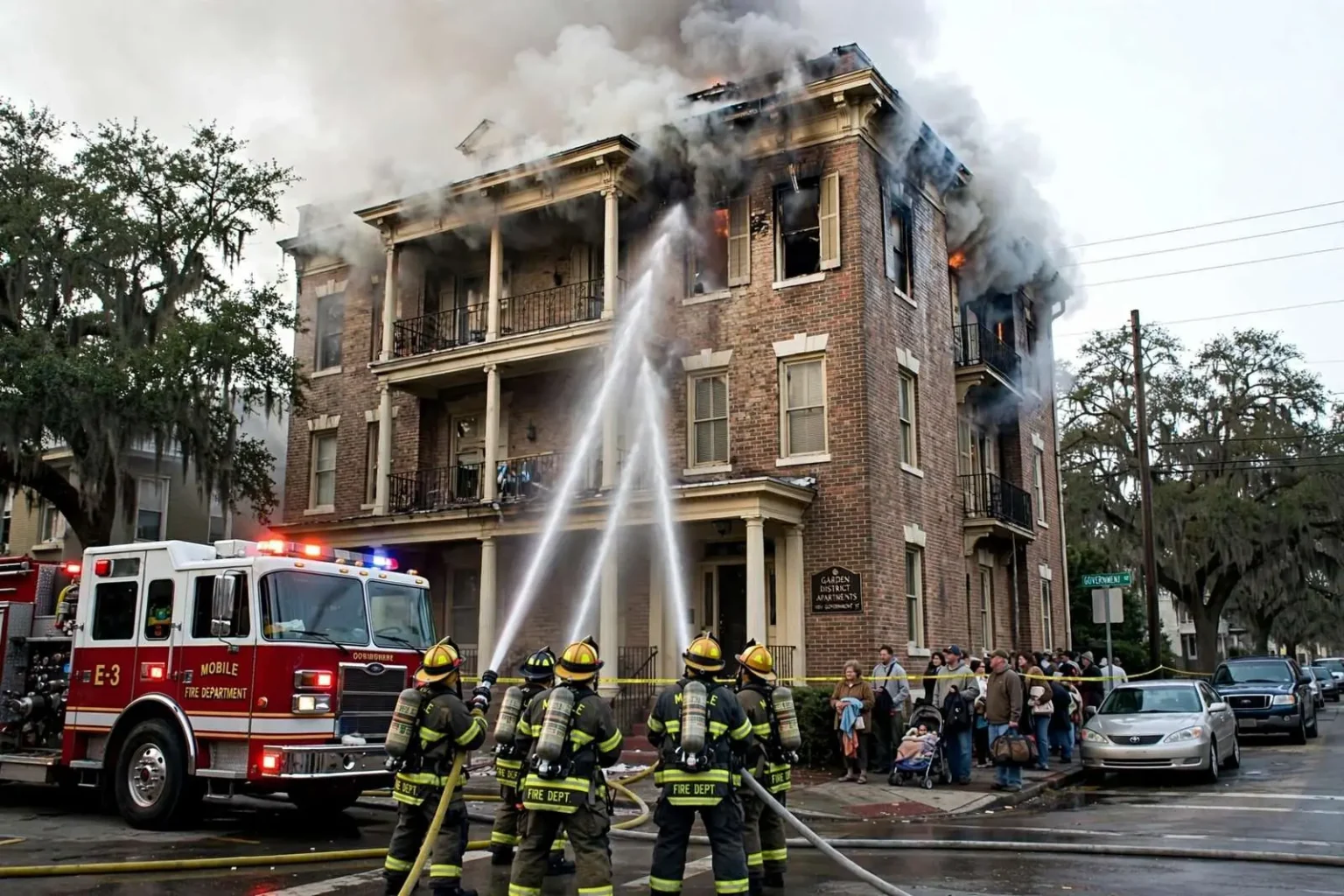
MOBILE, Ala. — Seventeen people were left without homes after a fire moved through the Garden District Apartments at 1051 Government St. in downtown Mobile in March 2008, according to an archived local news report from March 28 of that year.
The fire began shortly after 4 p.m. Mobile Fire Department official Steve Huffman said flames spread into the attic of the apartment building, prompting firefighters to withdraw from the structure and fight the blaze from outside — a standard and necessary tactical shift, since a fire moving through attic spaces can travel unseen above crews and collapse ceilings without warning.
Residents evacuated as firefighters went door to door checking that no one remained inside the building. All tenants escaped safely, a fact that stands as the incident’s most important outcome: a mid-afternoon fire in a occupied downtown apartment house claimed no lives and reported no injuries.
Investigators believed the fire began in an electrical appliance in a third-floor apartment. Electrical appliances have long been among the leading causes of residential fires, and a third-floor start in a building with attic space above it created precisely the conditions that pushed flames out of a single unit and into the structure as a whole.
The building and the Garden District
1051 Government St. sits in the heart of the Garden District, the residential corridor just west of downtown Mobile known for its historic homes, oak-lined streets, and early-20th-century apartment buildings. Government Street itself is one of Mobile’s principal east-west thoroughfares, running from downtown past the campuses and neighborhoods of midtown, which meant an afternoon fire there drew immediate visibility — traffic, onlookers, and news coverage within minutes.
Apartment buildings of that vintage often present particular challenges in a fire. Older framing, shared attics, and multiple floors of occupied units mean that a fire starting in one apartment can threaten the entire structure long before residents on other floors realize it. The Garden District Apartments fire was contained to damage across 12 apartments, nine of them occupied, with the remaining three vacant at the time.
For the 17 displaced tenants, the arithmetic was sobering: nine occupied apartments, all damaged or affected, and no home to return to that evening. The American Red Cross was working to find temporary housing for the displaced residents in the hours and days after the blaze, the organization’s standard response to residential fires across Alabama.
How Mobile firefighters fought it
Withdrawal from a building is among the hardest calls a fire officer makes. Crews sent inside an apartment fire attack the blaze at its source and search for occupants, but when flames move into an attic — the void space above the top floor — the structural risk changes character entirely. Attic fires spread laterally across the top of a building, eating through rafters and wire pathways, and a ceiling failure in a committed interior crew can be catastrophic.
By pulling crews out and transitioning to an exterior attack, Mobile firefighters protected the one thing that mattered most in this fire: the safe evacuation already underway. Hose lines trained on the building from outside and elevated streams, where used, can slow an attic fire’s spread while keeping personnel clear of collapse zones. The trade-off is property — more of the building burns — but the department’s account of the incident, relayed through Huffman, reflects a decision made for life safety first.
The timing of the blaze, shortly after 4 p.m. on a weekday, likely aided the escape of all tenants. Many residents were still at work or school when the fire began, and those who were home had daylight on their side — able to see smoke, hear alarms, and move to exits without the disorientation that makes nighttime apartment fires so deadly.
Electrical fires and what follows
The suspected cause — an electrical appliance in a third-floor apartment — fits a pattern familiar to fire investigators nationwide. Consumer appliances, aging wiring, and overloaded circuits are recurring ignition sources, and their fires often begin inside walls or in the equipment itself, unnoticed until smoke or flame appears. Fire safety guidance from the U.S. Fire Administration and the National Fire Protection Association consistently urges residents to check appliance cords, avoid overloading outlets, and treat any appliance that smokes or trips a breaker as a hazard until it is repaired or replaced.
In a multi-story apartment building, that guidance carries added weight because one tenant’s appliance can decide the fate of every household in the structure — as the residents of 1051 Government St. learned in a single March afternoon. Investigators’ finding that the fire appeared to begin in an appliance, rather than in the building’s wiring, offered little comfort to tenants who lost their homes to someone else’s electrical equipment.
The Red Cross role in the aftermath is the quiet machinery behind every such fire. Its volunteers arrange shelter, food, and basic necessities for displaced families, often the same night, and follow up as households transition to longer-term housing. In a March 2008 fire that damaged 12 apartments and displaced 17 people, that work was the bridge between the tenants’ escape and their recovery.
A historical record with a clean bottom line
As archived news accounts go, the Garden District Apartments fire is one with a merciful summary: everyone got out. Seventeen people lost their homes, nine occupied apartments were damaged, and a downtown building took serious fire damage in its attic and upper floors — but no one was hurt, and no one died.
The report stands as a snapshot of Mobile in 2008: a fire department publicizing its response through a named official, a Red Cross mobilizing within hours, and a Garden District apartment house at the center of an afternoon emergency. It also stands as a reminder of how quickly an electrical appliance — the most ordinary object in any apartment — can redraw the lives of everyone in a building.
The attic-fire problem in apartment buildings
Fire departments across the country treat attic fires as among the most punishing calls in residential work, and the March 2008 Garden District fire illustrates why. When flames reach the void space above the top floor, they move through a hidden highway of rafters, wiring, and insulation that connects every unit beneath. Firefighters inside the building are then hunting a fire they cannot see, above a ceiling that may already be losing its integrity.
Standard tactical doctrine therefore calls for early detection of attic involvement and a rapid shift to defensive operations when it is confirmed. Defensive firefighting — working from outside the structure — sacrifices interior salvage to protect lives, and it requires more water applied over more time to bring the same fire under control. That is consistent with the archived account’s description of crews withdrawing from the building and fighting the blaze from the outside after flames spread into the attic.
The outcome — 12 apartments damaged rather than the building lost entirely — suggests the exterior attack held the fire at the top of the structure. Fires that reach attics in occupied apartment buildings routinely destroy the whole roof assembly, and the fact that the Red Cross was arranging housing for tenants rather than mourning them marks the difference between a bad afternoon and a tragedy.
Displacement and recovery after an apartment fire
The 17 residents displaced by the fire faced the cascade that follows every apartment blaze: insurance questions complicated by the fact that tenants rarely carry renters insurance, landlords’ property policies that cover the building but not the belongings inside, and the search for comparable housing in a downtown and midtown rental market. The Red Cross temporary housing effort covered the immediate need, but the longer recovery — replacing documents, clothing, furniture, and medications — falls on households and their support networks over weeks and months.
Fire officials in Mobile and elsewhere have long used such incidents to press the case for renters insurance, which costs little per month and covers exactly the loss that apartment tenants suffer in a fire: everything they own. The nine occupied apartments damaged in the 2008 fire represented nine separate households of personal property, none of it replaceable by the landlord’s coverage.
The incident also underscored the value of working smoke alarms and practiced escape in multi-unit buildings. With 17 people in the building when the fire began shortly after 4 p.m., the margin between total evacuation and injury was measured in the residents’ awareness of the fire and their ability to reach exits before smoke filled stairwells. All tenants escaped safely — the outcome every apartment fire drill and every alarm-battery check exists to protect.
Government Street and downtown Mobile’s fire risk
Government Street has been a central artery of Mobile since the city’s earliest decades, and the stretch through the Garden District mixes historic residences, churches, and apartment buildings with the traffic volume of a downtown corridor. For the Mobile Fire Department, whose stations are spaced to cover both the downtown core and the surrounding neighborhoods, a fire at 1051 Government St. was a location they knew well — an occupied multi-story building, close to the street, with limited side access in places.
The March 2008 fire remains a useful case study in the department’s account of its work: an electrical appliance fire on a third floor, flames into the attic, crews withdrawn, a full evacuation confirmed door to door, and a defensive attack that protected nearby buildings and allowed every tenant to walk away. Twelve apartments damaged, nine of them occupied, 17 people displaced, the Red Cross mobilized — and no injuries, in a fire that could easily have produced them.