

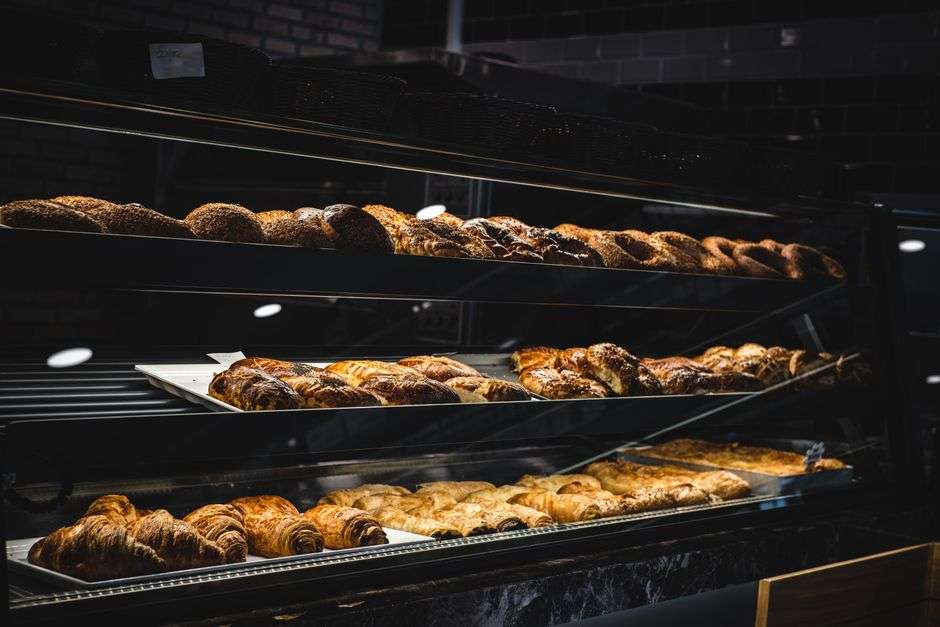
Not every success story in downtown Mobile begins with a business plan. Some begin with a pie — in this case, a lemon meringue pie baked in a Los Angeles apartment by a fashion school dropout who was trying to recreate a memory of her grandmother’s kitchen. That pie set Lacey Evans on a path that led to Dropout Bakery & Company, the storefront bakery at 358 St. Louis Street that she runs with her partner, William Allam, and that has become one of the sweetest stories in the city’s reenergized downtown core.
The name is not an accident. Evans and Allam both left college — she from the Fashion Institute of Design and Merchandising in Los Angeles, he from an interior design program at the same school — and decided that owning a business mattered more to them than a degree that did not fit. “Dropout” is a word they kept, wore proudly, and turned into a brand that now draws lines outside the door on weekend mornings.
A Mobile kid who always ran her own race
Evans grew up in Mobile and graduated from St. Paul’s Episcopal School in 2018 with a perfect 4.0 GPA. As a teenager she tried modeling, decided it was not for her, and concluded that the fashion industry itself might be a better fit. So she did what plenty of ambitious eighteen-year-olds do: she left home for Los Angeles to study at FIDM, one of the country’s best-known design schools.
The fit never materialized. “I hated sewing and knew I was wasting my time in fashion,” she has said. What she did love, almost from childhood, was food. She grew up watching cooking shows — Rachel Ray was on television constantly in her house — and baked for the sheer pleasure of it, a passion she never imagined would become a profession.
Meanwhile, she had already proven the entrepreneurial instinct that would define her later career. As a high school junior she built websites and ran a dropshipping business, selling swimsuits and jewelry online without ever carrying inventory. “Dropshipping means you don’t carry any inventory,” she has explained. “I knew from the start I wanted to own my own business. You know when you know.”
Allam came into the picture at FIDM, where he was studying design. The two began dating, and both eventually reached the same conclusion about their studies. They quit school and moved to Mobile together — a Connecticut native transplanted to the Gulf Coast, and a Mobile native coming home.
One pie, then an Instagram bakery
The first product of the new venture was born of a simple craving. The two were looking for a solution to their sweet tooth, and Evans remembered what her grandmother’s lemon meringue pie was supposed to taste like. She set out to recreate it from that memory. It turned out great, and she knew she was onto something.
Back in Mobile, she formalized the operation the way Alabama law provides for: she earned her cottage food certification and began baking out of her apartment kitchen. Alabama’s Cottage Food Law, first enacted in 2014 and revised in 2021, allows individuals to produce certain non-hazardous foods — baked goods, jams, candies, and the like — in their own home kitchens and sell them directly to consumers, provided they complete an approved food safety course and label their products properly. It is the on-ramp that a whole generation of Alabama food entrepreneurs has used to test a business idea without leasing commercial space.
Evans posted her creations on Instagram, where she already had a following, and the orders began to arrive. Friends asked for birthday cakes. She learned technique from YouTube videos, practiced relentlessly, and built a small online bakery that let customers order through direct messages. Then Mardi Gras season arrived, and everything changed: her king cakes went viral. Her version — a cinnamon bun base with brown butter cream cheese — was shared and clamored for across the city, despite the fact that she had never made a king cake before that season.
A television segment accelerated the snowball. Devon Walsh of WKRG News 5 interviewed Evans in her apartment in 2020 while she baked king cakes for the Big Brothers Big Sisters King Cake Cook-off. Nearly as soon as the piece aired, dozens of orders arrived, and Evans knew she needed more than an apartment kitchen.
The Innovation Portal open house that sold out in 30 minutes
The break came through Mobile’s small-business infrastructure. Evans connected with the Downtown Mobile Alliance and the Innovation Portal, the public-private incubator led by executive director Todd Greer on St. Louis Street downtown. Their advice was simple: set up a table with pastries in front of the building and see what happens.
She and Allam took the shot on Mother’s Day weekend in May 2020, in the middle of the COVID-19 pandemic. They sold out in thirty minutes. That single weekend led to a conversation about a business plan, then to a permanent arrangement: the Innovation Portal wanted a convenient place for its members to grab something good to eat, and Evans and Allam needed a base of operations. Dropout Bakery & Company opened its brick-and-mortar shop on May 7, 2022, occupying the corner space at 358 St. Louis Street with broad visibility and steady foot traffic.
Allam, whose interior design training suddenly had a purpose, built out the space himself — display cases included — and gave the bakery a modern, eclectic look that sets it apart from a traditional Southern bakery. The white exposed-brick walls carry neon signs, original artwork, and even hanging skateboards; customers are invited to write suggestions for future menu items right on the walls. He also manages the business side of the operation and does a bit of baking, with croissants as his particular domain. Evans handles the menu and the social media presence that made the bakery famous in the first place.
Sold out is a business model
Dropout Bakery runs on a rhythm that many bakeries would find nerve-wracking and customers have learned to work around. Monday through Wednesday are for prep. The shop opens Thursday through Sunday, typically at 8 a.m., and closes when the baked goods are gone — which is often well before the afternoon. Regulars know to pre-order, because the weekend menu is limited and everything sells.
The numbers behind that sold-out model are striking: Evans has said the shop moves roughly 336 croissants every weekend and about a dozen cakes a week. Croissant sandwiches — ham and cheese with Italian flakes, or turkey with pepper jack and lemon pepper — share the counter with cakes, macarons, quiche, and rotating specialties. The menu changes weekly, and she has experimented with healthier options as well, including a shortbread-based candy bar made with dates, coconut milk, salt, and vanilla paste.
Of everything on the menu, Evans counts macarons as the hardest thing she makes — a meringue-based almond cookie that punishes imprecision. “Everything in the process has to be just right, including the weather,” she has said. “Rain and moisture will ruin the result if you aren’t careful.” Precision is the whole craft, in her view: “Baking is such a precise science. There are a whole bunch of factors that have to be perfect.” Everything is made from scratch, with quality ingredients like Kerrygold butter.
Custom orders anchor the higher end of the business. A custom birthday cake needs about a week’s notice; wedding cakes require three months to a year. King cakes, the product that made the bakery’s reputation, remain a seasonal obsession. The bakery also sells merchandise with its logo, and Evans has long talked about expanding the sandwich program with deli-style builds on homemade French baguettes.
Growing up with downtown Mobile
Evans’s affection for her hometown’s core is part of the story. “Downtown used to be tumbleweeds when I was young,” she has said. “Now it’s booming, especially on St. Louis Street, where many historic buildings have been renovated recently.” The bakery has ridden that same wave — a corner storefront in a neighborhood that has filled in with renovated historic buildings, new restaurants, and foot traffic that barely existed a decade ago.
The business has grown enough to employ a small staff and to outgrow its corner space, and Evans has spoken openly about eventually needing a larger location — even about expanding to other cities someday. But the model she describes is the one the Innovation Portal preaches: launch, grow, and leave the nest when you can fly on your own. For now, the bakery’s future most likely involves a bigger footprint somewhere in downtown, a city Evans — a self-described beach girl at heart — has no intention of leaving.
The story of Dropout Bakery is, in the end, a very Mobile story: a local kid who left to find herself, came home, turned a global pandemic into an opportunity, and built a business with the help of the city’s entrepreneurial infrastructure. Two dropouts bet on themselves, and downtown Mobile has been eating well ever since.