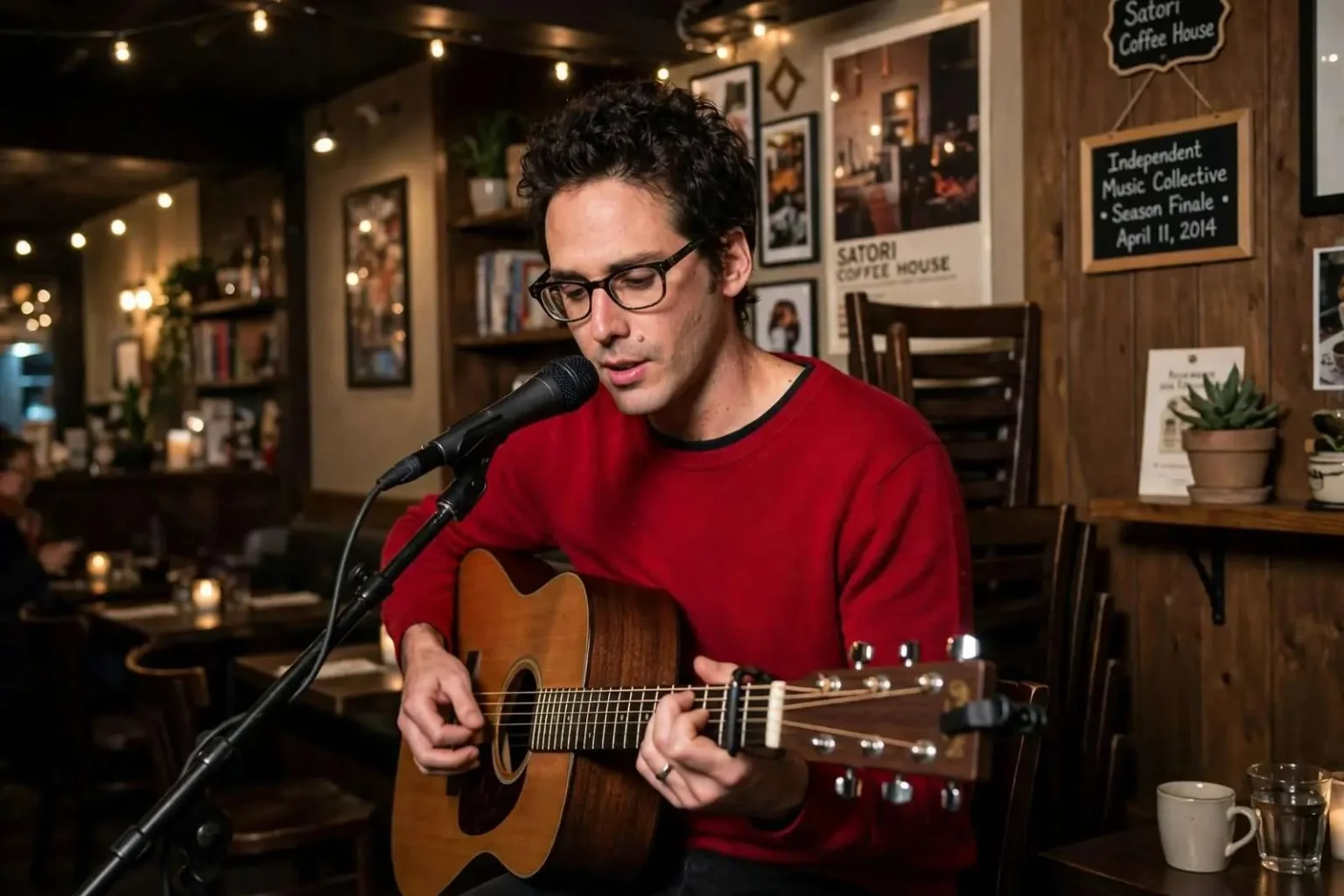
Eef Barzelay, the songwriter behind indie rock cult favorites Clem Snide, brought his solo act to Satori Coffee House on Friday, April 11 for the final Independent Music Collective show of the 2013-14 season — and a featured slot at the SouthSounds Music Festival. For Mobile audiences, it was a rare chance to see a nationally admired songwriter in an intimate listening-room setting, and the Collective saved one of its most distinctive bookings for last.
The evening followed the format that has made the Collective’s coffee house shows a fixture of the local scene. Doors opened at 7:30 p.m., with the performance starting at 8 and no opening act, putting full attention on the headliner. Admission was free for University of South Alabama students with a valid ID and $5 for everyone else, and SouthSounds festival wristbands were also honored at the door, tying the night directly into the festival weekend underway across downtown.
The special format suited Barzelay’s reputation. Rolling Stone has called him one of indie rock’s best-kept secrets, NPR has praised his sneakily firm grasp on poignancy and humor, and The New York Times has noted that the true narrative in his songs lives in the tiny details. Stripped of a full band, those qualities tend to come through even more clearly, which is precisely what a listening-room crowd comes to hear.
A Songwriter With a Cult Following
Barzelay built his name as the frontman and principal songwriter of Clem Snide, a band that emerged from the indie rock world in the 1990s and earned a devoted following for its blend of twang, orchestral touches and dry, melancholy wit. Over the years he has also carved out a parallel career performing solo, touring as a one-man act whose shows lean on his voice, his guitar and the wordplay that critics keep coming back to.
That dual identity — band leader and lone troubadour — has made him a favorite of presenters who program songwriter-oriented rooms. A solo set in a coffee house is a different proposition from a club show: the audience listens closely, the songs do the talking, and the lines between humor and heartbreak that reviewers have long noted in his writing get room to breathe.
He was no stranger to Mobile, either. Barzelay had previously played the city with the Collective, and live recordings from that earlier visit had already circulated among local fans, building an audience that knew what to expect from his return. Those recordings gave the Friday show something of a homecoming feel, with attendees who had been listening to his earlier Mobile performance for months.
The Independent Music Collective’s Season Finale
The show closed out the Independent Music Collective’s 2013-14 season, capping a year of programming that has worked to bring touring songwriters and indie acts to Mobile rooms sized for real listening. The Collective’s model is simple: intimate venues, attentive audiences and admission prices low enough for students to attend — free with a university ID, five dollars without. The April 11 show checked every box.
Booking a nationally reviewed songwriter for the finale also served the Collective’s larger purpose of connecting Mobile audiences to the wider indie scene. Acts that pass through rooms like Satori Coffee House often return to bigger stages in the region, and the Collective’s lineup gives local fans a running head start on artists before their reputations catch up to their ticket prices.
For the venue, the night showcased the strengths of a coffee house as a listening room. Without a bar crowd competing for attention, the performance carried across the space at conversational volume, and the no-opening-act format kept the evening tight: one artist, one set, and an audience that arrived to listen.
Satori Coffee House has long played that role in Mobile’s live music landscape, offering a room where touring acts can play to listeners instead of passersby. Pairing the space with a performer of Barzelay’s critical standing gave the Collective’s finale the feel of a much larger booking, and demonstrated how effectively the city’s smaller venues can complement the festival stages drawing crowds a few blocks away over the same weekend.
SouthSounds 2014 Takes Over Downtown
The show doubled as the featured IMC Showcase for SouthSounds 2014, folding the Collective’s season finale into the festival’s weekend program. Now in its fourth year, SouthSounds ran April 11-13 across downtown Mobile venues, bringing up-and-coming southern acts to the city each spring and turning the downtown entertainment district into a walkable circuit of live music.
The festival’s model — many venues, many stages, one wristband — has made it a springtime anchor for the city’s music scene. A single wristband admitted holders to shows across the footprint, and the Collective honored those wristbands at the Barzelay show, letting festivalgoers fold a nationally known songwriter into a night of hopping between venues.
For the acts, SouthSounds functions as a showcase in both senses: a chance to play for festival crowds, and a chance to be seen by the bookers, promoters and fans who decide which bands get invited back. For the city, it fills downtown blocks with music for a full weekend and gives local venues a share of the attention that usually goes to larger festival cities along the Gulf Coast.
What the Night Meant for Mobile’s Scene
Between the Collective’s season finale and the festival’s fourth run, the weekend said something about where Mobile’s live music scene stands. The city has spent years building the mix of venues, promoters and college audiences that traveling acts look for, and bookings like Barzelay’s are the kind that only happen when the local infrastructure can support them — a room suited to a listening show, a presenting organization with a season-long track record, and a festival that brings audiences downtown all weekend.
University of South Alabama students got the best deal in the building, with free admission on a valid ID, an approach the Collective has used to build the habit of live music attendance among students who will form the core of the city’s audience in the years ahead. The five-dollar general admission kept the bar low for everyone else, and wristband holders moved freely between the coffee house and the festival’s downtown stages.
Barzelay’s second Mobile appearance also closed a loop that began with those circulating live recordings. Fans who had heard his earlier show through traded recordings could finally hear the follow-up in person, and the set gave the Collective’s season the kind of send-off that makes its next lineup worth anticipating.
As the festival weekend rolled on through Saturday and Sunday across downtown, the Friday night showcase stood as an example of what SouthSounds is built to do: put emerging and admired artists in rooms where Mobile audiences can find them first. The 2013-14 Independent Music Collective season ended the way a season should — with a full room, a veteran songwriter and a city listening.
The Craft Behind the Songs
Part of what draws critics back to Barzelay’s work is the way his songs are constructed. The New York Times’ observation that the true narrative in his writing lives in the tiny details points to a style built on small, precise images rather than broad statements — the kind of songwriting that rewards a quiet room and repeat listens. NPR’s take, highlighting his grasp on poignancy and humor, captures the other half of the equation: songs that can pivot from a joke to a gut-punch in the space of a verse.
Those traits are exactly why his booking fit the Collective’s listening-room format so well. A crowd of a few dozen seated close to the stage hears the asides, the rewritten lines and the between-song stories that vanish in a larger venue. Veteran touring songwriters often say these small rooms are where their material is truly tested, and a Mobile audience got to sit in on that process.
His stop also fit a pattern for the 2013-14 season, in which the Collective emphasized songwriting craft over volume. Presenting a solo performer with a national critical record as the season finale reinforced the organization’s identity: this is a series for people who come to hear writers work, not just to fill a Friday night.
With the season now closed and the festival weekend still running downtown, attention in Mobile’s music community turns to what comes next — the Collective’s fall lineup, the venues that hosted hundreds of sets across three days, and the next wave of southern acts that SouthSounds will bring to the city when spring returns.
For the fans who filled Satori Coffee House on Friday, the practical takeaway was simple: show up early, because rooms this size do not stay open for long once word gets out. And for the Collective, the calculus for next season was just as plain. A finale this well matched — the right artist, the right room, the right weekend — is the kind of night that keeps an independent music series alive.