Elliott Backs Repainting the I-10 Bayway to Six Lanes, Calling a New Span Unaffordable
State Sen. Chris Elliott says restriping at least six miles of the existing Interstate 10 Mobile Bayway from four lanes to six is the most realistic way to add capacity once the companion Mobile River bridge is built. He credits federal waivers with making a phased approach possible and concedes the crossing will feel narrower.
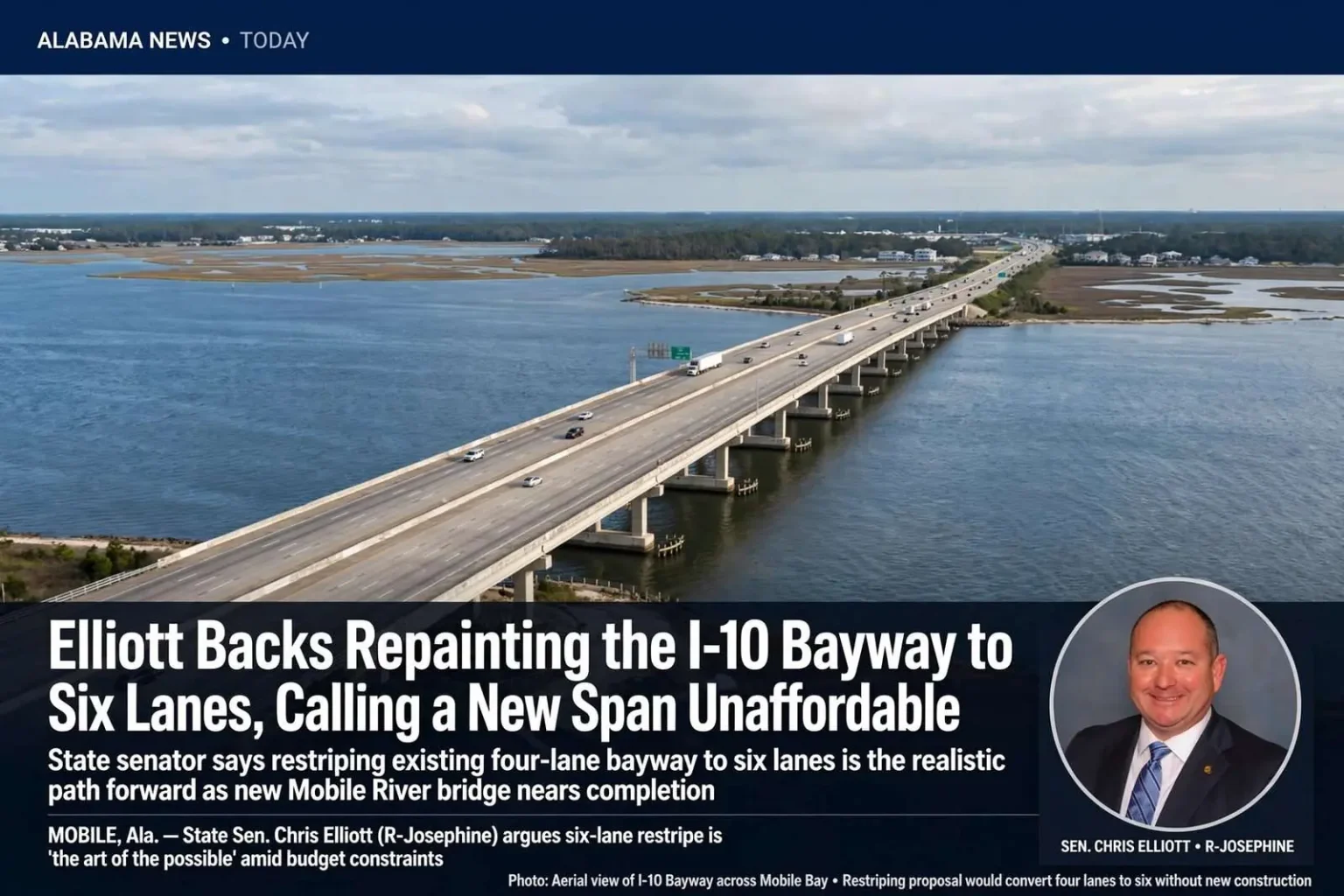
MOBILE, Ala. — A state lawmaker representing Baldwin County says the most realistic way to add capacity to the Interstate 10 Mobile Bayway is not to build a new one, but to repaint the one already standing.
In an interview last week, State Sen. Chris Elliott (R-Josephine) discussed the proposed restriping of the I-10 Mobile Bayway as a method of expanding capacity once the new companion I-10 Mobile River bridge is completed. Under the concept, the existing four-lane bayway would be restriped to carry six lanes without adding structure — a change accomplished with lane markings rather than concrete.
Constructing a new bayway is not an option, Elliott said.
‘The art of the possible’
Elliott framed the proposal explicitly as a matter of financial reality rather than of engineering preference.
“The real story is the art of the possible,” he said. “And this is where I will give ALDOT some credit. Would everybody like a new elevated, wide Lake Ponchartrain-looking crossing? Yes. We can’t afford that, period, full stop. That is not something the State of Alabama can afford. And so, for years we have been wrapped around the axle on the concept of a project that was never something that Alabama was going to be able to afford.”
The reference is to the long-running debate over how to relieve congestion on the I-10 corridor through Mobile and across the bay. Elliott’s argument is that the version of the project many people envisioned — a wide, elevated replacement crossing — was never within the state’s financial reach, and that the years spent pursuing it delayed progress on something achievable.
According to Elliott, the restriping option became available because the Trump administration and U.S. Sens. Tommy Tuberville (R-Auburn) and Katie Britt (R-Montgomery) worked to waive specific federal requirements.
“This is why the president and his administration, Secretary Duffy and others, deserve so much credit, and frankly, Coach Tuberville and Senator Britt deserve so much credit for working so hard to get these requirements out of this project so that we can phase this project, so that we can actually get this thing moving because we were never going to be able to afford the scope of widening and elevating a brand new bayway and bridge at the same time. It was too big for the State of Alabama to ever begin to handle,” Elliott said.
What the proposal actually covers
The proposal would include restriping at least six miles of the existing bayway, running from the U.S. Highway 90-98 intersection with I-10 on the Eastern Shore to the edge of Polecat Bay, which is the anticipated terminus of the eastern end of the proposed new Mobile River bridge.
That geography is worth pinning down, because it defines the seam between the two halves of the corridor project. The new Mobile River bridge would carry traffic over the river on the western end. The bayway carries I-10 across the bay to the Eastern Shore. If the bridge is rebuilt with additional capacity but the bayway behind it remains four lanes, the bayway becomes the constraint — the corridor is only as wide as its narrowest continuous segment. Restriping the bayway to six lanes is, in that framing, an attempt to keep the two halves of the corridor in rough proportion without paying for a second structure.
The word “phase” in Elliott’s remarks is central to the approach he describes. Phasing means dividing a large capital project into stages that can be funded and delivered sequentially rather than all at once. The sequence he sketches is the bridge first, with added bayway capacity following through restriping, rather than the simultaneous construction of a new bridge and a new elevated bayway that he says the state could never have afforded.
Restriping is a fundamentally different kind of project
Restriping and reconstruction are not variations on the same work. They are different categories of project, with different costs, timelines and consequences.
Reconstruction means building new structure: pilings, piers, deck, drainage, barriers and approaches. On a water crossing it is among the most expensive work a state transportation department undertakes, measured in years of construction and in capital costs that typically require dedicated funding mechanisms.
Restriping, by contrast, changes how an existing surface is allocated. The deck stays exactly as wide as it is today. What changes is the arrangement of markings on it — and, by necessity, the dimensions of what those markings define. Fitting six travel lanes onto a deck that currently carries four means every lane becomes narrower than it is now, and the space alongside the travel lanes shrinks as well.
Elliott did not soften that point.
“This restriping of the Bayway — I know some people are scared of it,” Elliott added. “You should be. It’s going to be a lot narrower, and it’s going to be a lot more interesting how to get across. But the other answer is absolute inaction, and that is not something that would ever sit well with me.”
The trade-offs narrower lanes involve
The design considerations that come with reallocating a fixed deck width are general engineering and traffic-safety questions, and they apply to any project of this type regardless of location.
Lane width. Interstates are conventionally designed with generous travel lanes to accommodate large commercial vehicles at highway speeds. Narrower lanes reduce the lateral margin between a tractor-trailer and the vehicles beside it. The effect is most pronounced for heavy trucks, which are wider than passenger vehicles and have less room to correct within a lane.
Shoulders. On a bridge or elevated causeway, shoulder space serves several functions at once: it gives a disabled vehicle somewhere to stop, it gives emergency responders a path to reach a crash, and it provides recovery room for a driver who drifts. When lanes are added to a fixed deck width, shoulder space is generally the first thing reduced. That is a design trade-off with operational consequences: on a crossing with limited shoulders, a single stalled vehicle can occupy a travel lane, and incident clearance times take on outsized importance because there is nowhere to move the obstruction.
Speed and enforcement. Narrower cross-sections are commonly paired with adjustments in posted speed, signage and incident-management practices. Those decisions belong to the transportation agency designing the project.
Capacity versus throughput. Adding lanes increases the theoretical capacity of a segment, though real-world throughput depends heavily on how reliably the facility operates — how quickly incidents are cleared, how traffic merges at the ends of the widened section, and what happens where six lanes narrow back to fewer.
None of these considerations resolves the question Elliott poses. His argument is comparative: that the relevant choice is not between restriping and an ideal new crossing, because the ideal crossing is not financially available, but between restriping and doing nothing.
Why federal requirements mattered
Elliott attributes the availability of the restriping option to federal action — specifically, to the waiver of certain federal requirements, which he credits to the Trump administration, Secretary Duffy, Tuberville and Britt.
He did not enumerate which requirements were waived, and that detail is not established in the material available. As general background, interstate projects that use federal-aid highway funding are subject to federal design criteria and review processes, and departures from those criteria ordinarily require formal approval. That framework is why a project’s feasibility can hinge on regulatory determinations as much as on engineering: a configuration that a state might be willing to build is not necessarily one it may build with federal participation.
Elliott also connects the waivers to phasing. In his account, the requirements in question were an obstacle to breaking the corridor work into stages, and removing them is what allows the bridge and the bayway capacity to be delivered separately rather than together.
Readers should note the limits of what is established here. The specific requirements, the mechanism by which they were waived, and the formal status of the restriping proposal within the Alabama Department of Transportation’s project development process are not detailed in Elliott’s remarks. What is established is a sitting state senator’s characterization of the policy path and his endorsement of the approach.
Credit to ALDOT, and a long-running debate
Elliott’s remarks include an unusual note for a legislator discussing a state agency: explicit credit to the Alabama Department of Transportation for arriving at the restriping concept. His framing casts ALDOT as having found a workable answer after years in which, as he put it, the discussion was “wrapped around the axle” on a project the state could not fund.
The I-10 corridor through Mobile has been the subject of planning, debate and public controversy for years, and the question of how to pay for a new river crossing has been the persistent obstacle. Elliott’s position is that the restriping approach sidesteps that obstacle for the bayway portion entirely, because paint and markings do not carry the cost profile of structure.
What to watch
Several questions follow directly from what Elliott described, and they are the ones residents of Mobile and Baldwin counties will want answered as the proposal develops.
- The design details. The restriping concept’s practical effect depends on the final cross-section — how travel lanes and any remaining shoulder space are allocated across the existing deck. Those dimensions are engineering decisions that have not been detailed publicly in these remarks.
- Incident management. On a long water crossing with reduced shoulder space, the plan for reaching and clearing disabled vehicles and crashes becomes a central operational question rather than a secondary one.
- The sequencing. Elliott describes restriping as a step to be taken once the new companion Mobile River bridge is complete. The timing relationship between the two — and what happens to traffic in the interval — is worth tracking.
- The waived requirements. Elliott credits federal action with making the option available but does not specify what was waived. Identifying those requirements would clarify what design latitude the project actually has.
- The end points. The described segment runs from the U.S. Highway 90-98 intersection with I-10 on the Eastern Shore to the edge of Polecat Bay. How traffic transitions at each end of a six-lane section is often where congestion relocates rather than disappears.
For now, what exists publicly is a state senator’s case for a phased approach and his candid acknowledgment that the result will feel different to drivers. Elliott’s own words leave little ambiguity about that: the crossing will be narrower, and in his phrasing, more interesting to navigate. His argument is that the alternative on offer is not a better bayway but no additional capacity at all.