Escambia County, Florida Voters Approve Elected Superintendent Referendum
Escambia County, Florida voters approved a referendum Tuesday with 71.16% support and 27.32% turnout, meaning the school superintendent will now be elected starting in November 2028.
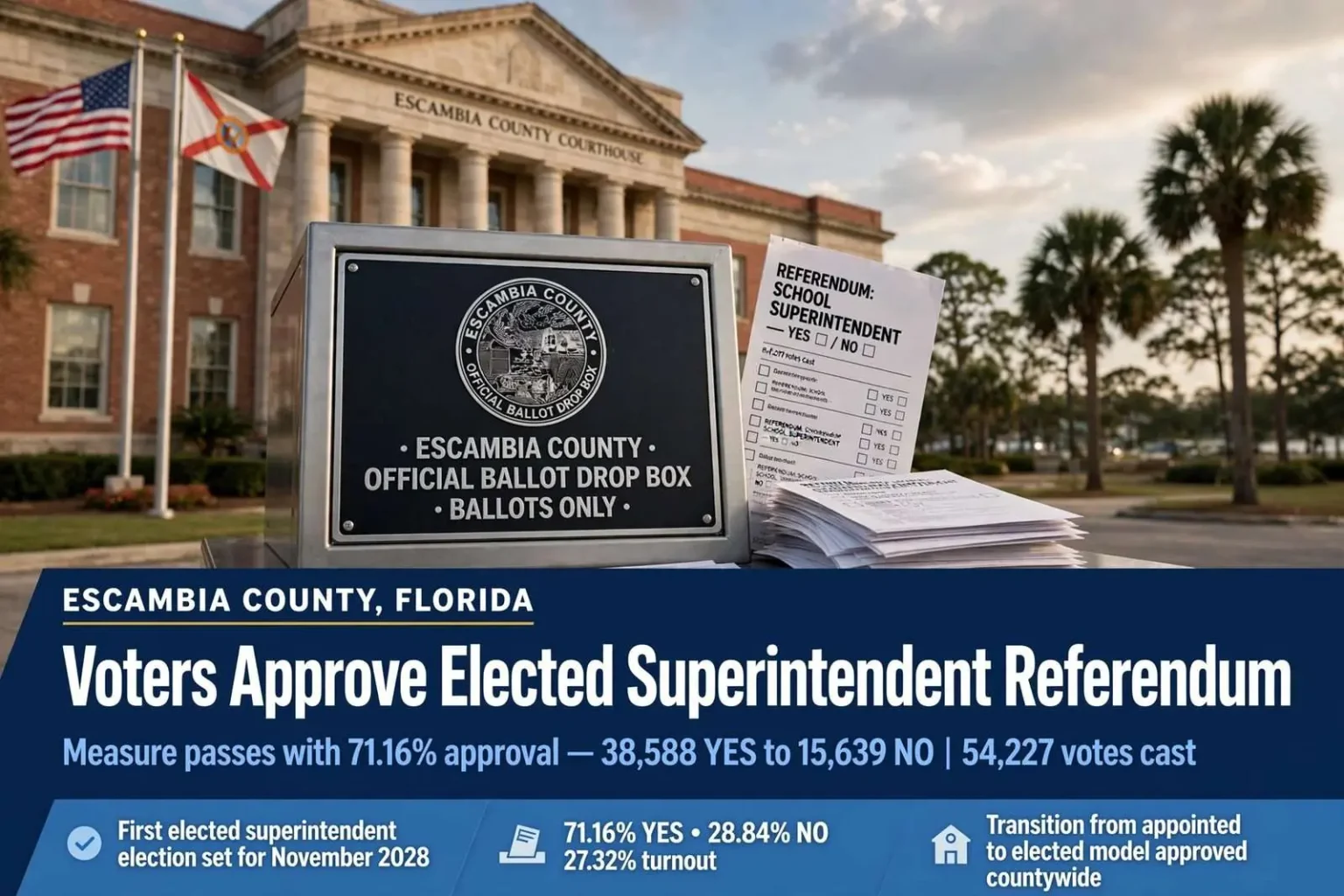
Escambia County’s superintendent referendum was approved Tuesday evening, with unofficial final results showing 38,588 votes, or 71.16 percent, in favor and 15,639 votes, or 28.84 percent, against, out of 54,227 total votes cast on the measure. As a result, voters will elect the county’s next school superintendent rather than have the position filled by appointment.
Escambia County, Florida voters headed to the polls Tuesday to decide whether the county’s school superintendent should be elected by voters or continue to be appointed by the Escambia County School Board. The referendum appeared on every ballot in Tuesday’s primary election, regardless of a voter’s party affiliation or district.
The exact wording voters saw read: “Shall the superintendent of schools of Escambia County, Florida, be elected by the majority of the qualified electors of Escambia County, Florida? Yes or No.”
With the measure now passed, Escambia County voters will elect their next school superintendent during the November 2028 general election. The transition from an appointed to an elected system will take years to play out — the current appointed superintendent’s term continues until the change takes effect, and candidates for the first elected term will begin organizing as the 2028 cycle approaches.
The margin itself was striking. A better than 70 percent approval in a county whose electorate splits closely between the Pensacola-area’s more urban precincts and the rural north end suggests the question cut across geography and party alike, appealing to voters who preferred direct accountability for the district’s top job regardless of their views on the board’s performance.
Countywide Turnout
Unofficial results showed overall voter turnout in Escambia County at 27.32 percent, with 55,592 of the county’s 203,476 registered voters casting ballots across 80 precincts. Neighboring Santa Rosa County, which shares the northwest Florida media market with Escambia County but did not have the superintendent question on its ballot, saw a turnout of 22.65 percent, with 32,129 of 141,852 registered voters casting ballots across 41 precincts.
Neither the town of Jay in Santa Rosa County nor Century in Escambia County had local municipal contests on Tuesday’s ballot. Century’s Precinct 22, which votes at the Billy G. Ward Courthouse, saw 61 total votes cast, with the superintendent referendum passing there 44 to 16 and one undervote recorded. In Santa Rosa County, Precinct 4 in Jay’s Linda Carden Community Center saw 372 voters turn out to cast ballots.
The small western Escambia precinct’s results tracked the countywide pattern almost exactly — a roughly three-to-one margin in favor of an elected superintendent, in a mill town whose schools have long been among the district’s most watched. Century’s schools sit at the far western edge of the county, and local voters there have historically taken a close interest in who runs the district, making the referendum’s easy passage in Precinct 22 unsurprising to local observers.
The turnout numbers reflected the primary’s modest statewide draw. A 27 percent turnout is typical of a Florida primary without a marquee statewide race, and school officials noted that the superintendent question drew to the polls exactly the kind of voters — property taxpayers with children or grandchildren in the district — most invested in its outcome.
A Question Voters Have Weighed Before
This isn’t the first time the issue has surfaced in Escambia County. Florida’s constitution allows each county to choose whether its school superintendent is elected or appointed, but the choice can only be changed through a referendum — and across the state’s 67 counties, the overwhelming majority have long since gone to elected superintendents, making Escambia one of the few holdouts with an appointed system.
Advocates of the elected model argued that the superintendent is the most powerful unelected official in county government, overseeing hundreds of millions of dollars in school construction and operating budgets and thousands of employees, and that such power should answer to the ballot. They pointed to neighboring counties where elected superintendents campaign on specific promises — school closures, bus routes, vocational programs — and deliver their records to the voters every four years.
Supporters of the appointed system had argued the opposite case for decades: that a professional superintendent chosen on merit, insulated from campaign politics, could focus on instruction and long-range planning rather than fundraising and election cycles. School board members who backed the appointed model warned that an elected superintendent might be a skilled politician without management credentials, and that the county’s big-district problems — aging schools in Pensacola’s core, growth pressures in Beulah and the fast-growing northern corridor — demanded continuity more than campaign promises.
That argument lost Tuesday, decisively. The 71.16 percent approval suggests that the accountability argument resonated with voters across the county’s 80 precincts, from the beach precincts to the Alabama state line, and that the board’s long defense of the appointed system failed to persuade even its natural constituencies.
What happens next is a matter of statute and calendar. The passage of the referendum fixes the first elected superintendent’s election to the November 2028 general election, giving the district several years of appointed leadership before the transition. School board seats, meanwhile, remain on their own election cycles, and the board that hires the last appointed superintendent will be the same board that works alongside — and shares power with — the first elected one.
For voters, the immediate practical effect is modest: the 2028 ballot in Escambia County will carry a superintendent’s race, and candidates will spend the years between now and then assembling platforms on school performance, construction priorities and district finances. For the district’s teachers and administrators, the change promises a new political reality in which the district’s top office answers, for the first time in generations, directly to the electorate of Escambia County.
How the Night Unfolded
The result was never seriously in doubt on election night. Early and absentee returns showed the measure running ahead countywide from the first reporting, and the margin held steady as precincts reported through the evening. By the time the unofficial totals were finalized — 38,588 yes, 15,639 no — supporters had gathered at watch parties across the county to mark a change they had pursued for years.
The referendum’s placement on a primary ballot — where every voter, regardless of party, saw the question — gave it the broad exposure advocates had sought. Past efforts to bring the question before voters had struggled with petition requirements and board reluctance; placing it on the primary ballot ensured that the decision would be made by the broadest possible slice of the electorate rather than by those who happened to attend a board meeting or sign a petition.
Local civic groups had debated the elected-versus-appointed question in public forums across the county in the months before the vote, and letters pages in the Pensacola-area press carried the arguments through the summer. The debate rarely broke along party lines — arguments for accountability came from voters of both parties, as did occasional warnings about politicizing the schools’ administration.
The neighboring-county contrast sharpened the debate. Santa Rosa County’s superintendent is elected, and its schools have served as the comparison point for Escambia parents — sometimes favorably, sometimes not — throughout the discussion. Voters could see the elected model in operation a few miles east, which advocates said made the abstract question concrete.
With the vote certified in the days that follow, Escambia County takes its place among Florida’s elected-superintendent counties, closing a decades-long debate with a margin — better than seven in ten — that leaves little ambiguity about what the county’s voters wanted. The next chapter begins in November 2028, when Escambia County voters will, for the first time, choose their schools’ chief executive at the ballot box.
The superintendent question has deep roots in Florida history. When the state rewrote its constitution in the late 1960s, it preserved each county’s right to choose its own system, and in the decades since, counties have periodically gone to the ballot on the question. Escambia’s previous looks at the issue — including petition drives and board debates stretching back over the years — had always ended short of the voters. Tuesday’s referendum, appearing automatically on the countywide ballot, was the first time the full electorate decided the question directly.
Local history gave the debate its texture. The Escambia County School District is one of Florida’s oldest, serving the Pensacola metropolitan area and a sprawling rural north county that stretches to the Alabama line, and its leadership structure has been the subject of periodic review by grand juries, civic associations and editorial boards. Each review weighed the same trade-off that dominated Tuesday’s campaign: professional insulation versus democratic control.
Business leaders watched the vote closely as well, since the superintendent’s office shapes the workforce pipeline that underwrites the region’s military installations, hospitals and growing aerospace sector. Whatever system governs the office, employers’ message to the incoming leadership was the same: the district’s graduates are the county’s economic future, and the voters just made themselves the superintendent’s ultimate boss.