Fairhope Boy With Muscular Dystrophy Receives Wheelchair-Accessible Vehicle From Nonprofit
Fairhope's Beckham Kendall, a 10-year-old living with muscular dystrophy and autism, received a new wheelchair-accessible vehicle Saturday from the Jett Foundation, easing his family's trips to medical appointments and outings.
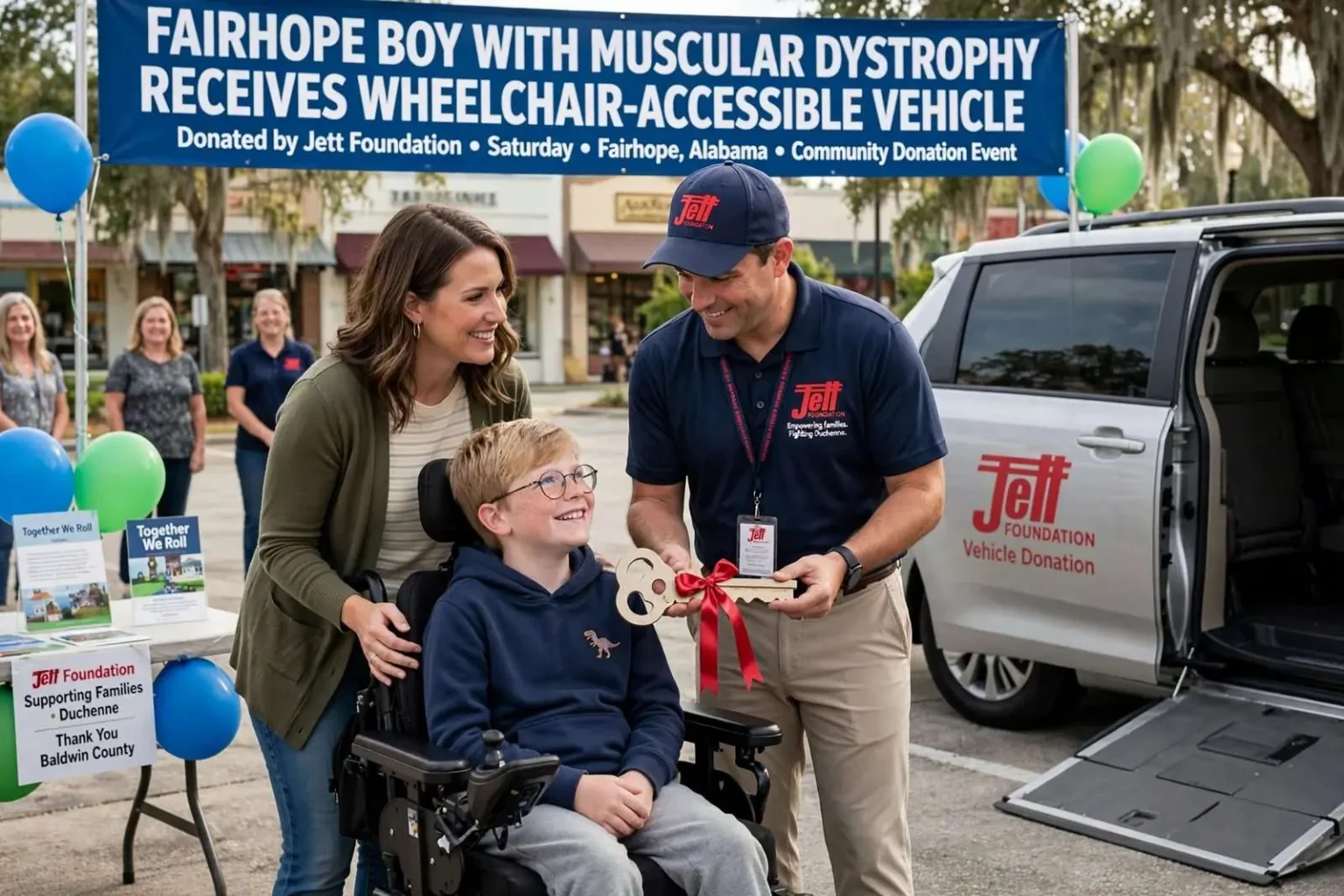
A 10-year-old Fairhope boy living with muscular dystrophy and autism received a new power wheelchair-accessible vehicle Saturday, a donation his family says will make it easier to get to medical appointments, family outings and everyday activities.
The presentation marked the end of a fundraising and application journey that friends, family members and donors in the Baldwin County community supported from the start. For a household that has had to navigate the transportation challenges that come with a progressive neuromuscular condition, the arrival of a vehicle built around a wheelchair changes the daily arithmetic of simply leaving the house.
A Vehicle Built Around a Family’s Needs
Beckham Kendall’s family received the vehicle during a Saturday presentation, marking a significant change for a household that has had to navigate transportation challenges tied to his condition. The vehicle will allow Beckham to travel more easily to medical appointments, family outings and other activities that require his wheelchair.
Accessible vehicles of this kind are typically converted so that a power wheelchair can be secured safely inside the passenger compartment, with ramps or lifts and restraint systems replacing the need to lift a child and disassemble a wheelchair for every trip. For families managing muscular dystrophy, that difference can determine whether a medical appointment across Mobile Bay, a school event or a simple errand is practical on a given day.
Beckham’s mother, Kandace Kendall, said the experience carried meaning that went beyond the vehicle itself. “It’s really been about raising awareness, reducing muscular dystrophy, and also seeing how much the community and our family and friends really came around us and donated their time and their money to make this a reality for us,” she said.
Her comments reflected the two sides of the donation: the practical relief of dependable accessible transportation, and the visible demonstration of support from a Gulf Coast community that rallied around one family’s needs. The family’s fundraising effort drew contributions of both money and time from neighbors, friends and strangers across the Baldwin County area.
About the Donation
The vehicle came from the Jett Foundation, a nonprofit organization that supports individuals and families affected by Duchenne muscular dystrophy, a progressive genetic neuromuscular disorder that primarily affects boys and gradually weakens muscle function over time. The condition often requires increasing levels of mobility support, including power wheelchairs, as it progresses — making accessible transportation a significant need for many affected families.
The Jett Foundation is based in Massachusetts and was founded in 2001. In the years since, the organization has raised more than $16 million for biomedical Duchenne research, alongside its work providing direct support — including transportation assistance — to families managing the day-to-day realities of the disease.
The foundation’s family support programs exist because the needs created by Duchenne extend well past the doctor’s office. As the condition progresses, families commonly face mounting expenses for wheelchairs, home modifications and vehicle conversions, costs that standard insurance coverage does not always meet in full. Organizations like the Jett Foundation step into that gap, pairing research fundraising with practical aid designed to keep affected children active in their communities.
Understanding Duchenne Muscular Dystrophy
Duchenne muscular dystrophy is among the most common forms of muscular dystrophy in children, and it is caused by a mutation in the gene that produces dystrophin, a protein muscles need to function. Without adequate dystrophin, muscle fibers are progressively damaged and replaced by scar tissue and fat, leading to steadily increasing weakness.
Most boys with Duchenne begin showing symptoms in early childhood — often as frequent falls, difficulty running or climbing stairs, or delayed motor milestones. Many rely on power wheelchairs by their school-age or adolescent years as leg muscles weaken, while the condition’s effects eventually extend to the muscles of the heart and lungs. The disease primarily affects boys, though rare cases occur in girls, and families typically coordinate care among neurologists, cardiologists, pulmonologists, physical therapists and orthopedic specialists.
Because the progression is gradual but relentless, mobility equipment is not a one-time purchase. Wheelchairs must be replaced and refitted as a child grows, and transportation must adapt alongside them. That reality is what makes a wheelchair-accessible vehicle such a significant gift for a family like the Kendalls — it addresses a need that will persist and evolve through Beckham’s teenage years and beyond.
Life with Duchenne also reshapes the ordinary rhythms of a household. Doorways may be widened and bathrooms modified as mobility equipment changes. School plans must account for both physical access and the energy demands of the school day. Parents often become full-time coordinators of care, scheduling appointments across multiple specialties while also advocating for their child in classrooms and community settings. It is a demanding routine, and one that families describe as easier to manage when the practical obstacles — like getting to an appointment across the Bay — have been removed.
Research into Duchenne has accelerated in recent decades, with scientists pursuing gene-based therapies, exon-skipping treatments and approaches aimed at restoring dystrophin production. Advocacy organizations, including those based on the Gulf Coast and nationwide, have played a visible role in raising both money and public awareness, pushing the disease into the public conversation in ways that were rare a generation ago.
Why Accessible Transportation Matters
For families in South Alabama, geography makes accessible transportation especially consequential. Specialty medical care for neuromuscular conditions is concentrated in Mobile, meaning regular trips across the Bay for appointments, therapy sessions and evaluations. A family without an accessible vehicle may face difficult choices about which appointments to keep, or may resort to lifting a child and a heavy power wheelchair into a standard vehicle — a process that is difficult, slow and, over time, risky for both child and caregiver.
An accessible van changes that calculus. With a ramp and secure wheelchair docking, a trip that once took considerable planning and physical effort becomes a routine errand. Families consistently describe the difference in terms of independence: the ability to say yes to a birthday party, a school function or a spontaneous outing without first calculating the logistics of mobility equipment.
The benefit reaches the whole household. Siblings can be picked up on time, parents can manage work schedules with less disruption, and the child at the center of it all travels in his own chair, comfortably positioned among his family rather than transferred in and out of it.
How Vehicle Donation Programs Work
Accessible vehicle giveaways follow a path that typically begins months before the keys change hands. Families apply through a sponsoring nonprofit, often documenting a diagnosis, describing their transportation situation and outlining how a converted vehicle would be used. Applications are then weighed against the organization’s resources, since converted vehicles represent one of the largest single expenses a disability-focused charity can undertake.
Fundraising frequently enters the picture as well. Many programs ask families to participate in raising a portion of the cost, which is where the community efforts described by the Kendall family come in. Local fundraisers, online campaigns and word-of-mouth appeals by friends and relatives often supply the margin between what a foundation can provide and what a fully converted, wheelchair-ready vehicle costs. The result is usually a hybrid effort — national nonprofit resources combined with hometown donations — culminating in a presentation like the one held Saturday.
A Community Effort on the Eastern Shore
The Kendalls’ story also highlights the role that community fundraising plays in making such donations possible. Friends and family members organized and contributed their time and money to support the family’s application and the process leading to Saturday’s presentation, an effort Kandace Kendall described as central to what the experience meant.
Fairhope, a city of roughly 20,000 residents on the eastern shore of Mobile Bay, has a long tradition of civic and community support, and stories of neighbors organizing around a local family’s needs are a familiar feature of life in Baldwin County’s smaller communities. Church groups, school communities and youth sports organizations often form the backbone of such efforts, spreading the word through social media and personal networks until a family’s need becomes a community project. Saturday’s presentation fit squarely within that tradition — a moment arranged not by a distant institution but by people who knew the family and understood what the vehicle would mean.
For the Kendall family, Saturday’s donation reflects both a practical solution and a reminder of the community support that surrounded them throughout the process, as friends, family and donors contributed to making the accessible vehicle possible.
As Beckham heads into his middle-school years, the vehicle will carry him to the appointments, classrooms and activities that fill a 10-year-old’s calendar — this time with the whole family traveling together, and with a Fairhope community’s fingerprints on every mile.