

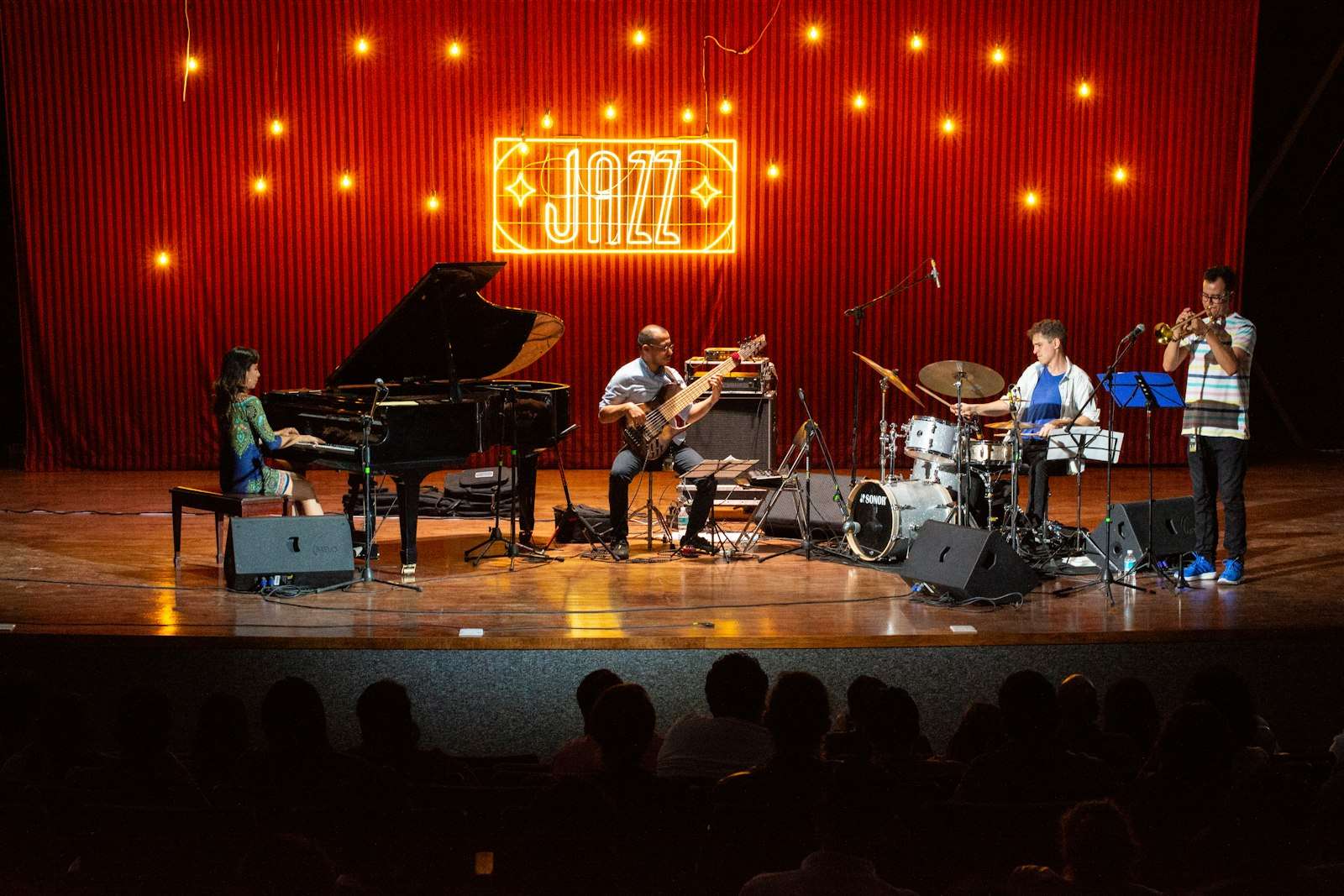
Roman Street, the Fairhope-based instrumental group led by brothers Josh and Noah Thompson, will perform Thursday at Mobile’s Saenger Theatre as part of an International Jazz Jam that also features New Orleans’ famed Preservation Hall Jazz Band and the group’s longtime mentors, Tonic Strings. The bill joins three generations of Gulf Coast and New Orleans music on one of the Saenger’s most storied stages, pairing the area’s best-known instrumental act with the institution that has carried traditional New Orleans jazz around the world.
Josh Thompson, who formed the band with his brother Noah alongside bassist Jason Sikes and percussionists Daniel Brett and Nik White, credited Tonic Strings with shaping how the brothers approach music.
“Tonic Strings truly exemplify what it means to be a musician,” Thompson said. “Not only have they affected how my brother and I play, but they have taught us that music is a lifelong pursuit and that we must always strive to be better.”
Thompson also pointed to the brothers’ parents as a driving force behind the band’s success, saying their support has been essential. That family scaffolding — two brothers, an act built around their guitar work, and parents invested from the beginning — has defined Roman Street’s identity from its earliest Fairhope days through a touring career that has taken the band well beyond the Gulf Coast.
A new album and a full calendar
Roman Street released its latest album, “Amore,” in March, and Thompson said the record has been well received. The band is now touring as much as its schedule allows, largely sticking to shows around the region, while looking ahead to a Christmas album and the start of work on a new studio project next summer.
The group’s next major milestone is already on the calendar: an opening slot for guitarist Jesse Cook at the Saenger Theatre on January 21. Thompson called Cook “a phenomenal guitarist with an equally incredible band” and said the band is thrilled for the opportunity to share the stage with him. For a group whose sound blends acoustic guitar traditions with Latin and New Orleans flavors, opening for the flamenco-influenced Cook represents both a booking and a lineage — the instrumental-guitar tradition passed from one act to the next on the same stage where the band would share a bill with its own mentors this week.
Advice for aspiring musicians
Asked what he’d tell young musicians along the Gulf Coast interested in jazz, Thompson pointed back to the lesson Tonic Strings gave him.
“Your music, of any style, is something to be shared with the world, and you should pursue music as a lifelong passion,” he said.
The counsel carried particular weight in a region where young players grow up within reach of two of America’s great musical cities — Mobile’s own jazz heritage and the New Orleans tradition just up the road — and where the path from school talent shows to professional stages is one that Roman Street itself has traveled in full view of the hometown audience.
Preservation Hall’s New Orleans roots
Sharing the bill is Preservation Hall Jazz Band, the touring ensemble tied to one of New Orleans’ most storied music institutions. Preservation Hall itself was purchased in 1961 by Ben Jaffe’s parents, Sandra and Allan Jaffe, who turned the French Quarter room into one of the world’s best-known jazz venues. The hall famously serves neither food nor liquor; instead, it charges a modest entrance fee for 45- to 60-minute sets built around traditional New Orleans jazz, keeping the room focused entirely on the music and the players who carry it.
Allan Jaffe, who died in 1987, is widely credited with helping preserve that traditional jazz sound at a time when it had fallen out of fashion elsewhere in the city. In the early 1960s, the pioneers of New Orleans jazz were aging and their audiences had moved on to newer sounds; the Jaffes’ hall gave the surviving masters a room of their own, and the band that grew from it carried the style to stages worldwide. The venue’s austere format — no bar, no food, just the band and the audience a few feet apart — became part of the institution’s identity as much as the music itself.
Ben Jaffe, who grew up in the French Quarter and later graduated from Isidore Newman School and Oberlin College, eventually joined the band on bass and tuba and took over his father’s role as the hall’s director. Under his stewardship the band has balanced reverence for its founding repertoire with collaborations and new material that have introduced traditional New Orleans jazz to generations who never set foot in the French Quarter room.
First time in Mobile
Ahead of the Mobile date, Jaffe said Thursday’s show will be the band’s first time playing the city, though he has performed at the Saenger Theatre before, catching a Tom Waits concert there years earlier. He said he did not have personal ties to Mobile’s jazz scene going into the show but was looking forward to sharing the bill with Roman Street and Tonic Strings.
The band keeps an intensive touring schedule, playing roughly 200 days a year, a pace that has made the ensemble cultural ambassadors for New Orleans as much as a working band. Each tour date doubles as a representation of the hall itself — the room that never served a drink, now heard on stages across continents.
Jaffe’s visit comes amid local discussion about whether Mobile could support a dedicated listening room in the same spirit as Preservation Hall — a venue built specifically to showcase the city’s own jazz musicians, who organizers say remain underappreciated relative to the depth of Mobile’s jazz heritage. The Saenger date put that conversation on stage in miniature: a New Orleans institution devoted to its city’s music, sharing a bill with Mobile artists devoted to theirs, in a 1920s vaudeville house that has hosted the region’s musicians for nearly a century. If the night demonstrated anything, it was what a room built for listening can do for the players who fill it.
The Saenger and Mobile’s stage tradition
The Saenger Theatre itself anchors the evening’s significance. Opened in the 1920s as a vaudeville and movie palace on Joachim Street, the venue has spent a century at the center of Mobile’s live-performance life, surviving the downtown’s lean decades and returning as the city’s premier mid-size stage after an extensive restoration. Generations of Gulf Coast audiences have seen touring Broadway shows, symphony pops, rock acts and jazz legends under its ornate ceiling, and its stage has served as both aspiration and proving ground for the region’s own musicians.
For Roman Street, the date continued a relationship with the venue that the January booking with Jesse Cook would extend — two Saenger appearances in a single season, one alongside their mentors and the band from Preservation Hall, the other opening for an international guitar star. Few Fairhope-formed acts have stacked a resume like that, and the hometown turnout for both dates testified to the band’s standing across Mobile Bay.
The International Jazz Jam format also reflected the ties that bind the Gulf Coast’s music communities. Mobile and New Orleans sit barely two hours apart, their jazz traditions intertwined since the music’s earliest days, and local players have long moved between the cities’ clubs, festivals and second lines. A bill joining a Fairhope band, its Mobile-connected mentors and Preservation Hall’s ensemble put that circulation on display rather than leaving it to history.
A band built in Fairhope
Roman Street’s path from Fairhope to stages like the Saenger has made the group something of a hometown standard-bearer. The band’s name — a nod to the Roman Street the Thompson brothers grew up on — has always advertised its roots, and its instrumental style, blending acoustic guitar with New Orleans rhythm and Mediterranean melody, grew from the Eastern Shore’s easy position between Mobile’s jazz past and the Caribbean and Latin currents that wash up the Gulf.
The band’s steady output has kept that growth visible: album releases on a regular rhythm, a touring schedule that returns home often, and the December-to-December pipeline of new projects Thompson described — a Christmas album next, then studio work the following summer. The pace reflects the lifelong-pursuit ethic Thompson credited to Tonic Strings, applied with the discipline of a band that has treated the Gulf Coast not as a stopping point but as a home base to build from.
Thursday’s jam offered the audience a rare configuration as well — three acts that share history and affection on one bill, in a genre where the joy of playing together is the point. For young musicians in the crowd, the evening doubled as a map: the mentors on stage, the band a decade or two ahead, the institution from New Orleans still playing 200 nights a year. The lesson Thompson preached was embodied on every side of the stage — music as a pursuit without a finish line, and a Gulf Coast stage capable of hosting whatever a player grows into.