Federal government awards $125 million grant for I-10 Mobile River Bridge project
The U.S. Department of Transportation awarded a $125 million INFRA grant for the I-10 Mobile River Bridge and Bayway project, with a second grant for.
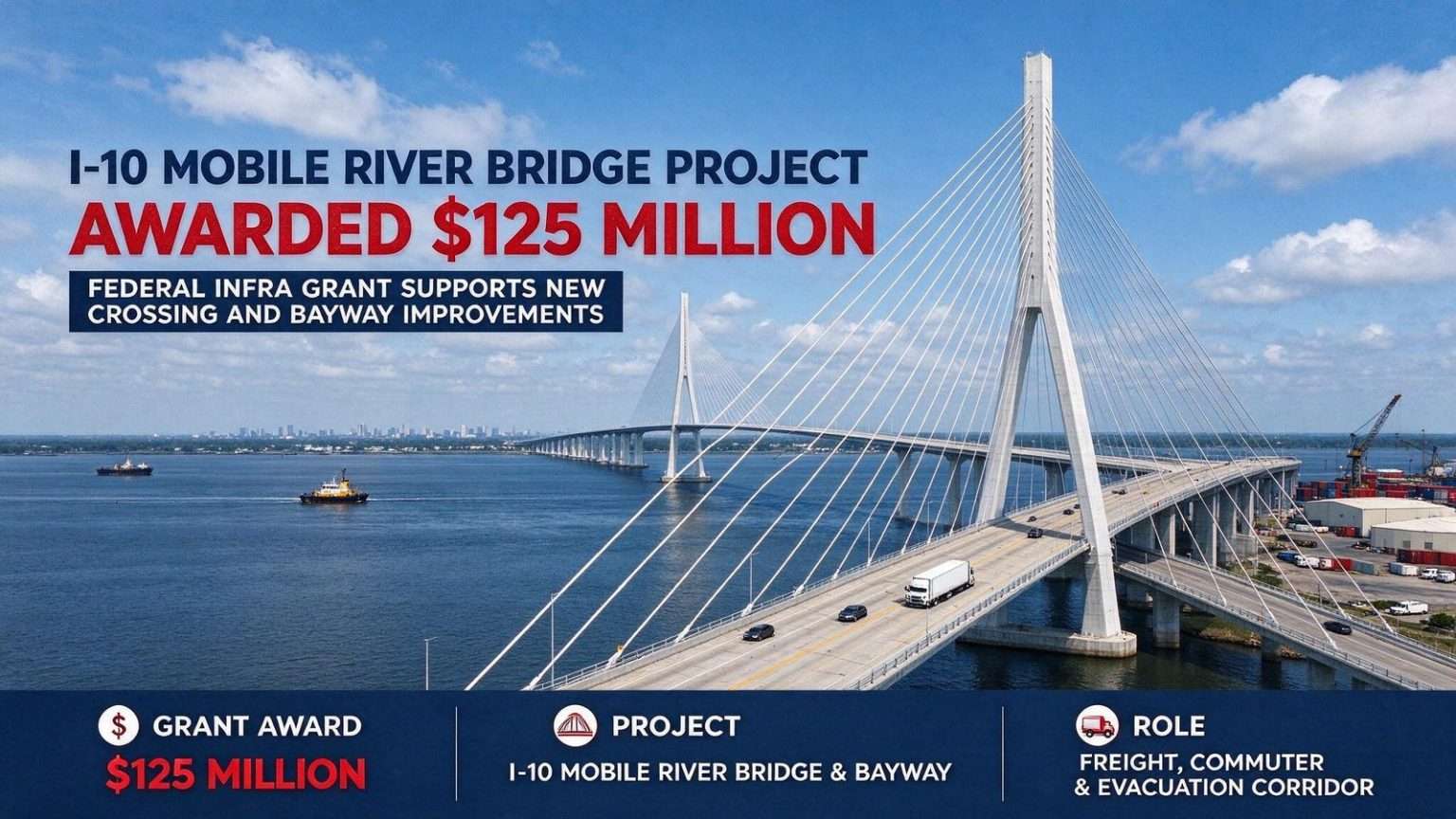
WASHINGTON, D.C. — U.S. Sen. Richard Shelby (R-Ala.) announced Monday that the U.S. Department of Transportation has awarded two INFRA grants to fund major infrastructure projects in Alabama. The larger of the two, $125 million, will go to the Alabama Department of Transportation to help build the I-10 Mobile River Bridge and Bayway project — one of the largest competitive federal grants ever awarded to the state.
A second grant of $6.87 million will help the city of Tuscaloosa replace an overpass bridge on University Boulevard and U.S. Highway 82. The pairing of the two awards in a single announcement underscored how Alabama’s federal delegation has worked the competitive grant process, pairing a nationally significant megaproject with a hometown safety project in the state’s western side.
“I am proud to announce that Alabama is receiving two major INFRA grants to assist in construction and completion of important infrastructure projects in Mobile and Tuscaloosa,” Shelby said. As chairman of the Senate Appropriations Committee at the time, Shelby held one of the most influential positions in Congress over federal transportation spending, and Alabama’s record of winning competitive infrastructure awards during his tenure reflected both that influence and the strength of the state’s project applications.
What the Bridge Project Is
The money will support a cable-stayed bridge and added roadway on I-10. The Mobile River Bridge and Bayway project is the largest transportation undertaking in south Alabama’s history: a new crossing spanning the Mobile River just north of the existing Wallace Tunnel, connected to a rebuilt and widened Bayway across Mobile Bay.
The existing I-10 route through downtown Mobile funnels all interstate traffic — from the port, from Florida-bound vacationers, from commercial trucks moving between the Southeast and Texas — through a pair of tunnels bored beneath the river in the early 1970s. The tunnels carry limited lanes, cannot be widened, and bottleneck chronically; backups approaching the Bankhead and Wallace tunnels are a daily reality for commuters and a standing hazard for hurricane evacuations, when the Bayway becomes the region’s only practical eastward escape route.
The new alignment would lift through traffic over the river on a high-level cable-stayed span, freeing freight and commuter flows from the tunnel chokepoints and adding capacity along the Bayway, where the existing causeway sits low over the water. Planners have framed the project as essential to the port’s continued growth and to the region’s ability to absorb the traffic that comes with it.
Local Officials Welcome the Award
U.S. Rep. Bradley Byrne (R-AL) called the news “outstanding” for Southwest Alabama. “Fighting for federal funding for this bridge has been one of my top priorities in Congress,” he said, while renewing his opposition to a tolling proposal for the project.
Byrne’s position captured the central tension in the project’s financing. Even with a $125 million federal award, the bridge and Bayway reconstruction carries a price tag measured in the billions, and state officials had proposed tolling the new crossing to repay the construction debt. Local opposition to tolls has been persistent and vocal — commuters in Daphne, Spanish Fort and Baldwin County argued they would pay twice for a road they already fund through state taxes, and elected officials across the Eastern Shore made the same point in public hearings. Byrne’s statement paired congratulations with a renewed pledge against toll collection, reflecting the politics of a project nearly everyone wants but few want to pay for directly.
Mobile Mayor Sandy Stimpson also welcomed the grant, noting the bridge matters “not only to Mobile and the Gulf Coast, but … the flow of commerce throughout the U.S.”
The mayor’s framing was not rhetorical flourish. I-10 is the principal east-west interstate along the Gulf, and the traffic crossing Mobile Bay includes a heavy share of freight moving between the ports of the central Gulf, the industrial corridors of Texas and Louisiana, and the population centers of Florida and the Southeast. The Port of Mobile’s own expansion — including the container terminal at Choctaw Point and the growing rail connections that feed it — multiplies the truck traffic that must cross the river and the bay. A bottleneck in Mobile constrains shipping patterns well beyond the city limits, which is precisely the argument that elevated the project to national significance in the federal grant competition.
How INFRA Grants Work
The INFRA program — Infrastructure for Rebuilding America — is the U.S. Department of Transportation’s premier competitive discretionary grant program for large highway and freight projects. Unlike formula funding, which flows to states automatically by law, INFRA grants are awarded through applications judged on national and regional significance, project readiness, economic outcomes and the commitment of non-federal matching funds.
Winning an INFRA award of $125 million places a state project in rare company; most competitive awards each year go to a short list of megaprojects around the country, and Alabama’s haul was among the largest ever secured by the state through a competitive process. The grant does not complete the project’s financing on its own, but it does something nearly as important: a major federal commitment validates the project’s engineering and benefit-cost case, strengthens applications for other funding sources, and signals to state and local officials that the national funding apparatus considers the bridge worth building.
For the Alabama Department of Transportation, the award also validated years of environmental review, design work and public comment on the bridge and Bayway — the slow, expensive groundwork that competitive federal programs demand before a dollar is committed.
What It Means for commuters and the Region
For the roughly hundreds of thousands of drivers who cross Mobile Bay on I-10 each week, the grant represents movement on a project that has been discussed for decades without visible progress. The daily reality of tunnel backups affects school buses, port trucks, hospital traffic and vacationers headed to the beaches in a single shared corridor, and local business groups have long argued that congestion itself functions as a tax on the regional economy.
Hurricane evacuation is the starkest example. When a storm threatens the central Gulf Coast, the Bayway and the tunnels become the funnel through which the Eastern Shore’s population moves west or north, and the corridor’s limited capacity is a recognized weakness in the region’s emergency planning. A wider, higher crossing directly addresses that vulnerability — one reason state and federal reviewers weighted the project’s resiliency benefits heavily.
The grant also matters for Baldwin County’s growth trajectory. The county has been among the fastest-growing in Alabama for years, and its development is pinned to the capacity of the few crossings that link it to Mobile. Additional lanes on the Bayway, and a new high-level river crossing to the north, would shape where new neighborhoods, schools and commercial centers take root over the coming decades.
The Road Ahead for the Project
A $125 million grant is a milestone, not a finish line. The bridge and Bayway project’s full cost will require a stack of funding — state bonds, federal formula funds, additional competitive grants and, in the original plan, toll revenue — and questions about how the remainder is financed were guaranteed to follow this announcement, as Byrne’s anti-toll comments anticipated.
What the award changes is the project’s standing. Alabama’s congressional delegation, from Shelby’s announcement in Washington to Byrne’s and Stimpson’s statements at home, treated the INFRA grants as confirmation that the Mobile River Bridge belongs among the nation’s priority projects. For local residents, the announcement moved the bridge one visible step closer from concept to construction — a cable-stayed span over the river that would mark the Mobile skyline, ease the tunnel bottleneck, and carry the Gulf’s commerce over the bay for generations. The work of securing the rest of the funding, and of settling how the project is paid for, remained the next chapter of a story Mobilians have been following for decades.
Tuscaloosa’s Share of the Announcement
While Mobile dominated the announcement, the second INFRA grant carried its own local significance. The $6.87 million award will help Tuscaloosa replace an overpass bridge on University Boulevard and U.S. Highway 82, a corridor that carries heavy daily traffic between downtown, the University of Alabama campus and the western parts of the city.
Overpass replacements are the unglamorous work of infrastructure: structures built in the mid-twentieth century age out, and the cost of replacing them routinely strains municipal budgets. A competitive federal award of nearly $7 million relieves a substantial share of that burden for a city that, like Mobile, has used its own capital budget to modernize aging corridors. The pairing of the two projects in Shelby’s announcement also reflects the practical politics of infrastructure — a senator’s competitive-grant wins are judged by constituents in both the metropolitan flagship project and the hometown repair.
For south Alabama, though, the day’s headline was the bridge. One of the largest competitive federal transportation awards in state history now points directly at the Mobile River and the Bayway, where the region’s oldest traffic problem and its newest growth are converging on the same few miles of interstate.