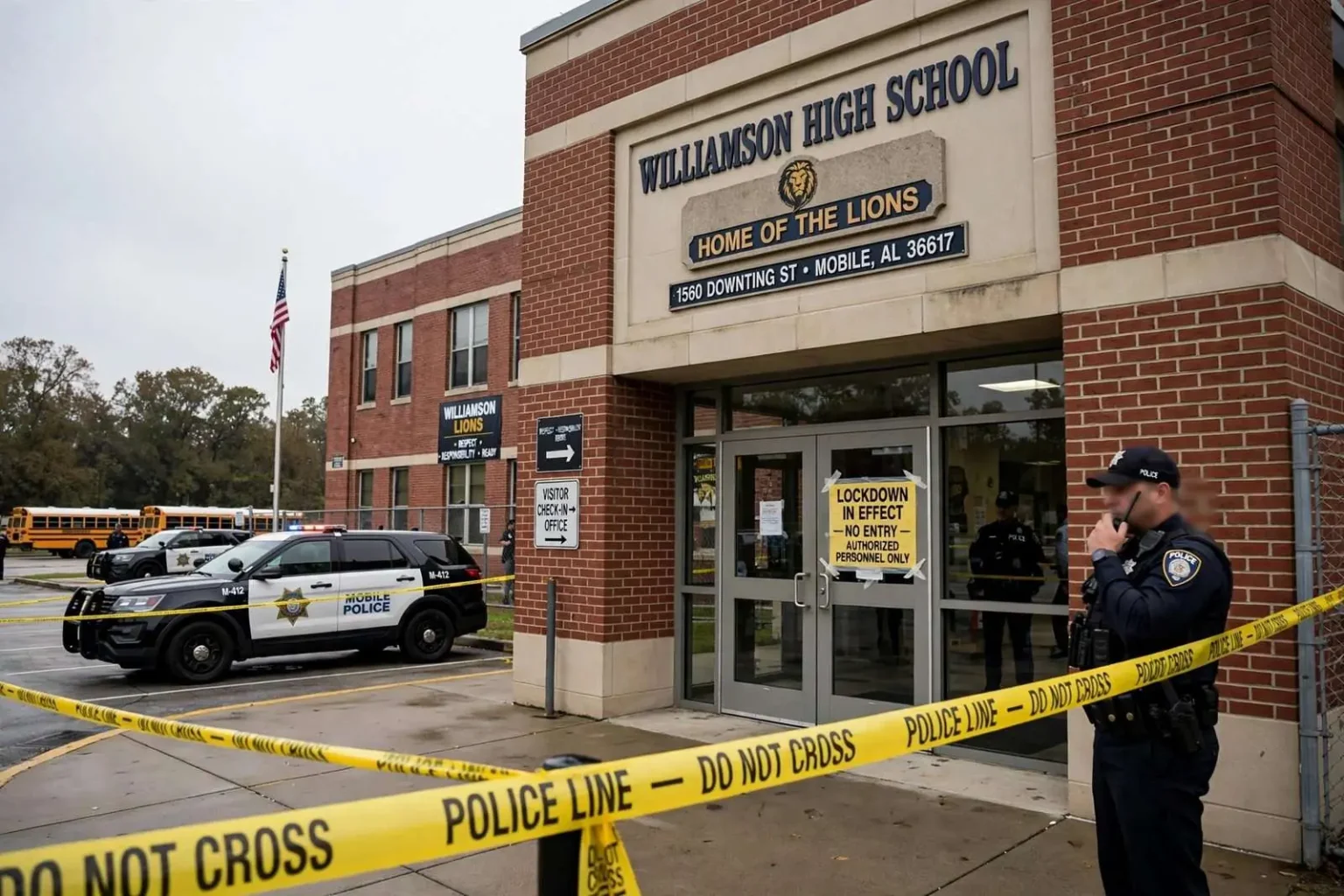
The safety of a Mobile high school campus was shaken when Mobile Police responded to Williamson High School after a disorderly complaint involving students, prompting school administrators to place the building on lockdown while officers sorted out what was happening. The incident, which involved both a fight inside the school and two armed men outside, ended with criminal charges against four young people and an ongoing investigation that left many parents in the Mobile County Public Schools system asking questions about campus security.
According to Mobile County Public Schools, the trouble began in the cafeteria, where a fight broke out between students during the school day. As that altercation unfolded, school officials moved to secure the campus, placing Williamson High on lockdown — a standard protective measure in which students are kept in classrooms, hallways are cleared and entry to the building is restricted until police confirm the situation is under control. Lockdowns at large high schools can be disruptive and frightening for students, but they are designed to prevent a single incident from spreading and to keep anyone outside the school from entering while police respond.
Two Armed Men Outside the School
While the cafeteria fight was underway, Mobile Police said, two men were seen outside the school building — and both were armed with guns. Police said the two men did not take part in the fight inside the school. Antonio Pettaway, 18, and Clifton Granderson, 20, were charged with possession of a deadly weapon on school grounds, a serious criminal offense under Alabama law. The charge reflects the state’s particularly strict treatment of firearms at schools: Alabama prohibits weapons on school property, and bringing a gun onto a K-12 campus is prosecuted as a felony matter rather than a minor weapons violation.
The school district acknowledged it did not know whether the two incidents — the student fight in the cafeteria and the armed men outside — were connected. That uncertainty was a central part of the initial response, since investigators had to work two separate threads at once: identifying and charging the students involved in the cafeteria altercation, and determining why two armed men, neither of them students, were on the campus with weapons during school hours.
Students Charged in the Cafeteria Fight
The consequences inside the building were swift as well. A 14-year-old student and a 16-year-old girl who were involved in the cafeteria fight were taken to the Strickland Youth Center on disorderly conduct charges. The Strickland Youth Center, located in Mobile, is the facility where juveniles arrested in Mobile County are held and processed through the juvenile justice system. Because both students are minors, their cases would proceed in juvenile court, where proceedings are closed to the public and the focus is generally on supervision, counseling and rehabilitation rather than adult sentencing.
The age gap between the students involved and the two men charged outside — one 18, the other 20 — illustrates the range of people who can become entangled in campus incidents. Neither Pettaway nor Granderson was reported to be a Williamson student, and adults who bring weapons onto school property face the full weight of the adult criminal justice system, where a conviction for possession of a deadly weapon on school grounds can carry significant prison time.
The investigation remained ongoing in the days after the incident, and police said no further information was available at the time. District officials promised additional updates as the case developed, and the episode added to ongoing conversations across Mobile County about safety at large high schools, the speed of police response and how quickly lockdown procedures can be activated when trouble starts. Williamson High School, located in the Toulminville area of Mobile, serves several hundred students and has long been one of the flagship schools in the northern part of the city. For parents of Williamson students, the incident was a reminder that campus safety depends on the coordination between school administrators, the district’s security staff and the Mobile Police Department — and on how quickly all three can move when a normal school day is interrupted.
The incident also renewed attention to how information reaches parents during campus emergencies. When a lockdown begins, families typically learn of it through text alerts, social media posts and word of mouth, often before the district can confirm details. School communications officials in large districts like Mobile County’s walk a careful line in those first hours: confirming that an incident occurred and that students are secure, while avoiding details that could compromise the police investigation or identify juveniles, whose records are protected by state law. District officials said additional updates would be promised as the case developed, and the charges against the four individuals — two adults and two juveniles — became the confirmed public account of the day.
The presence of two armed men outside a school, unconnected or not to the fight inside, is the element of the case that drew the most community concern. Alabama’s weapons-on-campus statute exists precisely for this scenario, and Mobile Police’s decision to charge both men the same day signaled how seriously the department treats firearms at schools. School resource officers, police departments and district security staff across Mobile County review incidents like this one to refine how quickly a perimeter can be established around a school when a threat appears outside the building. For now, the case moves forward in two courtrooms at once — adult court for Pettaway and Granderson, juvenile court for the two students — while Williamson High returns to the ordinary rhythm of a school year that, for one day, was anything but ordinary.
Beyond the immediate charges, the episode sits within a longer regional conversation about youth violence and school safety that Gulf Coast communities have wrestled with for years. School districts across Alabama have expanded their use of school resource officers, controlled single-point entries, visitor management systems and camera networks, all aimed at shortening the distance between a problem starting and adults responding. Mobile County, as the state’s largest district, operates campuses of very different sizes and settings — from small rural schools in the county’s northern reaches to large urban high schools like Williamson in the city — and each presents its own security geometry. A fight in a cafeteria is a different problem from armed strangers at the edge of campus, but both demand that staff follow rehearsed procedures without hesitation.
Disorderly conduct charges against juveniles involved in school fights serve both a punitive and an early-intervention purpose in the juvenile justice system. The Strickland Youth Center, where the two students were taken, is the county’s juvenile detention and intake facility, and a stay there — even a brief one — typically triggers involvement from probation officers, family court and social service providers. Judges in Mobile County’s juvenile court emphasize accountability alongside family engagement, on the theory that a first serious incident is the cheapest moment to change a young person’s trajectory. Whether the two students’ cases end in diversion, probation or something more serious will depend on their records, the circumstances of the fight and the discretion of the court.
The Adult Charges Carry the Most Weight
The strongest penalties in the case belong by law to the adults. Possession of a deadly weapon on school grounds is charged under Alabama’s school safety provisions, and a conviction can bring a prison sentence measured in years rather than months, reflecting the legislature’s judgment that firearms near children are among the most serious public safety threats. The 18- and 20-year-old defendants will also carry felony records into adulthood if convicted, with consequences for employment, housing and firearms rights that extend far beyond any sentence. Prosecutors in Mobile County have generally pursued these cases to verdict rather than light plea arrangements, particularly when the weapon was carried during school hours.
What investigators still had not determined, at the time of the initial report, was motive — why the men were there, and whether their presence had anything to do with the students who were fighting inside. That unanswered question is exactly why police kept the case open and why the district promised updates. A connection between the two threads would suggest a planned confrontation that happened to land on campus; no connection would make it a disturbing coincidence of timing. Either way, the day’s sequence — a fight reported, a lockdown ordered, police on scene, arrests made, charges filed in both systems — showed the machinery of school safety working end to end, and gave Mobile County families a concrete picture of what happens when a normal school day in Toulminville goes wrong. The final accounting of the incident — including whether the two threads were connected — now rests with the investigators and the courts, and with whatever the district chooses to share once its own review is complete.