

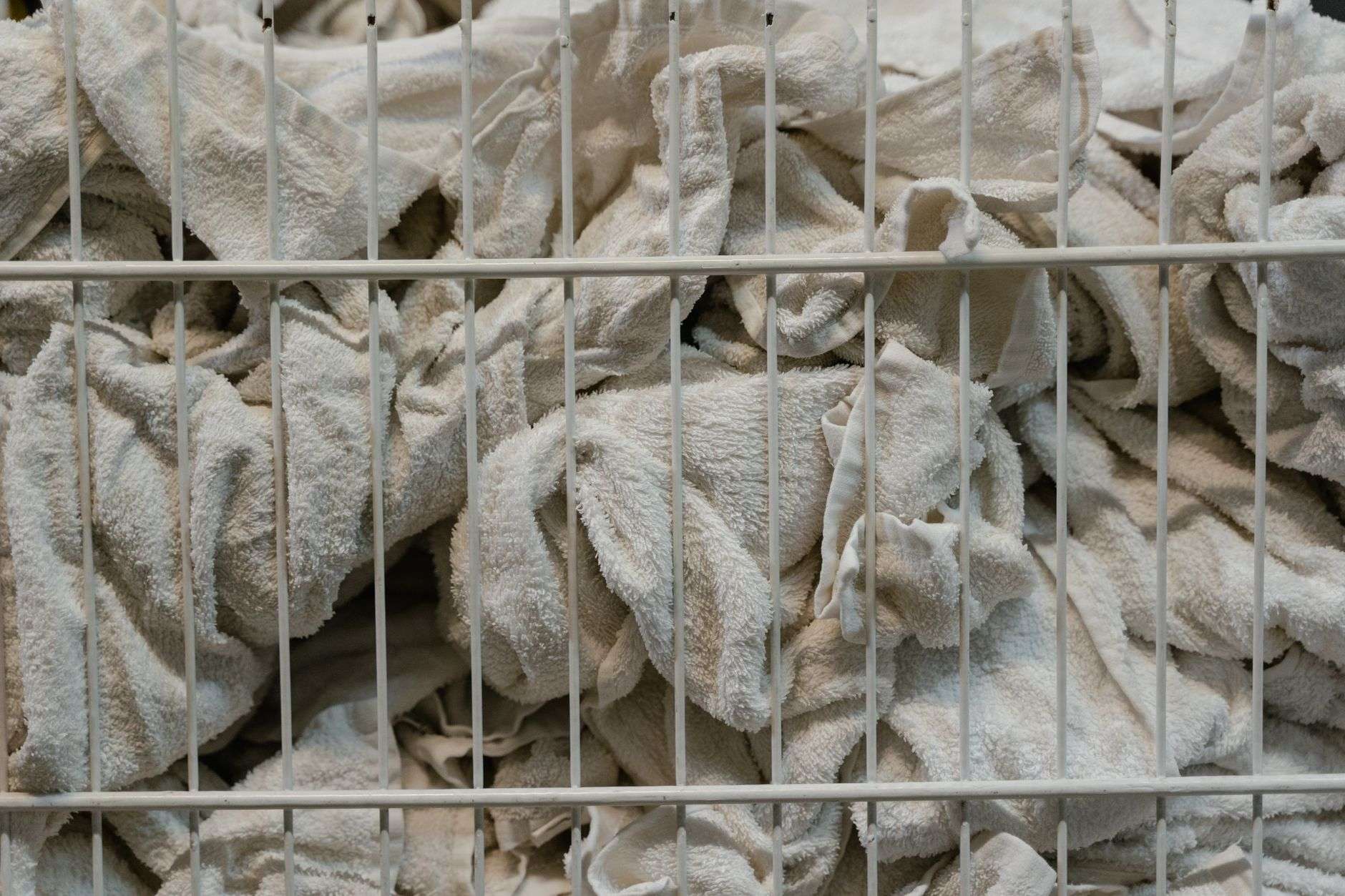
Every week during the beach season, tens of thousands of towels, sheets and pillowcases pass through the hotels and condominiums of South Baldwin County. Much of that linen now flows through Southern Sun Laundry in Foley, a 22,000-square-foot facility that owner Sean Chappell describes as one of the most advanced laundry processing operations in North America. Getting there took two decades, several hurricanes, a recession, the BP oil spill, a pandemic and a fire that burned his plant to the ground.
Chappell’s story is one of resilience in the most literal sense. “We didn’t have a Plan B,” he says. Here is how a microchip salesman turned dry cleaner built a laundry business that has become part of the behind-the-scenes machinery of Alabama’s Gulf Coast tourism industry.
From the Army and Microchips to the Beach
Chappell was born in New Orleans and moved often as a child, arriving in Mobile in 1977 at age 7 after his parents divorced. He graduated from Citronelle High School and joined the Army to help pay for college. He later spent years in industrial sales for a New York-based company with a semiconductor division that distributed microchips; the company had an office in Huntsville, and Chappell traveled for business while working remotely from his home in Mobile.
He took night classes at the University of Mobile and spent eight years earning a degree in business management. “The Reserves paid for my college,” he says. “That’s why it took so long.” One day, while listening to a Stephen Covey recording about priorities during a drive, he was moved to pull over and sketch a map of what mattered most in his life.
After 17 years with the company, he was asked to relocate. “I was at a crossroads and I needed to decide what to do in my life,” he says. “I was in my mid-30s and decided to make a change.” In 2003 he hired a business broker to help find a company to buy, and a dry cleaner in Gulf Shores came up for sale. Having vacationed at the beach with his family most of his life, he wanted to put down local roots. He bought the business in 2004 and grew it to four locations. “I went from high-tech to low-tech and from coat and tie to employee issues,” he says.
Hurricanes, a Recession and an Oil Spill
The Alabama coast tested him quickly. When Hurricane Ivan struck, Chappell expected the worst. Instead, after a few days out of business, demand surged as the area recovered and people needed their belongings cleaned. Seeing how disaster recovery worked, he bought two FRSTeam fabric restoration franchises in 2006, one in Summerdale and one in New Orleans, cleaning clothing and home furnishing fabrics for insurance companies after disaster claims.
The downturn of 2008 through 2010 hit beach businesses hard. “Nothing was happening at the beach, so I closed all my dry cleaning stores,” he says. Unable to sell them without income, he shifted his focus to disaster work and bought an existing laundry processing business. Fifteen days later, the Deepwater Horizon oil spill began in the Gulf of Mexico in April 2010. “Again, there was zero business. It completely went away for almost a year,” he says.
Through the Vistage business alliance, Chappell was introduced to Fairhope business consultant Dan Lumpkin, who encouraged him to expand the commercial laundry side beyond restoration work. The breakthrough came in 2017, when Chappell received an email saying that The Grand Hotel in Point Clear, then relying on an out-of-state third-party laundry service, had no towels. He went to see the hotel immediately, and for two and a half years it was his only non-disaster laundry client.
As hospitality work grew, he moved the restoration company to Daphne and separated it from the laundry operation. The disaster side kept growing with storm recovery work from St. Charles, Louisiana, to Panama City, Florida.
A Pandemic, Then a Fire
When the COVID-19 pandemic shut everything down in March 2020, the laundry business again dropped to nothing. The Grand Hotel went through massive layoffs, with only a handful of guests in the early months. When the beaches reopened about three months later, Chappell says, the business went “from zero to 100 percent full capacity, overnight.”
In summer 2021 he hired Courtney West, formerly director of event operations at The Grand Hotel, and the company added more hospitality clients. “Our equipment was old and held together with gorilla glue and duct tape, but we put out a good product and built our reputation,” he says.
On August 7, 2021, Chappell got a call: the laundry facility had burned to the ground the night before. It was a total loss. The only thing firefighters salvaged was his framed honorable discharge from the U.S. Army.
The next morning, every employee showed up in the parking lot ready to work. West bought a pop-up tent, and an FRSTeam employee brought an ice chest of water. Fortunately, most of the laundry was still on the trucks, and the team began sorting it and taking loads to laundromats. Brett Robinson offered part of its own laundry processing area, and Southern Sun operated there for more than a year while also subcontracting with a laundry service in Mississippi. Employees were carpooled among four locations. “Our attitude was that the customer was always first,” Chappell says. “After the fire, we were only down for 30 hours.”
Rebuilding From the Ground Up
With financing green-lighted by Bibb Lamar and Jay Weber at ServisFirst Bank, the company first tried to buy an existing local facility, but its offer was unsuccessful. So the team decided to build new, and traveled to four countries in seven days to research exactly what they wanted.
Chappell visited each of the area’s premier hospitality properties, including The Grand Hotel, and says all of them pledged to stand behind him. The company chose to build a 22,000-square-foot plant on the same site. Steve Bailey of Sun Coast Builders said he could get it built quickly, and Chappell contracted for equipment with Jensen, a Danish laundry-technology company whose North American headquarters is in Panama City, Florida. Jensen’s president and representative Carmen Coluccio helped plan the facility. “Everything fell into place,” Chappell says, adding that Jensen’s president wanted it to be the company’s flagship laundry facility in North America. The City of Foley helped expedite the building process.
“People moved mountains to make this happen,” he says. “Through it all, we never lost a client or missed a deadline.” He also credits his team: nobody left the company during the ordeal, and everyone took responsibility for client relationships. “We couldn’t have done it without the backing of ServisFirst,” he says.
The rebuild took about a year and a half. On January 31, 2024, the South Baldwin and Coastal chambers of commerce held a ribbon cutting for the new plant.
From Dirt Track to Formula One
“We were a dirt track racer and now we’re Formula One,” Chappell says of the new operation. The plant is heavily automated, with electronic tracking of client items and advanced systems for sorting, ironing, pressing and folding that deliver a wrinkle-free product. Among the improvements he cites:
- Re-wash rates, the share of items that must be cleaned again because they did not come clean the first time, dropped from 18 percent to 3 percent.
- A more careful process that extends the life of clients’ linens.
- Far better material handling, so the company knows exactly whose items are whose.
- A customer service system designed to operate at the highest levels.
“As a team, we created a clear vision of what we wanted and executed it,” he says. “We wanted to reinvent the market and we did.”
The Hidden Engine of Coastal Tourism
Commercial laundry is rarely seen by visitors, but it is essential to a region where tourism drives the economy. Gulf Shores and Orange Beach welcome millions of visitors a year, and each condo turnover and hotel checkout generates bags of linens that must be collected, cleaned, pressed and returned in time for the next guests, often within tight weekend windows. Industrial laundries handle that volume with tunnel washers, high-capacity dryers, automated ironers and folders, and tracking systems that keep each client’s inventory separate.
Reliability is the product as much as clean sheets. A laundry that cannot deliver on a Saturday can leave a resort unable to check in guests, which is why the hospitality properties’ pledges of support after the fire mattered so much, and why Chappell’s team worked so hard to avoid missing a single delivery.
Chappell feels fortunate to operate in one of the fastest-growing areas in the United States. “South Baldwin County is one of the best tourist attractions in America,” he says. After everything the coast has thrown at his businesses, from hurricanes to an oil spill to a pandemic and a fire, Southern Sun Laundry stands as a case study in persistence, and as proof that some of the most important work in a beach town happens far from the beach.