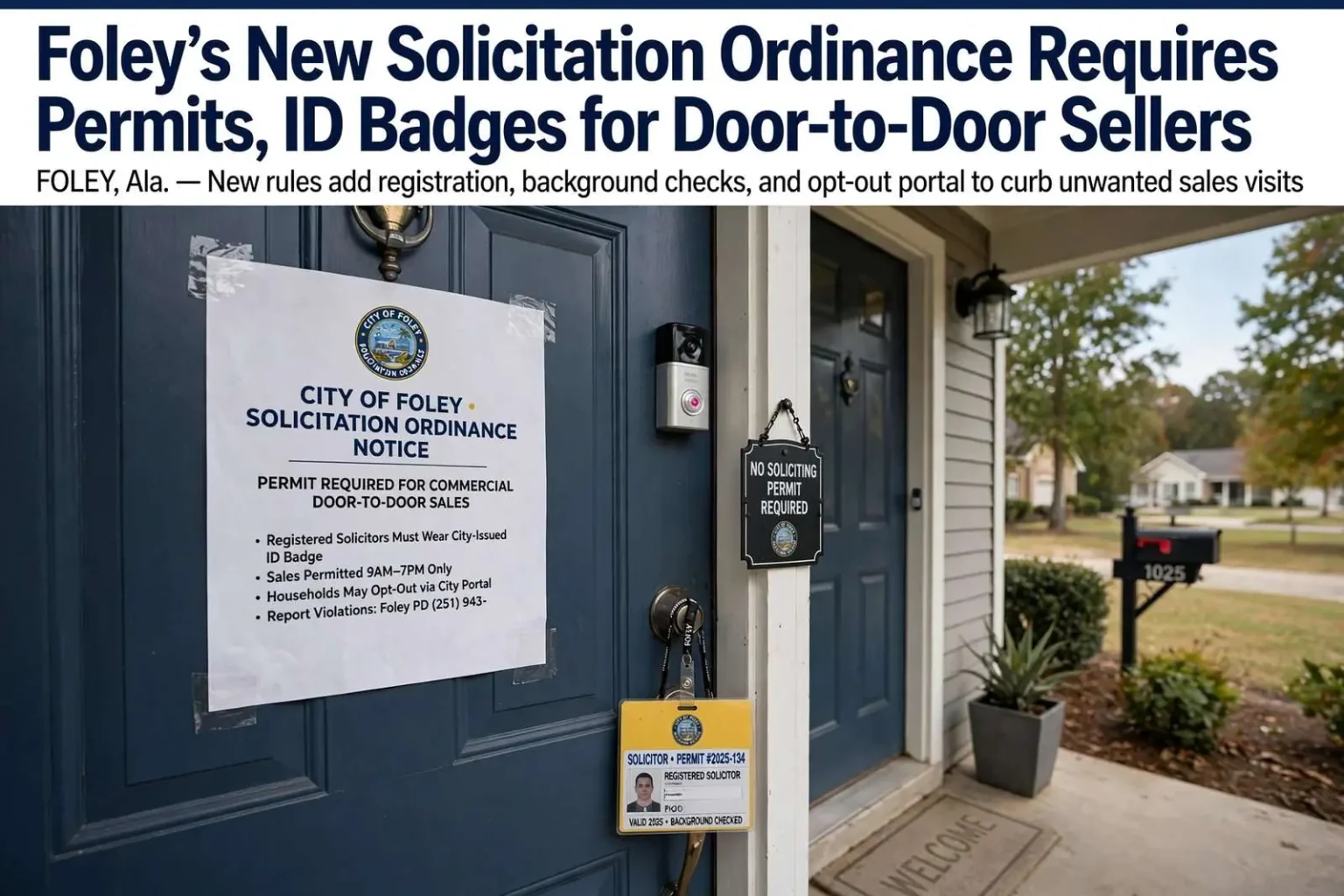
Foley’s New Solicitation Ordinance Requires Permits, ID Badges for Door-to-Door Sellers
The Foley City Council has approved a door-to-door solicitation ordinance requiring permits, background checks and ID badges for commercial solicitors, plus a No Solicitation Registry for residents. The rules take effect Oct. 30.
UPDATE (Oct. 1, 2026): The Foley City Council has given final approval to the door-to-door solicitation ordinance. The new rules take effect Friday, Oct. 30, and include a No Solicitation Registry that lets residents and neighborhoods opt out of commercial solicitation at all times. Details are in the “Final approval” section below.
FOLEY, Ala. — Foley residents and business owners who are tired of sales pitches at the front door may soon have more protection. The Foley City Council has taken up an updated door-to-door solicitation ordinance that tightens the rules for commercial solicitors. It adds permit and registration requirements and gives residents a way to opt out of commercial visits.
The measure amends Ordinance 1097-09 and replaces Section 5-134 of the city’s Code of Ordinances, the part of city code that covers door-to-door commercial solicitation. It was on the council’s agenda for first reading at its meeting on Monday, Sept. 21, at Foley City Hall. The council’s agenda described it as setting out permit, registration, enforcement and business accountability requirements for commercial solicitors.
City officials say the revision is designed to make Foley’s existing rules easier to enforce, spell out clear standards, hold businesses accountable for the people they send out and impose stiffer consequences on solicitors who repeatedly ignore the rules. The ordinance states its purpose as protecting residents from harassment, from deceptive or fraudulent sales practices and from unreasonable intrusions on their privacy at home.
The goal is to curb aggressive sales tactics and give property owners more control over who comes to their door. At the same time, the ordinance protects the rights of charities, political campaigns and religious groups to reach the public.
A familiar frustration
Most people know the feeling. The family has just sat down to dinner, a remote worker is on an important call, or someone is finally enjoying a quiet evening, and the doorbell rings. On the other side of the door is a stranger selling pest control, roofing, solar panels, security systems or some other product or service.
Many homeowners and businesses post “No Soliciting” or “No Trespassing” signs to head off those visits. Too often, those signs are ignored. That leaves residents and business managers feeling interrupted and disregarded on their own property.
The updated Foley rules are meant to address that. They put more responsibility on commercial solicitors and give the city clearer tools for enforcement.
Why city leaders say it is needed
Mayor Ralph Hellmich said city officials have spent several months working on the measure. He noted that many neighborhoods governed by homeowners associations already keep solicitors out through their own covenants and “no soliciting” signs, but plenty of Foley neighborhoods have no such protection. If the council approves the ordinance, the restrictions on commercial soliciting would apply across the entire city.
Hellmich said they want to ensure solicitors are legitimate, as sometimes illegitimate people come to doors causing questions; they want people to feel safe, so they created a system to legitimize solicitation requiring registration.
Councilman Timothy Lower said the proposal grew out of complaints from residents.
Lower said they heard from citizens that people want to feel comfortable in their neighborhoods, and door-to-door solicitation has become a quality-of-life concern, so they’re putting an ordinance in place to protect the community and keep Foley a great place to live.
What commercial solicitors will have to do
Under the city’s updated rules, commercial solicitors who want to go door to door in Foley must meet several requirements before they start. They include:
- A permit: Commercial solicitors must obtain a city permit before soliciting.
- Registration: Solicitors must complete a registration process to get that permit.
- Background checks: Every solicitor must undergo a background check, paid for by the business that employs them.
- A business license: The business doing the soliciting must hold a business license.
- ID badges: Once verified, registered solicitors receive a name badge with identification, which they must wear while working.
- Set hours: Door-to-door solicitation is limited to the hours between 9 a.m. and 7 p.m.
- Business accountability: Solicitors must follow the city’s established business accountability guidelines.
- Enforcement standards: Solicitors must comply with the city’s enforcement standards.
Together, these requirements are intended to make sure the city knows who is knocking on residents’ doors and which business they represent. They also give residents a way to tell whether a solicitor is authorized to be there.
Penalties for breaking the rules
The ordinance carries real consequences for those who ignore it. A permitted solicitor who violates the rules can have his or her badge revoked. Violations are treated as misdemeanors, punishable by a fine of up to $500 and up to 180 days in jail for each offense.
An online opt-out portal
One of the most practical changes for residents is a planned online portal. Under the updated rules, neighborhoods and individual residents will be able to use the portal to opt out of soliciting.
Opt-out lists of this kind work much like the national Do Not Call Registry does for telemarketing. Instead of relying only on a sign in the window, a household or neighborhood can formally tell the city that it does not want commercial solicitors to visit. As adopted, the ordinance calls this list the No Solicitation Registry, and residents can request city “No Soliciting” signs for their property through Foley’s online Citizenserve portal.
Who is exempt
Rules on door-to-door visits have to balance a homeowner’s privacy against constitutional protections for free speech and religious expression. Courts have long held that cities can regulate commercial sales at the door, but that they cannot broadly shut down noncommercial speech.
Foley’s updated ordinance reflects that balance. Charities, politicians and religious groups are exempt from the new solicitation restrictions, and the city has stressed that it recognizes and respects the First Amendment rights of people and organizations engaged in religious, political and charitable speech. That means volunteers raising money for a cause, candidates and campaign workers going door to door before an election, and members of faith groups sharing their message can continue to do so.
The new permit, registration and opt-out rules are aimed at commercial activity: people who come to the door to sell a product or service.
What it means for residents
The updated rules will not stop every knock at the door. They do give Foley residents a stronger set of tools against commercial solicitors who do not respect a property owner’s wishes.
Here are a few practical steps residents can take:
- Ask for identification. Commercial solicitors are required to wear ID badges. If someone selling a product or service cannot show one, residents do not have to engage.
- Use the opt-out portal once it is available. Signing up provides a formal record of a household’s or neighborhood’s wishes.
- Keep posting signs. “No Soliciting” signs remain a clear, visible message to anyone approaching the door.
- Report concerns. Residents who run into a solicitor who appears to be operating without a permit, or who is acting aggressively, can contact the city or the Foley Police Department.
- Do not feel pressured. Residents are never obligated to open the door, make a purchase or sign a contract on the spot.
What it means for businesses
The ordinance also affects companies that use door-to-door sales in Foley. Those businesses will need a city business license, and each salesperson will need to go through the permit and registration process, which includes a background check paid for by the business. Businesses should also expect to be held to the city’s accountability and enforcement standards.
Companies that plan to canvass in Foley should contact the city before sending crews out, so they understand the current requirements and any fees.
A growing city
The update comes as Foley continues to grow at a rapid pace. The south Baldwin County city has added roughly 10,000 residents since the 2020 census, according to U.S. Census Bureau estimates released in May 2026. It grew by nearly 8% between July 2024 and July 2025, which ranked it as the nation’s 14th fastest-growing municipality among those with at least 20,000 residents. Foley is now the second most populous city in Baldwin County.
With more households across the city, the updated rules will apply to a larger number of residents and neighborhoods than ever before.
Final approval: what the adopted ordinance includes
Updated Oct. 1, 2026
The Foley City Council has now approved the ordinance, according to a city news release. The final version keeps the core requirements outlined above: permits, background checks, city-issued ID badges, proof that solicitors represent a legitimate business, and limits on the hours when solicitation is allowed.
Under the adopted rules:
- Applying: Anyone who wants to solicit commercially must complete an application through the city’s Revenue Department, identify the company they work for and undergo a background check at their own expense.
- Licensed employers: Companies that employ or use solicitors must hold a Foley business license.
- Badges and hours: Solicitors must display their city-issued badge at all times while working, and solicitation is permitted only between 9 a.m. and 7 p.m.
- No Solicitation Registry: Residents or entire communities that want to opt out of commercial solicitation at all times can join the registry, and residents can obtain “No Soliciting” signs for their property through the city’s online Citizenserve portal.
- Enforcement: Businesses and solicitors that ignore “No Soliciting” signs can face warnings, citations and revocation of their permits.
The release said Mayor Ralph Hellmich wanted to protect residents’ privacy without restricting solicitors’ free speech.
Hellmich said solicitation has always been an area between freedom of speech and privacy rights, and he commended the staff for working hard to balance the positives and negatives.
What comes next
The new ordinance goes into effect on Friday, Oct. 30. Between now and then, companies that plan to canvass in Foley should contact the Revenue Department to begin the application and background check process, and residents who want to opt out can use the Citizenserve portal on the city’s website to sign up and request a “No Soliciting” sign.
The Foley City Council meets at City Hall, and ordinances and meeting agendas are posted on the city’s website. Residents who have questions about the solicitation rules can contact City Hall.
Related coverage from South AL News
- A Design Manual, a Door-to-Door Ordinance and a Fire Truck for Sale: Foley's Sept. 21 Agenda Is Longer Than It Looks
- Foley Nonprofit Permit Fees Cut Up to 50% Under New City Council Ordinance
- Robertsdale Crowned Grand Champion at Foley's First Gulf Coast Heavy Equipment Roadeo
- Foley Flood Ordinance Would Add 150-Foot Floodway Buffer, Allow Stem Walls in Coastal Zones