Foley Serial Robbery Suspect Set for January Sentencing on Federal Charges
A Foley man who admitted to three armed robberies at local businesses using a toy gun to intimidate employees faces federal sentencing on Jan. 8.
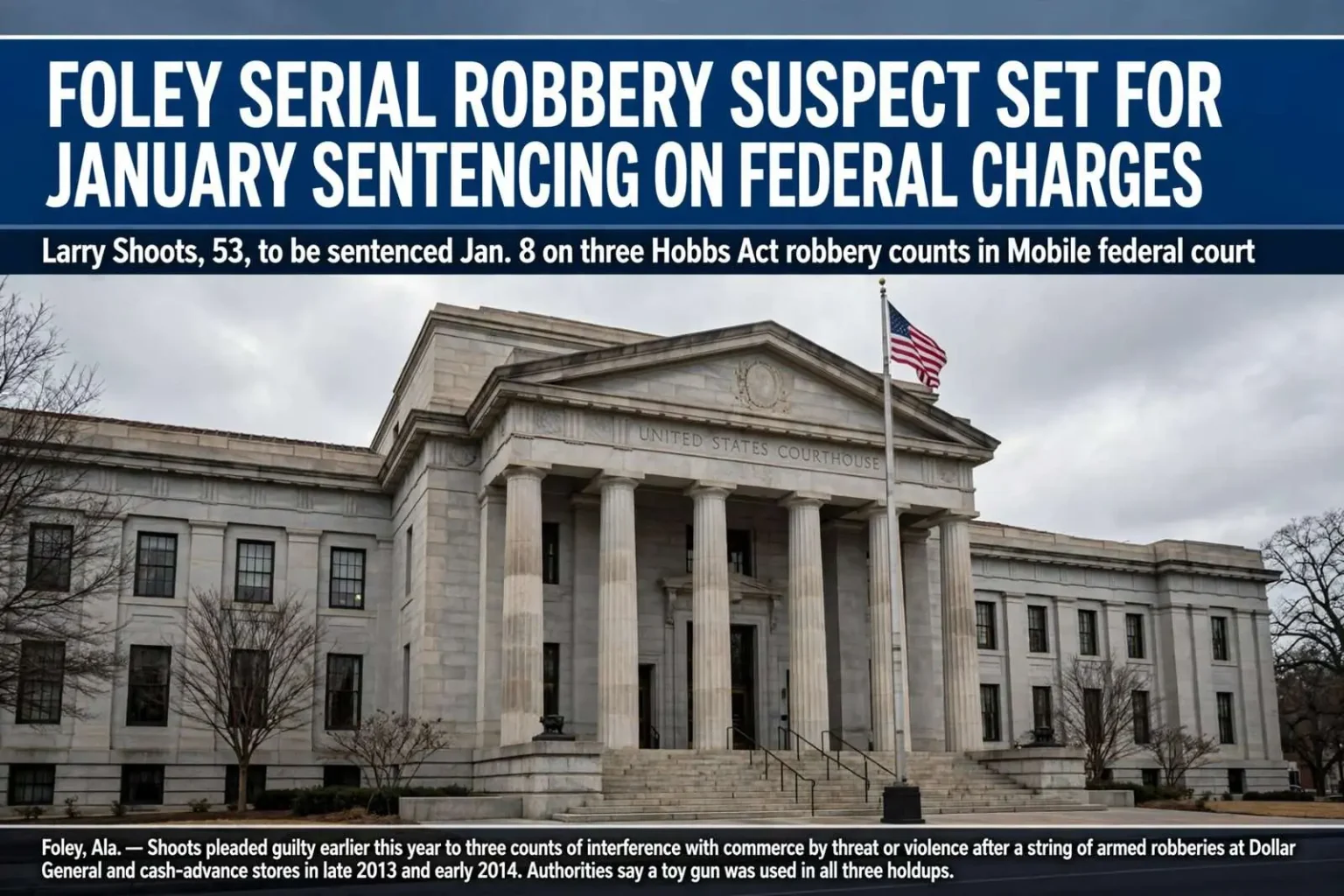
A Foley man who admitted to a string of armed robberies at local businesses is scheduled to learn his fate in federal court early next year, with a sentencing hearing set for Jan. 8.
Larry Shoots, 53, entered a guilty plea earlier this year in federal court in Mobile to three counts of interference with commerce by threat or violence, a charge tied to a series of holdups that rattled Baldwin County business owners in late 2013 and early 2014. Prosecutors say Shoots targeted stores in Foley, using a toy gun to convince employees he was armed and dangerous.
Court records lay out the sequence. The first robbery took place on Dec. 1, 2013, at a Dollar General on Riviera Boulevard, where a man in a black hat and green mask covering half his face took roughly $823 from a cash register and bank bag.
Weeks later, on Feb. 7, an armed robber wearing a black ski mask made off with more than $4,000 from an Approved Cash Advance location on South McKenzie Street. A third robbery followed on Feb. 26 at another Dollar General on North McKenzie Street, where the gunman forced an employee to open a safe before escaping with nearly $800.
The Arrest and the Toy Gun
Foley police arrested Shoots on March 20 after connecting him to the string of holdups. He later admitted using a toy gun during the robberies and told investigators he had disposed of it; the weapon was never recovered.
The toy detail complicates the picture without changing the law. To the employees behind the counters — a Dollar General clerk on a December evening, a loan office worker staring at a masked figure demanding the safe — the weapon read as real, and that is precisely what the law addresses. Federal robbery statutes turn on the threat of violence, not on whether the object in the robber’s hand could fire.
The money trail was modest by federal case standards — roughly $823, more than $4,000 and nearly $800 across three holdups, about $5,600 in all — but dollar amounts are not what carries the sentence in cases like this. The counts themselves and the circumstances of each robbery do the legal work.
Foley police connected Shoots to all three robberies within weeks of the last one, an investigation that stitched together surveillance descriptions from three separate scenes: the black hat and green half-mask in December, the black ski mask in February, and the pattern of discount stores and cash-loan offices along the McKenzie Street corridor.
The Federal Track
Court records indicate other individuals were also taken into custody in connection with the case and are facing separate charges at the state level in Baldwin County, though the federal case against Shoots proceeded on its own track. The split is common in multi-defendant robbery cases: federal prosecutors take the defendants and counts that fit their statutes, while the district attorney pursues state charges against the rest.
The three counts Shoots pleaded guilty to each carry significant federal penalties, and his upcoming sentencing will determine how much time he could spend behind bars.
Federal interference-with-commerce charges are often used in armed robbery cases involving businesses engaged in interstate commerce, giving prosecutors additional leverage beyond state robbery statutes. The statute — known as the Hobbs Act — reaches any robbery that obstructs, delays or affects commerce, and a national retail chain’s store or a cash-advance franchise qualifies with little argument. Federal sentencing, guided by the advisory guidelines and a judge’s weighing of each robbery’s circumstances, tends to produce longer terms than comparable state sentences.
What the Hobbs Act Is and Why It Applies
The charge at the center of Shoots’ plea — interference with commerce by threat or violence — comes from the Hobbs Act, a federal statute passed in 1946 and originally aimed at labor racketeering. Over the decades it has become one of prosecutors’ most versatile tools against robbery, because its commerce element is intentionally broad: any robbery that touches goods or money that have moved across state lines, or a business that engages in interstate commerce, falls within its reach.
In practice, that means nearly every armed robbery of a chain retailer qualifies. A Dollar General store receives its merchandise through interstate commerce; a cash-advance business operates within a national financial network. prosecutors need only connect the robbed business to that flow of commerce — a low bar that federal courts have affirmed repeatedly — and the case moves from state court to the federal system, where the sentencing framework is generally stiffer.
For defendants, the consequences are structural. Federal convictions carry no parole in the way state systems often provide, sentences run day-for-day, and the advisory guidelines assign substantial ranges for robbery counts enhanced by the threat of force. Three counts of Hobbs Act robbery put a sentencing judge working with significant baseline exposure — which is why the Jan. 8 hearing, not the guilty plea, will determine the real outcome of the case.
The Toll on the Businesses
Behind the counts are three workplaces that were changed by what happened in them. A Dollar General clerk confronted by a masked man demanding the register; a cash-advance employee ordered to hand over more than $4,000; a second Dollar General worker forced at gunpoint to open a safe. Robberies of this kind leave lasting effects on the people who experience them, and employers in the affected corridors spent the weeks between holdups reviewing their own procedures — when to open a safe, what to hand over, how to trigger an alarm.
The retail strips where the robberies occurred — Riviera Boulevard and the McKenzie Street corridor in Foley — form the commercial spine of the city, where discount stores, lenders and small shops serve a steady flow of local customers. A serial robber working that geography in a span of three months put every late-shift employee in the area on notice, and the string’s end brought the kind of relief that small-business communities feel when a pattern ends.
Foley police’s March 20 arrest — barely three weeks after the third robbery — closed the pattern quickly by the standards of serial-robbery investigations, where suspects often surface only after CCTV images circulate or a fingerprint matches. Connecting a single suspect to three scenes across three months took witness descriptions, surveillance footage and the kind of canvass work that local departments run when a pattern takes hold in their jurisdiction.
The Sentencing to Come
The Jan. 8 hearing will follow the standard federal sentencing sequence. A presentence report — prepared by probation officers and reviewed by both sides — will lay out Shoots’ history, the circumstances of the offenses and the guideline calculation. Prosecutors and the defense will file their positions, and any victims who choose to appear or submit statements can address the court before the judge imposes sentence.
The judge’s task will be to weigh the guideline range against the factors federal law requires: the nature of the offenses, the history of the defendant, the need for deterrence and protection of the public. Three robbery counts, committed over three months with a weapon presented as real — whatever its actual capabilities — compose a picture that typically supports a substantial term of imprisonment in the federal system.
Shoots’ guilty plea resolves the factual question months before sentencing, sparing the victims the testimony of a trial. The plea also gave investigators his own account: admission of the toy gun, and of its disposal. That the weapon was never recovered leaves its description resting on his word and the employees’ perceptions — one more loose end in a case that otherwise hangs together on surveillance, witnesses and a documented pattern.
What It Means for Foley Businesses
For the business owners along Foley’s retail corridors, the case’s movement to a resolution carries a practical message about how robbery gets punished when it crosses into federal court. The chain store robberies that once might have been resolved in state court now increasingly end in the federal system, where sentences are longer and parole does not soften them — a shift local law enforcement has publicized precisely to deter the next pattern.
The case also illustrates the coordination between Foley police and federal investigators. A municipal department develops the local case — the scenes, the witnesses, the arrest — and the United States Attorney’s office in Mobile takes the prosecution into a system with broader reach. For a city of Foley’s size, the partnership extends the punitive consequence of robbing a local store far beyond what the county courthouse alone could offer.
The other individuals taken into custody in connection with the case will answer to state charges in Baldwin County on their own track, meaning the full account of the holdups — who did what, and who answers for which piece — will continue to emerge in both courtrooms as the year turns.
The Pattern, Summed Up
The series ran from Dec. 1, 2013 to Feb. 26, 2014: two Dollar General stores and an Approved Cash Advance, roughly $5,600 taken, one toy gun presented as real, and one suspect now awaiting a Jan. 8 sentencing in federal court in Mobile. For a span of weeks, that pattern defined the mood of Foley’s commercial strips; the guilty plea and the sentencing date ahead mark its formal end.
What remains for the community is the ordinary aftermath of a robbery case: employees who continue working the same counters, businesses that continue operating the same corridors, and a legal system that will decide, at the January hearing, how many years the three holdups will cost the man who committed them.