Foley Wins Two Main Street Alabama Awards for a $525,000 Streetscape and a Workshop Series That Provided Childcare
Foley Main Street and the City of Foley received Awards of Excellence at Main Street Alabama's 13th annual banquet for the East Jessamine Street Improvement Project and the Downtown Forward: Skills for Success workshop program.
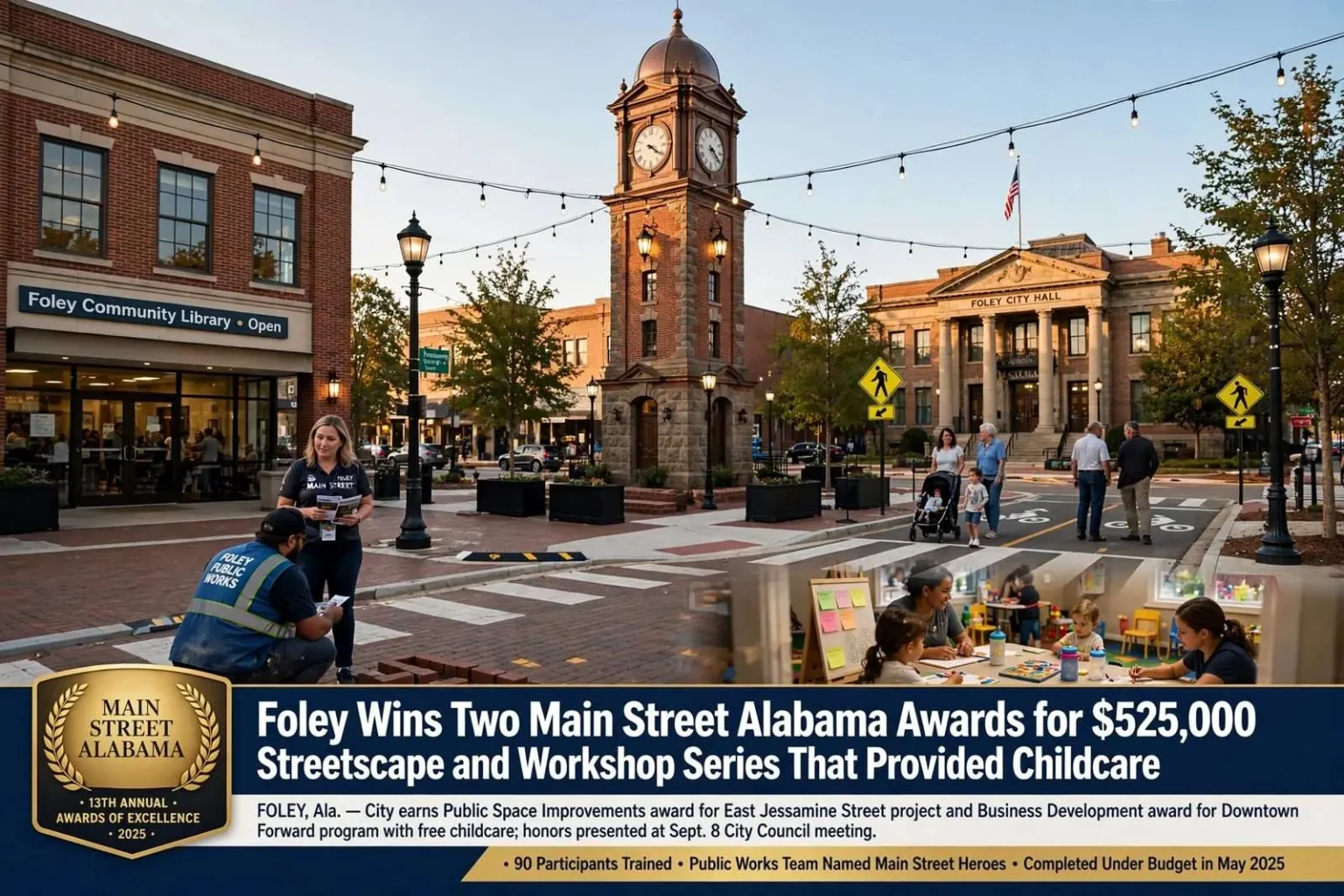
FOLEY, Ala. — Foley Main Street and the City of Foley were recognized at Main Street Alabama’s 13th annual Awards of Excellence Banquet last month in Enterprise, taking honors for downtown public space improvements and business development. The awards were presented locally during the Foley City Council meeting on Sept. 8. The banquet was sponsored by Energy Southeast and the Alabama Black Belt National Heritage Area.
Members of the Foley Public Works Department were also recognized for their contributions to the downtown district.
The East Jessamine Street Project
The City of Foley received the Public Space Improvements Award of Excellence for the East Jessamine Street Improvement Project, which the city describes as the culmination of a 15-year vision to create a more walkable and connected downtown.
The complete-street design transformed East Jessamine Street into a functional corridor and a gateway to the downtown district. Improvements strengthened connections between Foley City Hall, the Foley Community Library and Riviera Utilities, as well as Heritage Park and the pedestrian bridge over Alabama 59.
The project features symmetrical walkways centered on the Centennial Clock Tower, along with decorative lighting and traditional brick elements. Traffic-calming measures were incorporated as well, including mid-block crossings and context-sensitive lane widths intended to improve pedestrian safety.
Completed in May 2025, the project came in under its total budget of $524,965 — even after adjustments made during construction to accommodate downtown businesses.
What ‘Complete Street’ Means in Practice
The term appears frequently in municipal planning and is worth unpacking, because the design philosophy behind it explains the specific choices in this project.
A complete street is designed to serve everyone using it — pedestrians, cyclists, transit riders and drivers — rather than being engineered primarily to move vehicles through at speed. The design elements follow from that premise.
Context-sensitive lane widths means narrower travel lanes than a standard highway cross-section. Narrower lanes reduce driver speed without requiring enforcement, because drivers naturally slow when the roadway feels constrained.
Mid-block crossings acknowledge that people cross where they want to go rather than walking to a corner. Providing a marked, designed crossing at the point where people actually cross is safer than expecting them to detour.
Symmetrical walkways and decorative elements serve a function beyond appearance. A street that feels like a place people belong is one people walk in, and pedestrian activity is what makes downtown retail viable.
The connection points the project strengthened — city hall, the library, the utility offices, a park and a pedestrian bridge over a major highway — are the destinations that generate walking trips downtown. Linking them is what turns a set of buildings into a district.
The budget detail is also worth noting. A public works project completed under budget after mid-construction changes to accommodate businesses reflects both planning discipline and a decision to absorb inconvenience on the city’s side rather than on the merchants’.
Downtown Forward: Skills for Success
Foley Main Street received the Business Development Award of Excellence for its Downtown Forward: Skills for Success program.
The program consisted of three workshops led by Auburn University business faculty and staff, providing downtown Foley businesses and their employees with small-group training designed to strengthen workplace and leadership skills. A total of 90 participants attended.
The workshops focused on soft skills contributing to professional growth, stronger customer relationships and improved business performance.
What distinguishes the program is less its content than its removal of the obstacles that usually prevent downtown employees from attending anything.
Each workshop was offered twice, once in the morning and once in the evening, to accommodate different shifts. Through a partnership with First Baptist Church of Foley, childcare was provided. Downtown restaurants supplied breakfast and dinner for participants.
Those three provisions address the actual reasons hourly retail and restaurant employees do not attend professional development: they are working during the session, they cannot arrange childcare, or attending costs them a meal and time they cannot spare. A program that eliminates all three is a different proposition than one that simply offers training.
Attendees received a copy of Drew Dudley’s This Is Day One: A Practical Guide to Leadership That Matters, which frames leadership as a daily practice rather than a function of formal position — a fitting choice for an audience made up largely of people who do not hold management titles.
Dudley’s “Leading with Lollipops” concept holds that people may not control what they have to accomplish on a given day, but they are always in control of who they are.
“The night was a wonderful reminder of why this work matters,” said Main Street Alabama President and State Coordinator Mary Helmer Wirth. “It is an honor for me to present the awards and seeing the pride each community has in its Main Street district was truly inspiring. Our local Main Street programs are doing meaningful work across Alabama, and the Main Street Four-Point Approach continues to help communities build on what makes them special while preserving the places that tell their story.”
Public Works Named Main Street Heroes
Local Main Street programs also selected Main Street Heroes for outstanding contributions to their communities, recognized during the Toast to Heroes Reception sponsored by Regions Bank ahead of the awards banquet.
Foley Main Street selected Public Works Director Darrell Russell and the Foley Public Works team.
The department partners with Foley Main Street to turn ideas and concepts into completed projects — the practical work of installation, maintenance and event setup that downtown programming depends on and that rarely receives credit.
“What truly sets the Foley Public Works team apart is not just their workmanship, but their character,” Foley Main Street President Wes Abrams said. “Their positive attitude makes them a joy to work with for business owners as well as Foley Main Street. By combining pride with a genuine commitment to public service, the City of Foley Public Works team has earned our Community Leader Award.”
Alabama State Rep. Frances Holk-Jones presented two Alabama House of Representatives resolutions recognizing Russell and the Public Works Department for the Main Street Hero honor, and Foley Main Street for its national accreditation.
The Main Street Four-Point Approach
Wirth’s reference to the Four-Point Approach describes the framework Main Street programs operate under nationally, and it explains why the two Foley awards fit together.
The approach organizes downtown revitalization around four areas: design, covering the physical environment; economic vitality, covering business development and investment; promotion, covering marketing and events; and organization, covering partnerships and volunteer capacity.
The premise is that none of the four works alone. Beautiful streetscapes without viable businesses produce an attractive empty district. Strong businesses in a deteriorating physical environment struggle to draw customers. Foley’s two awards — one for a streetscape project, one for business capacity building — land in two different points of that framework.
National accreditation, which Holk-Jones’s resolution recognized, requires a program to meet standards across all four areas and to demonstrate measurable results.
About the Organizations
Main Street Alabama is a nonprofit that promotes public-private partnerships, community engagement and strategies designed to create jobs, encourage investment, attract visitors and support growth in core commercial districts, building on the history, culture and distinctive attributes of communities. It has 36 designated and 34 network communities across the state.
Foley Main Street is a nonprofit dedicated to economic vitality, historic preservation and community development in Downtown Foley, working through partnerships, events and business-support initiatives.