

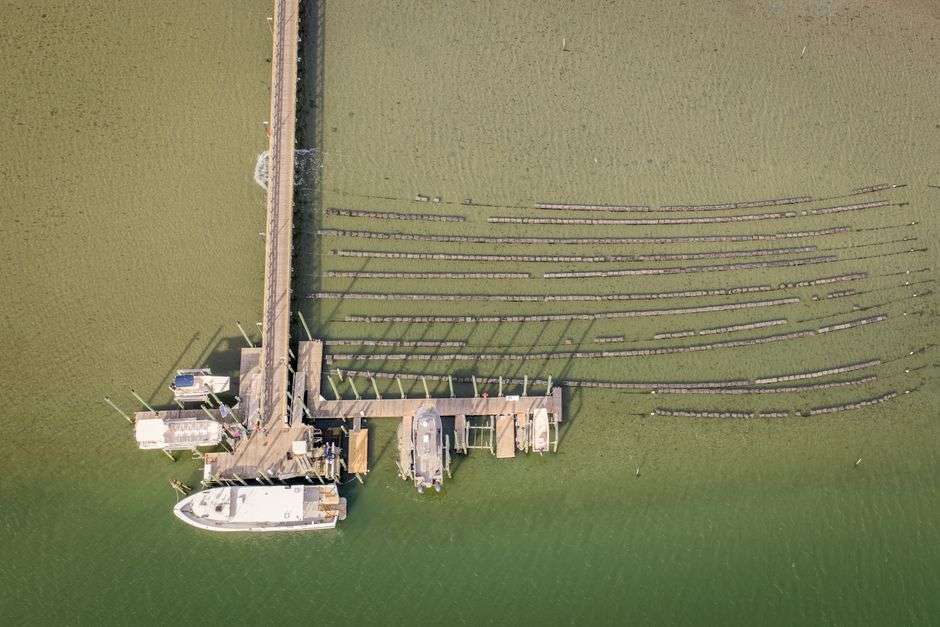
Beneath the docks and piers of coastal Alabama, a quiet water-treatment operation has been growing one mini reef at a time — and it started with a teenager who just wanted to catch a fish. The Eagle Reef Project, born as John Shell’s Eagle Scout service project, has grown from a single ambitious high schooler’s goal into a partnership-backed initiative spanning Mobile and Baldwin counties, with local governments, a university, and an environmental coalition now helping to scale it up.
The project stepped into the public spotlight on July 18, 2023, when supporters gathered at Julep Point at the Grand Hotel in Point Clear to announce the next phase: an effort to deploy 1,000 of the man-made mini reefs under piers, docks, and wharves across Mobile and Baldwin counties, installed with help from homeowners, marinas, and restaurants.
How one fishing trip became a project
John Shell grew up on the water around Mobile, Gulf Shores, and Soldiers Creek, fishing and boating like generations of coastal kids before him. But by age 17 — a senior at St. Paul’s Episcopal School in Mobile and a member of Troop 147 — he had noticed something wrong. A fishing trip with friends came up empty, and the fish populations he had grown up around seemed to be thinning. He decided to do something about it.
Shell’s research led him to Ocean Habitats, a Florida nonprofit founded by marine biologist David Wolff that manufactures preassembled “mini reefs” designed to hang beneath private docks. The structures are compact — a little more than two cubic feet — and are built from durable polypropylene panels, tubes, rope, and floats. Tied between four pilings under a dock or wharf, they float up and down with the tide, suspended above the bay floor and out of sight.
What happens next is the whole point. Within months of installation, the reefs become real estate for filter feeders — oysters, barnacles, sea squirts, and mussels — which colonize the latticework and begin straining algae and particles out of the water. An adult oyster can filter up to fifty gallons a day on its own. The settled reefs, in turn, shelter small fish, shrimp, and crabs, which attract the game fish anglers care about. Shell’s stated aim was simple and ambitious at once: everyone who comes to coastal Alabama, resident or tourist, should be able to experience catching a fish.
He originally set out to place fifty reefs. Instead, he raised more than $52,000 in a single summer and had installed 175 reefs by the time of the July 2023 announcement — most of them purchased by private waterfront homeowners and put in place by Shell and his Scouting friends. He earned his Eagle Scout badge along the way, and then kept going.
Why the bay needed the help
The project’s ambitions were regional from the start. Shell framed the effort as a complete filtering system for coastal waters stretching from Dauphin Island to Bayou La Batre, on both sides of Mobile Bay, out to the mouths of the lower rivers that feed it, and eastward along the Intracoastal Waterway to Wolf Bay, Perdido Bay, Ono Island, and Little Lagoon as far as Innerarity Point, Florida. If a seventeen-year-old could raise tens of thousands of dollars in a few months, he argued, the business and waterfront communities of the coast could accomplish far more if they got engaged.
The reefs address a genuine deficit. On the Alabama coast, oyster reefs have been depleted by erosion and sedimentation, drought, predation, and harvesting pressure, and the loss of natural oyster and grass beds has rippled through the food chain — fewer filter feeders means murkier water and fewer fish. Oysters also strip out sediment and nitrogen, either consuming pollutants or binding them into small packets that settle harmlessly on the bottom.
The arithmetic of filtration is what makes the project compelling. Project backers have estimated that 1,000 deployed mini reefs would filter on the order of ten to eleven billion gallons of water annually and help facilitate as many as 500,000 new fish and crabs per year in coastal waters. A single reef, once fully loaded with oysters and barnacles, has been credited with filtering millions of gallons a year.
The partners who scaled it up
The July 2023 announcement formalized a coalition. The Eagle Reef Project joined forces with Partners for Environmental Progress (PEP) — a Gulf Coast organization formed in 2000 whose corporate partners pledge to science-based, environmentally sustainable practices — and the University of South Alabama’s Stokes School of Marine and Environmental Sciences, with the Alabama Department of Conservation and Natural Resources and the Marine Resources Department also at the table.
PEP announced the creation of its PEP Foundation to raise funds for projects like the reef build-out, and Tom Bramlette spoke for the organization at the press conference. Chris Blankenship, representing Governor Kay Ivey, emphasized the state’s focus on water quality. “We need everyone pulling together to ensure that we can improve and sustain our ecosystems and the production of seafood and the natural processes that clean our waters and promote healthy habitat,” he said.
For the university, then-president Joe Bonner framed the project as a model of cooperation. “Our Stokes School of Marine and Environmental Science has a long history of being the flagship institution in coastal sciences,” he said, noting the school’s ties to the Dauphin Island Sea Lab and its work on restoring marine populations. South Alabama committed to identifying deployment locations, stocking and maintaining the reefs, monitoring them, and testing the surrounding waters.
Fairhope signs on — and the awards follow
The project’s momentum carried it well past its founding summer. In December 2023, PEP, the Eagle Reef team, and the City of Fairhope installed fifty preassembled reefs along coastal waters in a single week — fourteen at city-owned locations and thirty-six under private wharves along Mobile Bay, Dog River, and the Perdido Bay system. Fairhope’s mayor at the time, Sherry Sullivan, championed the city’s adoption of the project after seeing Shell’s presentation at the Grand Hotel. City officials described the educational value alongside the ecological one: teaching younger residents what reefs and oysters do, and why cleaner water is worth protecting.
Recognition followed. In June 2024, Shell — by then a St. Paul’s graduate headed to Dartmouth College — received the National Eagle Scout Award for the project, along with an Exceptional Citizenship Award from the city of Mobile. By that point the project he started had helped deploy well over one hundred reefs, and the University of South Alabama had taken up its continued expansion.
A growing network under the docks
By 2026, the reef network was still spreading. PEP, now led by executive director Jennifer Denson, has continued rallying its corporate membership to fund and install reefs, and new municipal partners — including the city of Foley — have come aboard to place them at public locations. Denson has noted that anglers are noticing the difference at public fishing piers, and she has called on other local governments to join in, pointing homeowners to the organization’s website to get involved.
Researchers and city environmental staff continue monitoring the reefs and the waters around them to document how the structures affect biodiversity and water quality. PEP’s long-term ambition is striking: a long-term goal of tens of thousands of reefs across coastal Alabama, which — at full population — would collectively filter billions of gallons of bay and gulf water every year.
The Eagle Reef approach fits into a broader wave of oyster restoration work along the coast. In the summer of 2026, the U.S. Army Corps of Engineers’ research arm deployed 3D-printed oyster reefs made from dredged sediment into Mobile Bay near Coden — nature-inspired structures that quickly began attracting barnacles and oysters while doubling as wave breaks that reduce erosion. The Corps has called the work part of a national engineering effort around nature-based coastal defense, a sign that the humble oyster reef has become serious business for coastal scientists and engineers alike. Homegrown efforts like Eagle Reef and federally backed research projects are, in effect, working the same problem from different directions: rebuilding the filter feeders that keep coastal water clean.
The reefs themselves are practical by design. They come preassembled, cost a few hundred dollars each when purchased in bulk, weigh roughly two hundred pounds once loaded with oysters, and float above the sea floor where they cannot be smothered by sediment. If a site needs a head start, the reefs can be seeded with oysters to reestablish populations in a given stretch of water. And if a dock changes hands, the reef keeps working — no electricity, no maintenance, just tide and time.
What began as one seventeen-year-old’s answer to an empty stringer has become a durable piece of coastal Alabama’s environmental infrastructure — a project that turned private docks into working habitat, a Scout badge into a regional coalition, and cleaner water into a shared civic project. The bay did the rest.