

Some Eagle Scout projects are a bench. John Shell’s was Mobile Bay.
The St. Paul’s Episcopal School junior from Mobile devised a plan to install a network of small, floating oyster reef cages under wharves and piers across the entire coastal watershed — from Dauphin Island to Bayou La Batre, on both sides of Mobile Bay, down the mouths of the lower rivers, across the Intracoastal Waterway to Wolf Bay, Perdido Bay, Ono Island and Little Lagoon as far as Innerarity Point, Florida. The goal was water filtration at scale: cleaner water, and with it, the return of the oyster, crab and fish populations — and eventually the grass beds — that once defined the bay.
Simple Science, Suspended Above the Bottom
The reefs weren’t Shell’s invention. The cages — compact, proven designs built and installed by Ocean Habitat Inc., a Florida company south of Gainesville run by David Wolffe — had already delivered striking results in murky inlets and canals in Florida: colonized by oysters and barnacles within a short time, they cleared the water, which drew small fish, which drew game fish. Shell’s contribution was the research, the coordination, and the audacity of the deployment plan.
The design detail that matters most is elevation. Because each reef floats above the sea floor, suspended between four pilings, it largely escapes the oyster drills — the predatory snails that can wipe out bottom-planted oyster beds. Installation takes about ten minutes. Once colonized, a mature reef filters an estimated 11 million gallons of water annually.
The Filter Feeder That Runs the Bay
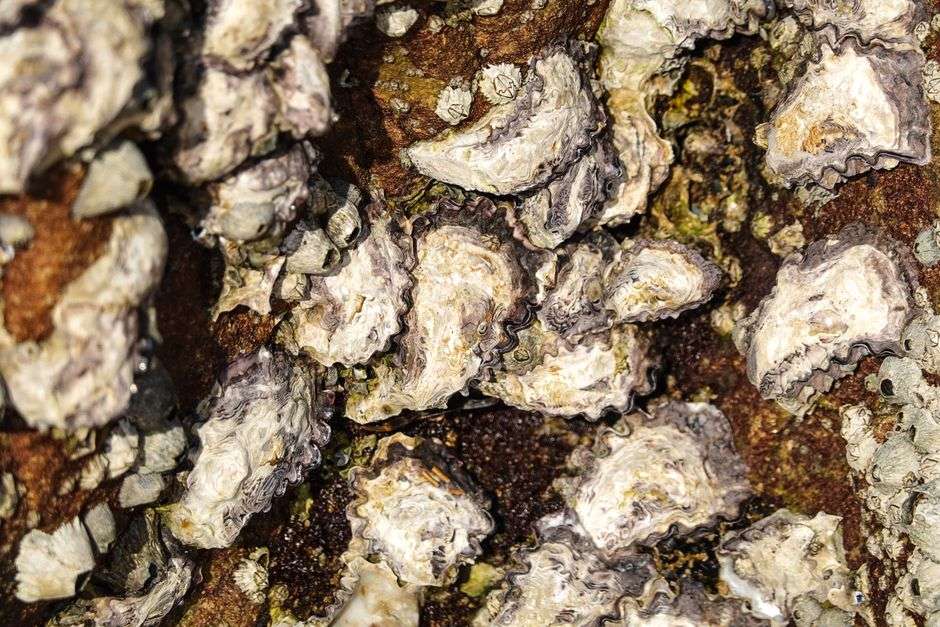
The arithmetic behind the project is the same one that explains why oysters matter. An adult oyster can filter up to 50 gallons of water a day, consuming sediment and nitrogen — the pollutants that cloud coastal bays — or binding them into small packets that settle harmlessly to the bottom. A mature female oyster releases around 100 million eggs a year; the larvae drift until they find structure, attach as spat, and the cycle compounds.
Each reef can be “baited” with four to six mature oysters to jump-start colonization. Then the reef does what oyster reefs have always done: become the seedbed for the next generation.
A Project That Outgrew Its Scout
Shell’s original target was 100 reefs. He had commitments for 200 before manufacturing caught up — supply chain delays left a waiting list of waterfront property owners wanting reefs on their own piers, at $300 to $400 per reef purchased in bulk, each weighing about 200 pounds once loaded with colonizing oysters.
He built the project with serious adult supervision, too. He consulted Dr. Sean Powers, the fisheries ecology specialist at the Dauphin Island Sea Lab; he looped in Chris Blankenship, Commissioner of the Alabama Department of Conservation and Natural Resources, and Colonel Scott Bannon, director of the Marine Resources Division, who were designated as the project’s institutional beneficiaries once Shell’s Scout work concluded. His father, Jeb Shell, CFO at Hargrove Engineers & Constructors in Mobile, deliberately stayed out of his son’s Eagle project — while making sure it would live on.
The momentum attracted allies and coverage: by the following summer, a press conference at Julep Point at the Grand Hotel announced a major expansion of what had become known as the Eagle Reef Project, with a scaled plan to install reefs across the coastal area’s publicly accessible waterfronts.
The Numbers That Sold It
Shell’s own summary remains the best pitch the project has. “If a seventeen-year-old kid can raise $60,000 in three months for this effort, imagine what the business and waterfront communities can do if they get engaged!” Per the reef’s developer, 1,000 installed reefs would filter 11 billion gallons of water a year and facilitate roughly 500,000 new fish and crabs annually.
The long-term vision — businesses, nonprofits and individuals funding 800 more reefs, with commemorative plaques at waterfront restaurants honoring loved ones who cherished the coast — turns water quality into something a community can actually purchase, one pier at a time. The first reef went into the water at Daphne, with up to 30 more slated for installation along Scenic 98.
The lesson outlasts the Scout badge: the technology to begin restoring an estuary the size of Mobile Bay is cheap, proven and small enough to fit under a private dock. What it needs is organizers — ideally, the kind who treat a school assignment like a bay-wide campaign.