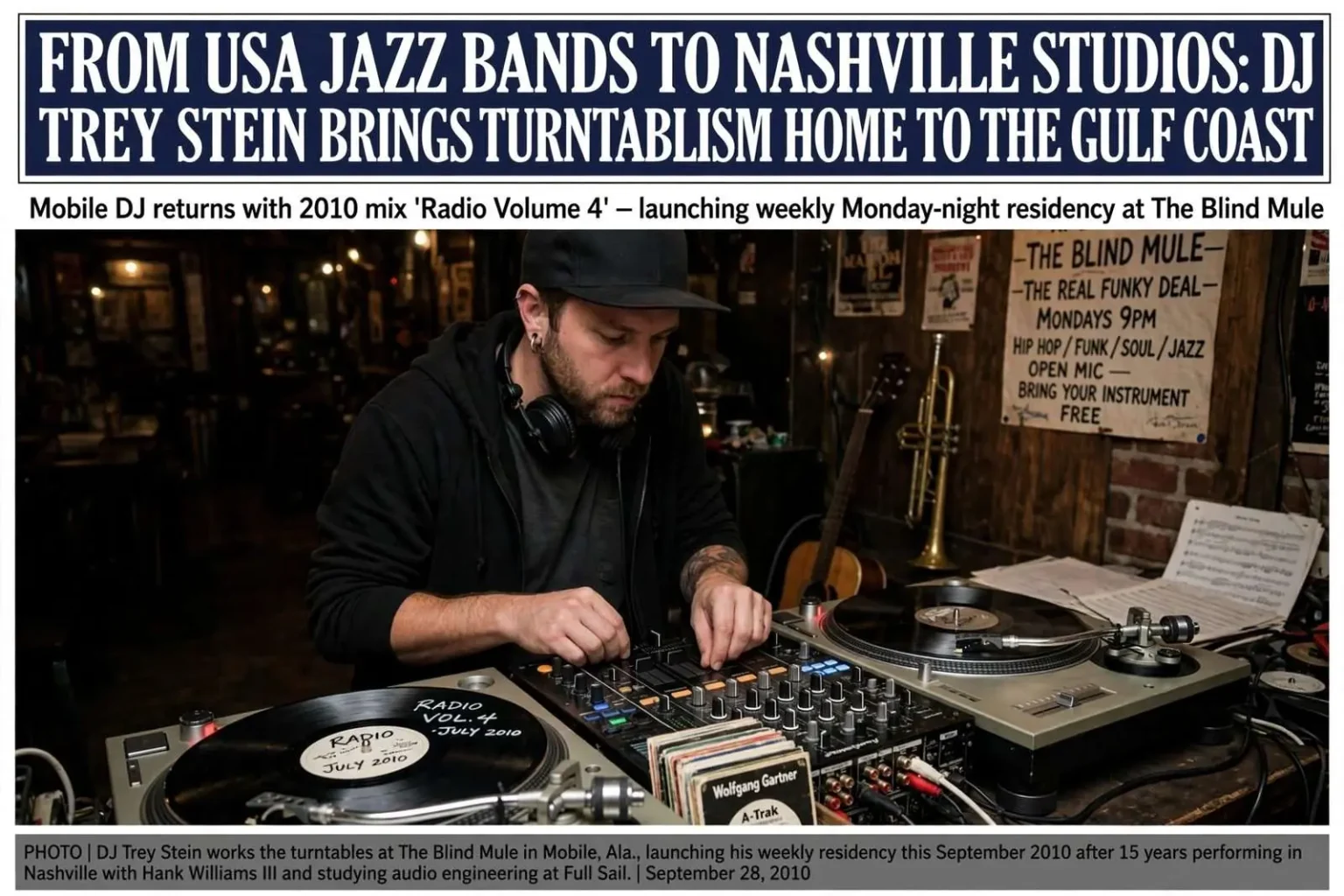
In August 2010, Mobile-area DJ Trey Stein released Radio Volume 4 online — a July mix the turntablist described as a crunchy blend of dirty oscillators, bit-crushed textures and raw vocals, featuring artists such as A-Trak, Adam Freeland, Wolfgang Gartner and Sidney Samson. The mix put a Mobile-trained musician’s ears on material circulating through the international electronic scene, and it arrived with a biography most hometown listeners had never heard.
A Musician’s Path to the Decks
Stein’s route to DJing ran through formal music training. He got his first record player around age five, played guitar and trumpet through high school, and majored in jazz composition and improvisation at the University of South Alabama, performing in the school’s Jazz Ensemble under director Mike Caldwell. The USA jazz program has long functioned as a training ground for Gulf Coast musicians, teaching theory, arranging and the improvisational reflexes that translate directly to the turntablist’s art of reading a room and building a set in real time.
Moving to Nashville in the late 1990s, he landed a DJ slot with Hank Williams III — touring nationally, including two weeks with the Melvins and a run on the Vans Warped Tour. The pairing of a Mobile jazz student with the outlaw-country heir’s band placed Stein on stages and festival grounds across the country, an education in crowd work that no studio course can teach.
He later studied audio engineering at Full Sail, interned at Nashville’s Black Bird Studio, and assisted multi-Grammy winner Bob Bullock at Warm Front Studio, where clients included Charlie Daniels and Randy Jackson. The engineering resume rounded out the musician’s toolkit: a DJ who understands signal flow, microphone technique and the discipline of a professional recording session approaches his own mixes — and his live rig — with a producer’s standards.
Back to the Gulf Coast
After roughly fifteen years in Tennessee, Stein returned to the Gulf Coast with a stated mission: injecting turntablism into the local music scene and proving there is an art to the craft beyond what commercial radio plays. Turntablism — the practice of treating turntables and mixers as instruments, with scratching, beat juggling and live remixing — occupies a niche between hip hop culture and experimental music, and Stein argued that Mobile audiences deserved to hear it practiced seriously.
Radio Volume 4 was both a calling card and proof of concept — a Mobile-trained musician bringing national-stage experience back to hometown audiences. The mix’s featured artists tell the story of the moment: A-Trak, the world-champion turntablist bridging DJ culture and electronic dance music; Adam Freeland’s breakbeat-inflected electro; Wolfgang Gartner’s maximalist house; and Sidney Samson’s Dutch club sound. Stein’s blend of those currents with the raw textures he described positioned the mix at the crossroads where DJ culture and electronic production were converging in 2010.
Update (Sept. 28, 2010): Stein’s calendar filled out quickly that fall. He launched a weekly Monday-night residency at The Blind Mule called “The Real Funky Deal” — an open mic dedicated to hip hop, funk, soul and jazz, with an open invitation for musicians to bring instruments and sit in. The Blind Mule, a bar and music room in Mobile’s Lower Dauphin district, gave the night a home in the blocks where the city’s original-music scene was concentrating.
He recalled similar nights in Nashville that grew into ten-piece funk outfits with MCs flowing over the top — proof that an open-format residency can become a full band experiment if the city’s players commit to it. The model relies on the kind of trained musicians Mobile produces steadily: university jazz programs, church organists, high school band directors and the working players who staff the Gulf Coast’s club and casino circuits all feed musicians into a room where a house DJ sets the key and tempo and lets the floor decide what happens.
He was also tapped to open for Bassnectar when the national electronic act rolled through the Soul Kitchen, a booking he framed as a chance to raise the bar for Mobile DJs. “When people from out of town play here they’ll want to bring their A game because they’ll have respect for Mobile’s DJs,” he said, adding that reading a crowd — filtering requests on the fly and protecting the dance floor — remained the core of his craft.
What Turntablism Brings to a Gulf Coast Scene
The distinction Stein draws is between a DJ who plays records and a turntablist who performs on them. In the turntablist tradition, the deck is an instrument: the scratch is a percussion part, the loop is an arrangement choice, and the mixer’s faders are played like keys. The lineage runs from hip hop’s Bronx beginnings through the battle circuits of the 1990s to the festival stages where A-Trak and his peers now headline — a tradition Stein carried into a Gulf Coast scene better known for guitar bands, brass ensembles and songwriter nights.
Mobile’s musical identity has always absorbed outside currents — Mardi Gras brass, the blues and country of the coastal South, the electronic wash that follows every national tour through the Soul Kitchen and the Dauphin Street rooms. A residency like “The Real Funky Deal” is where those currents get localized: a Monday night with no cover-band repertoire, where funk basslines meet samplers and a drummer who grew up on jazz band charts can trade fours with a DJ cutting a break.
The Bassnectar date at the Soul Kitchen carried its own significance. National electronic tours of the era were choosing Gulf Coast rooms more often, and the question of who opens them — and how well — shaped whether the market could sustain more such bookings. Stein’s framing of the slot as a statement about Mobile DJs’ professionalism reflects the promoter’s arithmetic: local openers who hold a room make the next national booking possible.
The Blend That Defines Radio Volume 4
For listeners, the July mix is the clearest statement of Stein’s sensibility. “Dirty oscillators” and “bit-crushed textures” describe a production aesthetic that intentionally roughs up sound — the artifacts of degraded digital audio used as musical texture rather than noise to be polished away. Paired with “raw vocals,” the mix sits in the strain of electronic music that keeps a human voice at the center while the machinery around it gets heavier.
That sensibility is the product of the whole path described above: a five-year-old with a record player, a jazz composition major arranging in real time, a national-tour DJ reading crowds, and a studio engineer trained in Nashville’s session rooms. Radio Volume 4 compressed all of it into one document, released from Mobile, for the scene he came home to build.
Nashville Lessons Carried Home
The fifteen years Stein spent in Nashville covered a period when that city was transforming from country music’s capital into a broader recording hub, and the rooms he passed through tell the story. Black Bird Studio, where he interned, was among the facilities where Nashville’s expanding rock and pop work got done, and assisting Bob Bullock — a multi-Grammy winner whose credits span decades of Nashville sessions — at Warm Front Studio put Stein in the room with clients like Charlie Daniels and Randy Jackson. Studio work of that kind teaches pacing, preparedness and the humility to make the artist’s record rather than your own, habits that carry directly into DJ booth discipline.
The touring years with Hank Williams III served a different education. Playing to audiences across the country — including the metal-leaning crowds that came with the Melvins dates and the punk-rock melting pot of the Vans Warped Tour — means learning to hold a crowd that did not come to hear you, and to win it anyway. Few formal music programs teach that; every working DJ knows it is the whole job.
Back on the Gulf Coast, that combination — conservatory training, studio professionalism and national touring — made Stein an unusual local act. A Mobile DJ who had opened rooms in Tennessee could pitch venues and promoters on something the market had rarely offered: turntablism as a headliner skill rather than a between-sets function.
Mobile’s Venue Landscape in 2010
The rooms Stein worked in 2010 were the same ones shaping the city’s broader original-music revival. The Blind Mule anchored the Lower Dauphin block with a bar-and-music-room format friendly to weeknight residencies — the kind of booking a national touring act never plays but a local scene cannot live without. The Soul Kitchen, meanwhile, handled the national touring circuit, bringing through the electronic, indie and hip hop acts that filled the gap between what local bands offered and what regional audiences traveled to see.
Monday nights are where scenes test themselves. Friday and Saturday belong to cover bands and touring bookings; Monday is cheap rent, empty calendars and creative risk. A weekly open mic devoted to hip hop, funk, soul and jazz — with instruments welcome and a DJ in charge of the foundation — is exactly the kind of low-stakes, high-skill incubator that turns a city’s scattered musicians into a working community. Stein’s memory of Nashville nights that grew into ten-piece funk outfits with MCs on top describes what such a residency can become when it works.
The fall of 2010 offered no guarantee that any of it would last — residencies come and go, national tours pass through once — but the pieces Stein assembled that season, from the online mix to the Monday-night room to the Bassnectar slot, sketched a blueprint for how a hometown musician with national experience could raise the ceiling for the scene he returned to. Reading the crowd, filtering the requests and protecting the dance floor, as he put it, remained the craft’s core; everything else was the evidence he brought to prove it.