Gary Tanner Banked $50,000 at a Mobile Rally as an Old Rival Warmed Up for a Rematch
State Sen. Gary Tanner raised more than $50,000 at a Mobile rally with two football names as hosts, while former Sen. George Callahan and Councilman Ben Brooks eyed the Republican side of District 35.
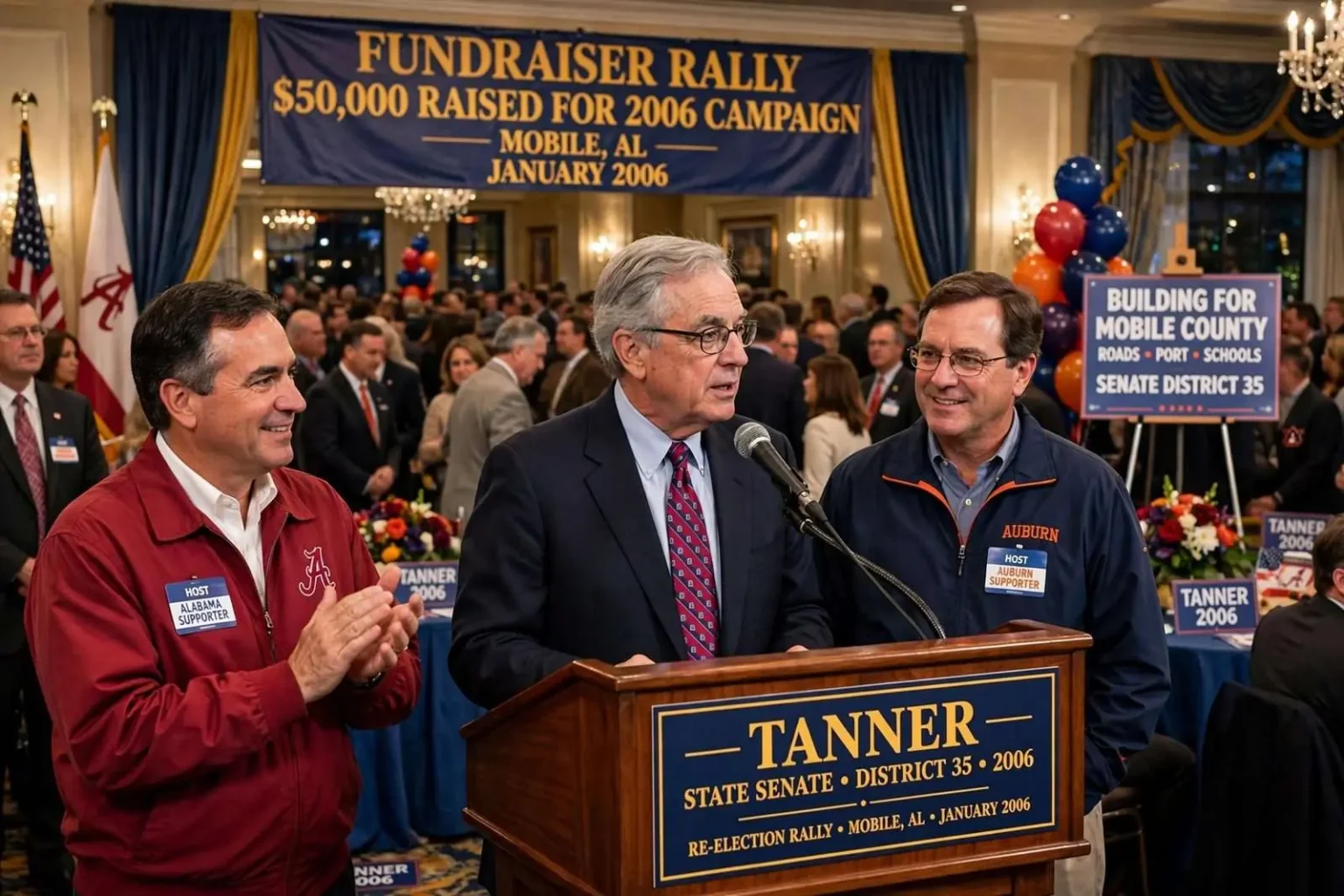
MOBILE — State Sen. Gary Tanner served notice that his re-election campaign in Senate District 35 would not be a modest undertaking, raising more than $50,000 at a rally in Mobile, according to his campaign. The event blended two of Alabama’s most reliable social fuels — college football and politics — and sent an unmistakable message to potential challengers months before qualifying even opened for the 2006 election cycle.
The celebrity hosts for the evening were drawn from the only rivalry that reliably fills a room in Alabama. Former University of Alabama quarterback Scott Hunter and one-time Auburn running back Willie Huntley, now a Mobile attorney, lent their names to the fundraiser, pairing legends of the Iron Bowl on the same side for a night. In a state where alumni allegiances run generation-deep, the pairing was more than decoration; it gave supporters of both schools a reason to write a check to the same Democrat.
Nearly 200 people attended, among them Mobile Mayor Sam Jones, whose own election a few months earlier had been engineered by several of the same political hands now working for Tanner. The overlap was no accident. In Mobile County politics, consultants and fundraisers move between campaigns, and a mayor appearing at a state senator’s rally signals that the city’s executive and the legislative delegation are on workable terms heading into an election year.
A Team with a Track Record
Tanner’s re-election operation reunited the consultants who had carried him to victory in 2002 and who had more recently run Jones’ mayoral campaign. Rick Heartsill of Direct Communications in Birmingham handled the media side; Tom Oppel of Message Audience and Presentation in Austin, Texas, brought national-caliber strategy work; and the Cunningham Harris fundraising group managed the money operation. Reassembling a proven team spared the campaign the startup costs — in time, money and mistakes — of building from scratch.
It also signaled seriousness to anyone reading the early signs. Senate races in Alabama are won on organization as much as ideology: sign crews, walk books, church announcements and absentee-ballot programs all take months to build. A campaign that starts with experienced professionals and a five-figure bank account in the winter before the election has a structural head start that is difficult to overcome.
A Democrat, Tanner had previously served as a Mobile County commissioner before moving to the state Senate — a familiar career path in a county where the commission has long been a proving ground for statewide and legislative ambition. Countywide service builds a donor base and name recognition across municipal lines, advantages that district-only politicians spend years trying to replicate. Tanner, 60, had turned that foundation into a Senate career representing a Mobile County district, and was positioning himself for another term as the 2006 cycle approached.
The Rematch That Would Not Go Away
Tanner faced the prospect of a familiar opponent in November: former state Sen. George Callahan, who had begun working the comeback trail within days of his 2002 loss to Tanner. Losing candidates in Alabama legislative races rarely vanish; they keep attending civic club meetings, keep their signs in storage, and keep a list of everyone who helped last time. Callahan had done all of it, and the expectation around the district was that a rematch was coming.
The 2002 contest had been among the more expensive and hard-fought legislative races on the Gulf Coast, and neither man had forgotten it. Hard-fought races leave residue — hard feelings among supporters, grievances about attacks ads, and a voters’ list on both sides that knows exactly where the undecided households are. A second meeting between the same two candidates tends to be less about introduction and more about settling accounts.
But Callahan would not necessarily have a clear path to a rematch. Mobile City Councilman Ben Brooks, according to reliable sources, was giving serious thought to a run for the state Senate seat himself — though a race for a circuit judgeship remained a possibility for him as well. Brooks had won election to the council by unseating an incumbent, so the political class took his ambitions seriously in either direction.
The distinction mattered enormously to Callahan. A contested Republican primary would force Callahan to spend money in the spring that he would rather have saved for the fall, and it would give Tanner months of quiet while his potential opponents bled each other. Incumbents of both parties understand the arithmetic; a divisive opposition primary is worth tens of thousands of dollars to the man or woman who benefits from it.
For his part, Tanner’s fundraising was designed with exactly that scenario in mind. Money raised early is not just for television; it pays for the absentee-ballot operation, the get-out-the-vote push and the polling that tells an incumbent where he stands. A war chest assembled a full year before the election allows a campaign to respond to whatever the other side does, rather than waiting for the calendar to catch up.
What District 35 Means in the Balance
Senate District 35 takes in a large swath of Mobile County, mixing city neighborhoods with suburban and unincorporated communities, and its seat carries weight far beyond the district line. Democrats and Republicans had traded the seat over the years, and with the Senate closely divided, every Gulf Coast legislative race figured into the balance of power in Montgomery. A single Mobile County seat could help determine committee chairmanships, budget priorities and the fate of local legislation affecting the coast.
That arithmetic explains why the parties and interest groups watch these contests so closely. Alabama senators represent roughly 130,000 constituents each after redistricting, and the Senate’s lean margins mean individual members hold real leverage over local projects — road funding for Mobile County, support for the port, and the annual budgets that flow back to schools and municipal governments. An incumbent with seniority, like Tanner, can claim the relationships that deliver; a challenger must argue the district deserves a change agent instead.
The rally itself reflected the ground rules of Gulf Coast fundraising. Events built around sports figures work in Alabama because the audience arrives with emotional investment already in place; the host’s job is to convert fandom into campaign checks. Hunter’s Alabama pedigree and Huntley’s Auburn history let the campaign appeal across the state’s deepest cultural divide, and the presence of Mayor Jones tied the event to the city’s freshly elected leadership.
Political professionals in Mobile read the gathering as the opening move of a long game. The money was banked, the team was intact, and the incumbent’s plans were public. Everything else — whether Callahan would qualify, whether Brooks would choose the Senate or a judgeship, and whether a primary would fracture the Republican field — remained unwritten. But the shape of the race to come was already visible in a hotel ballroom full of football heroes, county donors and one very interested mayor: District 35 was headed for another expensive, hard-fought campaign, and this time Tanner intended to be ready before it started.
How Alabama Senate Campaigns Are Won
Legislative races in Alabama reward different skills than countywide or statewide contests. A Senate district is small enough that door-to-door campaigning matters, yet large enough that no candidate can personally reach every voter. The campaigns that win typically combine old-fashioned retail politics with the modern mechanics of targeting: Precinct-level results from previous cycles tell a campaign which neighborhoods are reliably friendly, which are winnable, and which can be written off, and every dollar of advertising is aimed accordingly.
Absentee voting is another quiet battleground. Mobile County runs a substantial absentee program in every major election, and both parties organize their supporters to apply early and vote early. An incumbent’s officeholder experience — years of returning constituent phone calls about driver’s license lines, road repairs and state agency problems — builds exactly the personal relationships that convert into absentee requests and election-day rides.
Money figures differ sharply between a governor’s race and a Senate race, but the uses are similar. A five-figure haul like the one Tanner banked at the rally funds direct mail, radio, digital advertising and the payroll of a field operation, with enough reserve for the late-October television buy that decides most legislative campaigns. Challengers must raise the same money from scratch, often while holding down law practices or businesses, which is why early fundraising by an incumbent has a demoralizing effect long before any ad airs.
The 2006 legislative elections would also be shaped by forces larger than any district. All 35 Senate seats were up in a cycle that included a wide-open governor’s race, so turnout patterns driven by the top of the ticket would spill into down-ballot contests. A senator seeking re-election had to plan for a high-turnout electorate, not just his own base — one more reason the professionals around Tanner started so early, and one more reason the $50,000 raised on a winter night mattered more than it looked.