

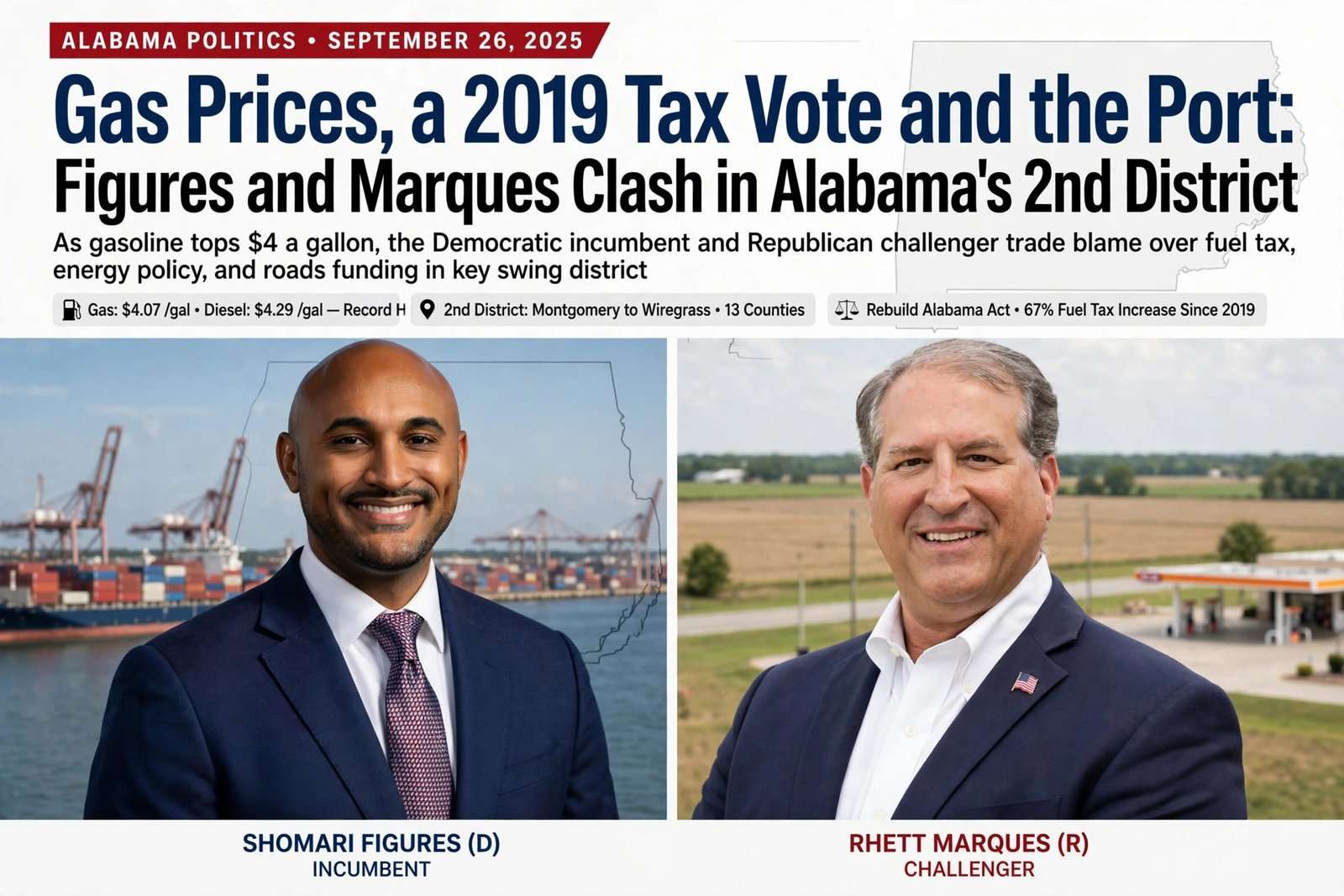
With gasoline topping $4 a gallon and diesel prices at record highs in Alabama, the race for the state’s 2nd Congressional District has turned into a fight over who is to blame. U.S. Rep. Shomari Figures, the Democratic incumbent, and his Republican challenger, state Rep. Rhett Marques of Enterprise, traded sharp statements this week over energy policy, taxes and the 2019 state law that raised Alabama’s fuel tax.
The exchange comes as some candidates, including Democratic gubernatorial nominee Doug Jones, have called for Alabama to temporarily suspend or freeze its fuel tax, and as several Republican-led states have moved to do exactly that.
Figures: ‘Republicans in Washington and Alabama are why’
Figures, a Mobile native seeking a second term, put the blame for high prices on the war in Iran, on Republican policies in Washington and Montgomery, and on the GOP’s backing of President Donald Trump’s administration.
“Gas is way too high and Republicans in Washington and Alabama are why,” Figures said in a statement earlier this week. “They refuse to stop the war in Iran which is driving up fuel costs to all-time highs, and Rhett Marques led Republicans in raising the gas tax by 67% increase.”
He also took aim at the idea that voters in the district will accept higher prices out of political loyalty, a theme he first raised last week in response to remarks by U.S. Sen. Tommy Tuberville.
“People are fed up with high fuel prices, and to suggest that people here are so blindly loyal to Trump that we are okay with high gas prices is an insult to our intelligence and independence,” Figures said.
At a Sept. 25 campaign stop in Geneva, Figures called Tuberville’s comments suggesting Alabamians would tolerate higher fuel prices “beyond irresponsible.” Tuberville, the Republican nominee for governor, has argued that Democratic energy policies helped drive up prices and has called for more domestic oil production.
Where the 67% figure comes from
The number Figures cited reflects the change in Alabama’s base gasoline tax since 2019. Before the Rebuild Alabama Act, the state’s tax stood at 18 cents per gallon, a rate that had not changed since 1992. The law phased in a 10-cent increase over three years, and it also created an automatic adjustment tied to the National Highway Construction Cost Index, which can raise the rate by up to one cent every two years. Those adjustments have added two more cents, bringing the tax to 30 cents per gallon as of July 2025.
The 12-cent increase, measured against the original 18-cent rate, works out to about 67%. Marques’ campaign has disputed the framing in the past, arguing that the percentage overstates the effect of the 2019 vote itself, which approved a 10-cent increase. The same figure was used against Marques by a Republican rival during this summer’s GOP primary.
Marques: Figures is attacking a bipartisan law he celebrated
Marques served in the Alabama House in 2019 and voted for the Rebuild Alabama Act, which passed the House 83-20 with support from members of both parties. Gov. Kay Ivey signed the measure that March after lawmakers approved it in a special session she called to address the state’s roads and bridges.
In a response on Tuesday, Marques said Figures was attacking a bipartisan law, and his campaign pointed to Figures’ past support for deepening and widening the Mobile ship channel. That project received a $150 million state commitment through the Rebuild Alabama package, which helped leverage hundreds of millions of dollars in federal funding, much of it secured by former U.S. Sen. Richard Shelby.
“Now, he’s disingenuously attacking the bipartisan Rebuild Alabama Act, despite the fact that he publicly celebrated the deepening and widening of the Port of Mobile that the law helped accomplish, along with 59 local road and bridge projects across Alabama’s Second Congressional District to date,” Marques said.
Marques also criticized Figures over federal benefits for people in the country illegally and over gender-transition care for minors, saying Figures “should prioritize investing in roads and bridges across Alabama’s Second Congressional District.” He added a jab at Figures’ residence: “Maybe this would be a higher priority for him if he actually lived in the district.”
Figures has rejected the suggestion that he is out of touch with the district’s rural counties. “I represent 13 counties right now, and there’s not a single county that will tell you that we haven’t been there for them, we haven’t been present, that we haven’t been listening, and that we haven’t been producing for them,” he said in Geneva last week.
Why the residency question comes up
Figures was first elected in 2024 under a court-ordered map that stretched the 2nd District from Mobile east toward the Georgia line, drawn after the U.S. Supreme Court’s 2023 ruling in Allen v. Milligan. This year, after a new Supreme Court decision, the Republican-controlled Legislature moved to return to its own map, and the Supreme Court in June allowed Alabama to use that GOP-backed map for the 2026 elections.
Under the new lines, Figures’ hometown of Mobile sits in the 1st Congressional District. Rather than run there, Figures chose to seek re-election in the 2nd District, which he currently represents. The district now centers on Montgomery and much of the rural Wiregrass region of southeast Alabama, including Marques’ home base in Coffee County. Members of the U.S. House are required to live in the state they represent, but not in a particular district.
National forecasters rate the race “Likely Republican,” reflecting the district’s new partisan makeup, though a summer internal poll released by a Democratic group showed the two candidates tied. Marques has Trump’s endorsement and is expected to speak at the president’s rally at the University of South Alabama’s Mitchell Center on Friday, Oct. 2.
What Rebuild Alabama pays for
The Rebuild Alabama Act was the first increase in the state’s fuel tax in nearly three decades. Supporters argued at the time that inflation and more fuel-efficient vehicles had eroded the purchasing power of the old 18-cent tax and that the state’s roads and bridges had fallen behind. Revenue from the new tax is divided among the state, counties and cities and must be spent on transportation infrastructure. The Alabama Department of Transportation is also required to publish an annual list of projects funded by the money.
The law also set up the Rebuild Alabama grant program for local governments. ALDOT distributes up to $15 million a year in grants for local road and bridge improvements. On Wednesday, Ivey’s office announced the latest round of those awards, including up to $3.8 million in new project allocations.
“Good roads make for more jobs, smoother travel and happier Alabamians. That is why improving our infrastructure has remained a top priority of my Administration,” Ivey said. “Through Rebuild Alabama, we are putting dollars where rubber meets the road and delivering real results in all 67 counties. Long after the construction crews pack up, these investments will keep Alabama rolling, moving and growing for generations to come.”
The ship channel work Marques highlighted is among the most visible projects tied to the law. The deepening and widening of the Mobile Harbor channel was designed to allow larger, more heavily loaded vessels to reach the Port of Mobile, one of the state’s largest economic engines.
Other states pause their fuel taxes
The debate over fuel taxes is playing out well beyond Alabama, and not along strictly partisan lines.
- Georgia: Gov. Brian Kemp, a Republican, this week suspended the state’s motor fuel tax for 30 days to give drivers temporary relief.
- Indiana: The Republican-led state recently paused or suspended a portion of its fuel taxes as prices climbed.
- Ohio: Republican gubernatorial candidate Vivek Ramaswamy has pushed for a pause in the state’s fuel tax, and the Republican-controlled Legislature began a special session this week to consider a 90-day suspension.
Alabama Republicans, by contrast, have largely resisted calls for a suspension. Jones has proposed temporarily freezing the 10-cent increase approved in 2019 and has campaigned on eliminating state taxes on fuel, arguing that relief is needed for farmers, truckers and Gulf Coast shrimpers. Tuberville has said the answer to high prices is “more American energy” and has blamed Democratic energy policies for the run-up.
Because fuel tax revenue is dedicated to roads and bridges, any suspension would reduce money available to ALDOT, counties and cities for transportation projects unless lawmakers replaced it from another source. Supporters of a pause argue that temporary relief for households is worth the short-term loss, while opponents point to the cost to road and bridge programs that depend on the dedicated revenue.
The cost at the pump
Diesel prices have hit families and businesses especially hard. According to AAA, the average price of diesel in Alabama reached $6.16 a gallon earlier this month, about 80% higher than a year earlier. Gasoline prices have topped $4 a gallon. For farmers in the Wiregrass, truckers moving freight through the state and commercial fishermen on the coast, fuel is one of the largest operating costs.
Both campaigns are betting that frustration over those costs will shape how voters in the 2nd District cast their ballots.
What voters should know
- Voter registration deadline: Monday, Oct. 19.
- Absentee applications: Due Oct. 27 by mail or Oct. 29 in person.
- Election Day: Tuesday, Nov. 3. Polls are open 7 a.m. to 7 p.m.
- Photo ID: Required to vote in Alabama.
Voters who are unsure which congressional district they live in under the new map can check their registration and sample ballot through the Alabama Secretary of State’s office.