
Good Samaritans on Mobile Bay Rescue Man Overboard After Personal Watercraft Capsizes
Snapper fishermen spotted a watch light and rescued a man treading water 10 miles offshore after his personal watercraft capsized in Mobile Bay.
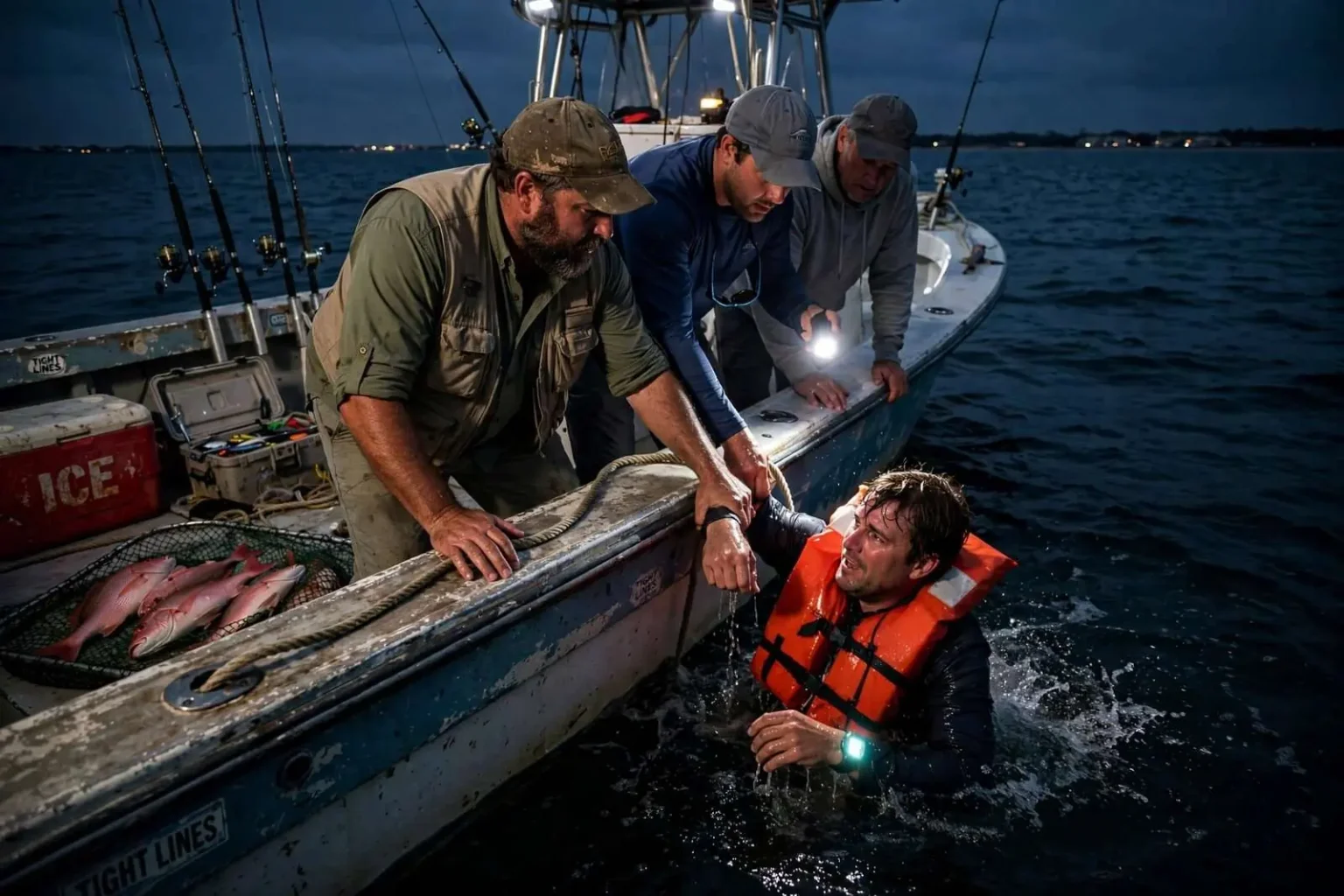
A father who fell from a personal watercraft roughly 10 miles offshore in Mobile Bay was rescued by a group of snapper fishermen who spotted the glow of his watch in the dark water and circled back to pull him aboard.
The incident unfolded Friday, June 12, when Brian Duff and a child left Tonty Court on Dauphin Island around noon aboard a red-and-white Yamaha wave runner, heading toward an offshore platform. They were reported overdue around 2:50 p.m. when they failed to return as planned. Coast Guard Sector Mobile launched a search, and an aircrew flew over the area multiple times without spotting the pair. Meanwhile, the child had already been located and was safe.
The afternoon’s chain of events — a routine outing, a fall no one witnessed, an overdue report, and a rescue that depended on luck layered over preparation — has become the kind of story Coast Guard officials on the Gulf Coast retell deliberately, because every element of it teaches the same set of lessons about surviving an accident on the water.
How the Rescue Unfolded
As the fishermen were heading back to shore, one noticed a light in the water — Duff’s watch. They turned around, heard yelling, and found Duff treading water in roughly 150-foot depths with an outgoing tide. He was wearing an orange life jacket and a long-sleeve shirt beneath it.
“They circled back around and heard hollering and found him,” one of the rescuers said. “He was distraught until they found out the child who had been with him was already found and safe.”
The geometry of the search explains why the fishermen’s sharp eyes mattered so much. A Coast Guard aircrew scanning open water from several hundred feet can cover enormous territory, but a single person in the water — even one wearing a bright orange life jacket — presents a target measured in feet against a search area measured in miles. Swell, chop, sun glare, and fading light each shrink the effective search further. The fishermen were close enough, low enough, and attentive enough to catch what the aircraft could not.
The light that gave Duff away deserves particular mention. Many anglers and offshore enthusiasts wear watches and headlamps with illuminated dials or strobe functions without thinking much about it; on this night, that incidental glow was the only thing separating a man in the water from an empty sea. The rescuers’ decision to investigate a faint light rather than dismiss it turned a probable tragedy into a reunion.
The good Samaritans brought Duff to shore. He was evaluated and released.
Life Jacket and a Watch Light Made the Difference
Duff’s life jacket kept him afloat through hours in open water, and the small light on his watch gave the rescuers a visual reference in fading light. Coast Guard officials say both are examples of simple preparations that dramatically improve the odds of being found alive after an accident on the water.
The hours Duff spent treading water with an outgoing tide would have challenged even a strong swimmer, and the life jacket eliminated the question of endurance entirely. Coast Guard statistics have documented the pattern for decades: the overwhelming majority of boating fatalities involve victims who were not wearing a flotation device, and drowning — not injury, exposure, or any other cause — remains the leading killer on recreational boats and personal watercraft alike.
Alabama’s boating laws require life jackets aboard every vessel, and children on the state’s waters face stricter requirements still, but the law cannot compel the habit that actually saves lives, which is wearing the jacket rather than stowing it. Duff’s orange vest did its work for hours in a bay known for currents that shift with the tide and winds that build through the afternoon.
The Coast Guard also noted that the aircrew flew over Duff several times without seeing him — a reminder that a person in the water presents a very small visual target, even for trained observers. Staying with the vessel or flotation device, wearing a life jacket, and carrying a light or whistle are consistently cited as the most effective survival steps.
The Search Infrastructure Behind the Story
Coast Guard Sector Mobile anchored the official response, as it does for incidents across a zone that includes Mobile Bay, the Gulf approaches, and the inland rivers of south Alabama. The sector coordinates surface patrols, helicopter crews, and broadcasts to mariners, turning an overdue report into a structured search within minutes. Its aircrews train specifically for overwater search patterns, sweeping grid lines across likely drift paths calculated from wind and current.
Dauphin Island, the barrier island community where Duff launched, sits at the gateway between the bay and the open Gulf, and its waters host everything from kayakers and paddleboarders to the offshore sportfishing fleet. The island’s boat ramps and launch sites see heavy recreational traffic in summer, which is why the overdue-report protocol matters: when a vessel is expected back and is not, a phone call to the Coast Guard starts a clock that ends, in the best cases, with exactly the kind of outcome this story had.
The recreational anglers who ultimately made the difference were part of that same summer traffic. Snapper fishing draws hundreds of boats into the waters off Dauphin Island during the season, and that crowd is itself a search-and-rescue asset — more eyes on the water than any agency could ever field. Coast Guard officials have long urged commercial and recreational boaters to report anything unusual they encounter, and this rescue is the textbook result of a crew that did exactly that.
Lessons for Every Boater on the Bay
The safety checklist that emerges from this incident is short enough to memorize and proven enough to trust. File a float plan with someone ashore — who is going out, on what vessel, toward what destination, and back by when. Duff was reported overdue only because someone knew when to expect him, and that call put the Coast Guard’s machinery in motion before nightfall.
Wear the life jacket rather than carrying it. On personal watercraft especially, where riders are exposed and falls are common, the jacket has to be on the body to do any good. An orange vest is also the single most visible thing a person in the water can offer a search crew, which is precisely what happened here.
Carry a light and a whistle on your person, not in a compartment that sinks with the boat. A strobing light turns a swimmer into a beacon after sunset, and a whistle requires no battery and reaches farther than any voice. Together they cost a few dollars and weigh a few ounces — and on this night, their equivalents were the difference between a search that ended and one that continues.
Stay with the craft whenever it floats. A capsized personal watercraft or an empty hull is dramatically easier for searchers to spot than a swimmer’s head, and remaining near it anchors a survivor against drifting away from the area where rescuers are looking. Duff, separated from his wave runner in the dark, was nearly invisible; the machine he left behind might have been found hours earlier.
A Community’s Role in Its Own Rescue
Stories like this one circulate on the Gulf Coast because they reward the habits locals already practice. The fishermen who turned their boat around when they saw a light could easily have written it off as a reflection or a distant flare, and no one would have blamed them for heading home with a limit of snapper and a long day behind them. Instead they spent the better part of an evening investigating, and their diligence delivered a father back to a child who was already safe.
The Coast Guard’s officials, for their part, closed the incident the way they prefer to close all of them: with the rescued party evaluated, released, and home, and with a public reminder that the equipment and habits involved cost almost nothing. Mobile Bay and the waters beyond it will keep testing boaters with sudden weather, strong tides, and long distances between help — as they always have. The evidence of this June night says the preparation that matters most is simple, and that a community of attentive boaters remains the Gulf Coast’s most reliable rescue fleet.
The timeline is worth appreciating as well. From a noon departure on Dauphin Island to a 2:50 p.m. overdue report to a rescue after dark, the sequence compressed every phase of a maritime emergency into a single day — the launch, the accident no one saw, the report that triggered the official search, the aircrews who scoured the water without success, and the civilian boat whose crew happened to be in the right place and took a second look. Any broken link in that chain and the story ends differently; every one of them held.
For the rescuers, the reward was the moment at the dock when Duff learned the child was safe — the news that, rescuers said, turned his distress to relief. For everyone else who boats these waters, the incident stands as proof that the dull, repetitive safety advice — wear it, carry a light, file a plan, stay with the boat — is not boilerplate. It is the actual difference between a close call and a casualty.


