

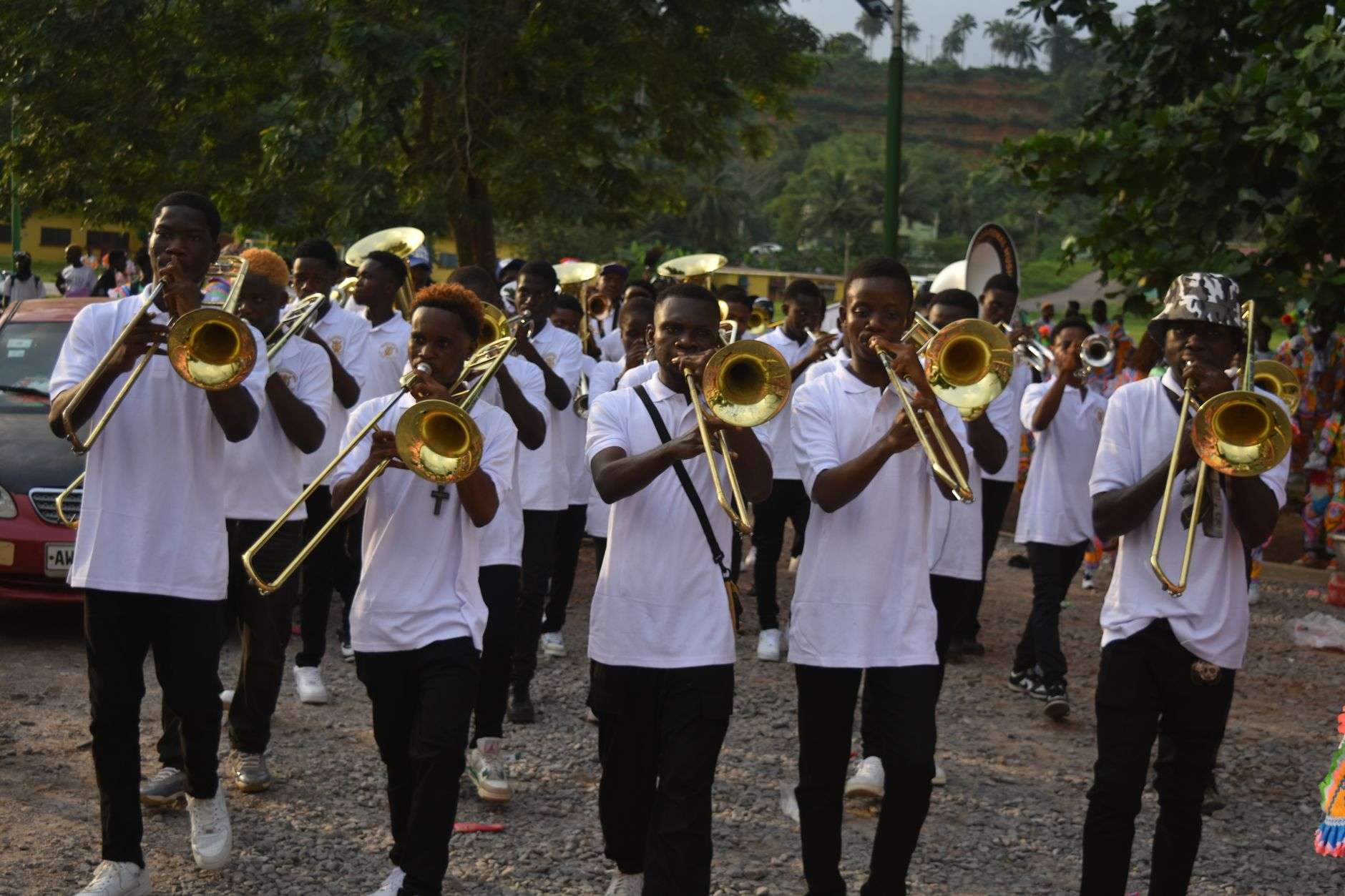
Clarke County High School has a new leader for its marching band program. Jeremy Welch, a Grove Hill native and 2013 graduate of the school, has been hired as the new band director for the Royal Band of Blue, taking the podium as students prepare for the 2026 fall football season. The hire puts a program that means a great deal to its community in the hands of someone who came up through it himself, and the timing — weeks before preseason rehearsals turn into halftime productions — leaves little room for a slow start.
Welch’s hiring fills a role with deep meaning in the Grove Hill community, where the Royal Band of Blue has long been a fixture of Friday night football games, parades and civic events across Clarke County. In towns the size of Grove Hill, the high school band is one of the few institutions that performs in public year after year, and the director who leads it becomes a familiar figure to families who have never set foot in a band room.
For Welch, the appointment marks a homecoming of sorts, returning him to the same hallways and practice fields where his own music career began. Directors who return to their alma mater carry a particular kind of credibility with students: they can point to the same marching rows and tell the band, truthfully, that they once stood exactly where those students are standing now.
The Royal Band of Blue’s name alone tells visitors what the program means here. Bands in small Alabama towns often carry titles that generations of graduates still recite with pride, and the band’s appearances extend well past the football schedule — parades, holiday events, competitions and the civic gatherings where a town shows itself off. A director in that seat inherits a public role as much as a classroom assignment.
A Hometown Connection
Welch is the son of Elbert Welch and Pamela Banks, both of Grove Hill, and grew up immersed in the same band program he now leads. After graduating from Clarke County High School, he went on to Southern New Hampshire University, where he earned a degree in business administration with a focus on human resource management, a background he says will help him manage the operational and organizational demands of running a competitive marching band program.
Those organizational demands are easy to underestimate. A marching band program is, in practical terms, a mid-sized organization that has to move equipment, schedule transportation, maintain instruments and uniforms, plan a competitive show and coordinate dozens of student schedules — all while school is in session. Directors with business training often point out that the paperwork and logistics consume as much of the job as the music does.
Beyond his academic training, Welch brings hands-on musical experience to the role. He is a former trumpeter with the Alabama State University Mighty Marching Hornets, one of the most recognized marching bands in the state, and he has performed with The Flying Bricks Community Band. Welch is proficient on five musical instruments, giving him the versatility to work directly with students across multiple sections of the band.
That range matters in a small-school program, where one director typically teaches every instrument without a staff of specialists. A director who can demonstrate a trumpet line, sit down at a woodwind part and understand the rhythm section’s challenges can diagnose problems across the whole field rather than relying on section leaders to translate. His time with a show-style band like the Hornets also gives him firsthand experience with the performance energy that Alabama audiences expect from a halftime show.
Grove Hill serves as the county seat of Clarke County, and its schools draw students from across a largely rural county, which makes the high school band one of the region’s most visible youth organizations. For many students, band is the activity that teaches discipline, teamwork and performance under pressure — skills that transfer to everything they do afterward, whether or not they ever play another note.
Community bands like The Flying Bricks fill an important niche for working musicians between school and professional ensembles. Performing with a community group keeps a player’s chops sharp across styles and age groups, and directors who have done it tend to bring a practical, adaptable musicianship to the podium — an asset when a school program needs to cover everything from concert literature to Friday night stands tunes.
Honoring a Legacy
In accepting the position, Welch spoke about the responsibility of following in the footsteps of the late John Connor, a band director whose influence shaped generations of Clarke County students. Welch said he intends to build on that legacy rather than simply maintain it. “I plan to lead, grow and continue building this program in the spirit of the late John Connor, who poured so much into generations of students,” Welch said. “I simply ask for your support, your encouragement and your prayers as we move forward together and build something special with the Royal Band of Blue.”
Succeeding a beloved longtime director is one of the hardest situations in school music education. Students remember how things were done, parents measure every change against memory, and the new director must honor the tradition while still putting their own stamp on the program. Welch’s approach — explicitly invoking Connor’s influence rather than distancing from it — signals that he intends to make the continuity itself part of his leadership.
Community members familiar with the program say Connor’s decades of dedication left a lasting mark on Clarke County High School, and many in Grove Hill will be watching closely as Welch works to carry that tradition into a new era. The audiences at Friday night games this fall will include alumni who marched under Connor and families whose children are now in the ranks, and both will be measuring what they see against what they remember.
Programs that survive a transition between directors usually share one trait: a culture that does not depend on a single person. Student leaders who can run sectionals, parents who know the logistics and an administration that supports the arts all give a new director room to breathe. Welch inherits whatever foundation Connor’s tenure built, and how quickly the band finds its footing this fall will say a great deal about the strength of that foundation.
Marching band in Alabama has grown into a genuinely competitive arena, with festivals and showcases across the state judging music, visual effect, color guard and percussion. A well-built halftime show doubles as competition material, and directors spend the summer balancing what will entertain a stadium crowd with what will hold up under a judge’s sheet. Shows built around recognizable hits give newer programs a head start, since the audience rewards familiarity even as the band refines the details.
Looking Ahead to Friday Nights
Welch’s arrival comes just as marching bands across south Alabama begin preparing their halftime productions for the upcoming football season. This year, the Royal Band of Blue will perform a show titled “Saturday Night Lights,” a high-energy tribute built around a mix of disco and pop hits spanning the 1960s through the 1990s. The production is expected to give band members a chance to showcase both musicianship and showmanship on the field, blending classic dance-era hits with the visual choreography that has become a hallmark of Alabama high school marching band performances.
A cross-decade pop and disco show is a practical choice as well as a crowd-pleasing one. Familiar hits give grandparents, parents and students something each generation recognizes, and the dance-driven arrangements lend themselves to the kind of movement-heavy staging that keeps a crowd engaged between plays. For the students, learning music their parents grew up with often becomes one of the season’s small pleasures.
The weeks before kickoff are when the season is actually built. Summer band camps compress months of work into long, hot days of sectional rehearsals and full-band run-throughs, with students learning music, drill and choreography at the same time. In south Alabama’s August heat, those outdoor rehearsals are as physically demanding as football practice, which is why band programs schedule water breaks and shade with the same care as the athletic department.
As rehearsals get underway ahead of kickoff, Welch said he is looking forward to working alongside students, parents and fellow educators to strengthen a program that has long been a source of pride for Grove Hill and the broader Clarke County community. The band booster network, the parents who move equipment and the teachers who share their students’ time will all play their part in that effort, just as they have for decades.
When the Royal Band of Blue takes the field this fall for the first time under its new director, the moment will close a loop that began more than a decade ago, when a Grove Hill kid picked up an instrument in the same program and started down the path that led back home. The first notes of “Saturday Night Lights” will belong to a new era, built deliberately on the one that came before it.