
Gulf Breeze Man Arrested After Firing Shots at Neighbor Who Told Him to Slow Down
A Gulf Breeze man was arrested after allegedly firing two shots at a neighbor who told him he was driving too fast where children played.
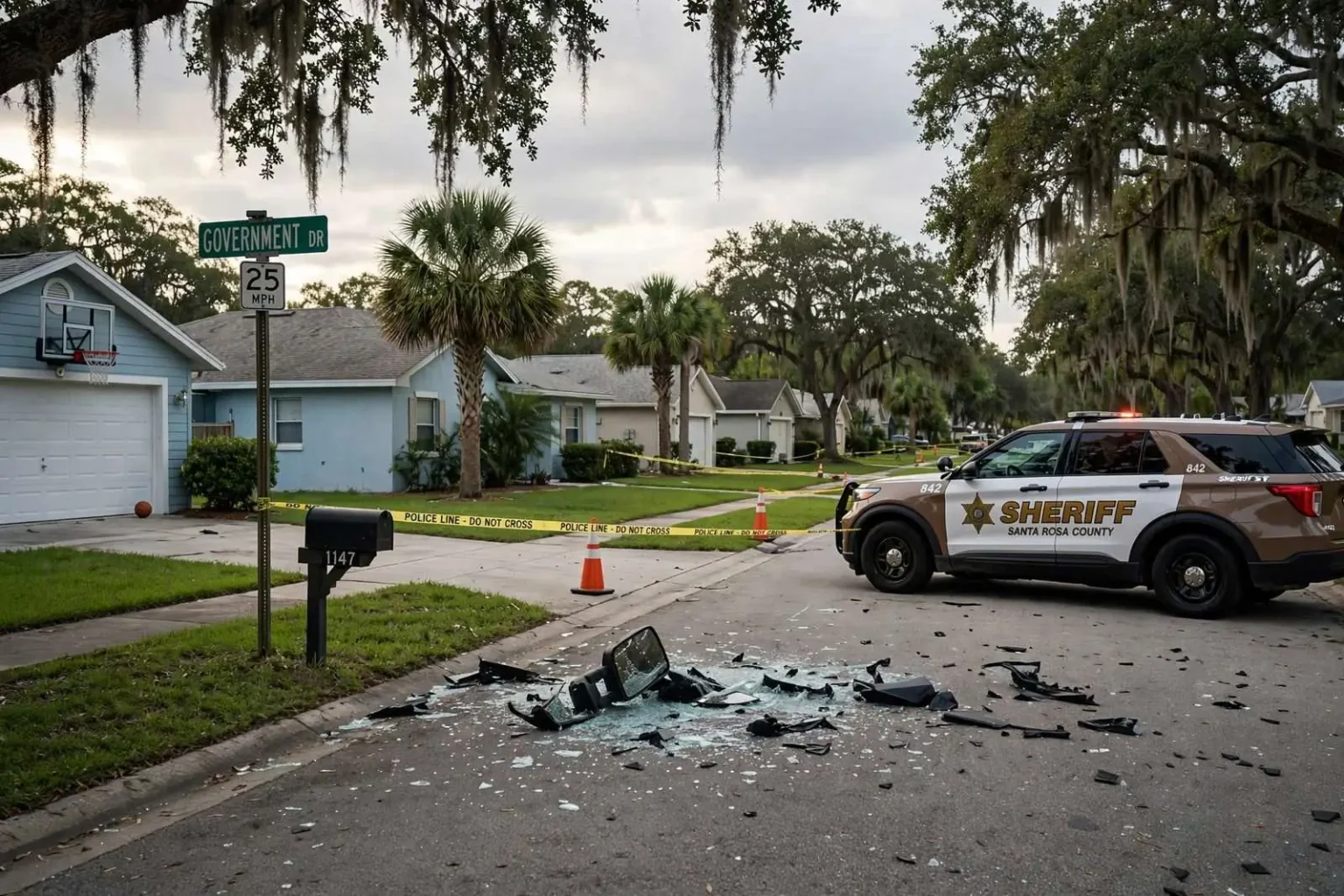
A Gulf Breeze man is facing charges after authorities say he fired two shots toward another man who confronted him about speeding through a neighborhood. The incident, laid out in an arrest report, began as a complaint about a driver racing down a residential street where children were playing and ended with a pistol pointed at a neighbor and two rounds fired at his feet.
Twenty-two-year-old Andrew Henderson is charged with aggravated assault with a deadly weapon and firing a weapon from a vehicle. Both charges stem from the encounter on Government Drive, and together they carry the potential for serious prison time — aggravated assault alone ranks among the most serious charges available to prosecutors in cases where a gun is brandished and shots are fired toward a person.
According to the arrest report, Robert Constantin yelled at a driver speeding down Government Drive, where his children were playing basketball, and told him to slow down. The driver was Henderson. What followed unfolded in seconds: Constantin confronted the speeding driver about the danger he posed to kids in the street, and during the argument that followed, Constantin punched the side mirror off Henderson’s truck.
How the encounter escalated
Deputies say Henderson threatened to shoot Constantin, drove away, then returned — pointing a pistol at Constantin and saying he was going to kill him before firing two shots at Constantin’s feet and speeding off again. The sequence, as investigators reconstructed it, transformed a traffic complaint into an armed confrontation in the space of a few minutes.
The decision to leave and come back armed is a central detail in the case. By driving away, Henderson had removed himself from the argument; by returning with a weapon drawn, authorities allege, he escalated a confrontation that had already ended into an assault. The two shots fired at Constantin’s feet — close enough to strike, aimed well enough to miss — are the kind of detail prosecutors treat as evidence of intent rather than accident.
Constantin’s own conduct — punching the side mirror off the truck — is documented in the report as well, but property damage and gunfire sit in different legal universes. A broken mirror is a matter for civil remedy or a misdemeanor; two rounds fired at a person’s feet from a drawn pistol is a felony that can put a defendant away for years. The arrest charges reflect that distinction: it was the shooter who faced the aggravated assault count.
The charges and what they carry
Aggravated assault with a deadly weapon requires the state to show that a person assaulted another with a weapon capable of causing death or great bodily harm — and a pistol pointed at someone with a threat to kill satisfies that standard on its own, even before a shot is fired. The second count, firing a weapon from a vehicle, addresses the danger created when shots come from a moving truck on a residential street.
Conviction on either count can bring prison time, fines, and the permanent loss of firearm rights that follows most felony convictions. For a 22-year-old, the consequences extend past sentencing: a felony record shapes employment, housing, and every background check that follows. Prosecutors treat cases involving gunfire in residential neighborhoods with particular gravity, and the fact that children were playing basketball within sight of the encounter only sharpened the context.
The case also illustrates the legal line residents walk when they confront speeders. Yelling at a driver to slow down is not a crime; even the broken mirror, while property damage, did not justify an armed response in the eyes of the deputies who made the arrest. The person who escalated to deadly force is the one now facing charges.
Speeding complaints in Gulf Coast neighborhoods
The Government Drive encounter echoes a pattern repeated across the Gulf Coast, where speeding through residential streets is among the most common complaints residents bring to police, homeowners associations, and city councils. Streets lined with houses and without through-traffic controls become shortcuts for impatient drivers, and where children play outdoors — as they were on the afternoon of this incident — the margin for error shrinks to nothing.
Gulf Breeze itself sits on a narrow peninsula in Santa Rosa County, Florida, its residential streets sandwiched between Pensacola Bay and Santa Rosa Sound. The city’s neighborhoods draw families precisely for their quiet, and a car tearing down one of those streets where kids are shooting hoops is the kind of event that turns neighbors into adversaries quickly. Community policing officials across the region consistently advise residents against direct confrontation with speeders — the safer route is documenting the vehicle and reporting it — though the law does not treat a shouted plea to slow down as any kind of provocation that excuses an armed response.
Traffic engineers and sheriff’s offices have tools short of confrontation: speed studies, radar details, speed cushions, and increased patrols all respond to a speeding complaint once it reaches the right desk. None of them put a parent face to face with an angry driver, which is the outcome every safety agency says to avoid.
When a traffic dispute becomes a shooting
Incidents like the one on Government Drive belong to the wider category of cases that law enforcement agencies track as escalating traffic disputes, and the Gulf Coast has seen its share of encounters that turned fatal over lane changes, horn blasts, and speeding complaints. Investigators in such cases look for the moment the aggression became criminal — in this case, deputies concluded, that moment came when Henderson returned armed, pointed the pistol, and fired.
The fact that the shots were fired toward the ground rather than at chest height does not soften the charge in the view of prosecutors. A round fired at a person’s feet can ricochet, and a pistol held on someone with a death threat is an aggravated assault the moment the trigger is pulled — or, under the charged standard, even when it is only pointed. The two charges Henderson faces capture both the threat and the gunfire.
Residents who witnessed the encounter or its aftermath provided the accounts investigators used to build the report, a reminder that neighborhood incidents of this kind rarely lack for observers. In a street where children were playing basketball, the presence of witnesses was inevitable, and their statements — along with Constantin’s account and the physical evidence from the damaged truck — gave deputies what they needed to move from a speeding complaint to a felony arrest.
What happens after an arrest like this
An arrest on aggravated assault and firing a weapon from a vehicle sets in motion the standard machinery of the criminal courts: first appearance, bond determination, and eventually the state attorney’s decision on how to proceed. Cases with a clear arrest report — the kind that documents threats, the return to the scene, the pistol, and the two shots — typically rest on a foundation assembled before the defendant ever sees a judge.
Bond conditions in cases involving firearms fired in residential areas frequently include no-contact orders and surrender of weapons, and violations of those conditions bring new charges on top of the original ones. For the complainant, the period after an arrest is often the tensest: the neighbor relationship, already broken, now carries the weight of a pending criminal case.
The case stands as a local example of the arithmetic that deputies and prosecutors apply to road disputes. A speeding driver, an angry homeowner, a broken side mirror — none of that produced an arrest for assault. The return trip with a pistol did. Gulf Coast law enforcement has repeated that message in case after case: walk away, call the authorities, and let the justice system handle the mirror and the speeding both.
The neighborhood after the shots
For the families on Government Drive, the incident’s aftermath is measured in more than charges. Children who were playing basketball when the argument began witnessed the prelude to a shooting on their own street, and the sound of gunfire in a residential block lingers in a neighborhood’s sense of security long after the truck speeds away. Community policing experience suggests the recovery is slowest precisely where residents thought they were safest.
Henderson, 22, now answers the charges in court, where the aggravated assault count and the firing-from-a-vehicle count will be weighed against the account deputies assembled from the scene. Whatever the outcome, the arrest report’s outline of the encounter — the plea to slow down, the punch to the mirror, the threat to kill, and the two shots at a neighbor’s feet — has already fixed the incident in the neighborhood’s memory as the day a speeding complaint nearly became a homicide.
Law enforcement agencies across the Gulf Coast continue to urge drivers and residents alike to break the cycle before it reaches that point: drivers who slow through neighborhoods where children play, and residents who reach for a phone instead of a confrontation. The Government Drive case is a study in how quickly the alternative unfolds — and in who ends up in handcuffs when it does.
Lessons drawn from the Government Drive case
The incident offers a checklist of sorts for neighborhoods across the Gulf Coast, distilled from the arrest report’s sequence of events. The speeding was the spark; the confrontation was the accelerant; the firearm was the catastrophe. Remove any one of those steps and the afternoon ends with a broken mirror or a traffic citation instead of felony charges. Safety officials note that no residential speeding complaint in memory has been resolved for the better by a gun, and this case adds its own local proof.
For parents, the case also carries the reminder that the presence of children changes the stakes of every traffic dispute. The children playing basketball on Government Drive were the reason Constantin confronted the speeding driver in the first place, and they were the reason the danger of gunfire on that street was measured in more than property. Deputies and school resource officers across the region reinforce the same guidance to families: when a driver endangers children, report the vehicle, and let the enforcement system carry the risk.
The courts will sort out what the charges against Henderson ultimately produce. What the community is left with, in the meantime, is the documented shape of a preventable escalation — and a neighborhood where the sound of two gunshots at a neighbor’s feet now marks the distance between a complaint about speeding and a case file at the county courthouse.


