
Gulf Shores named among National Geographic’s most wheelchair-friendly beaches
National Geographic has named Gulf Shores and Pensacola Beach among the top five most wheelchair-friendly beaches in the United States for their access.
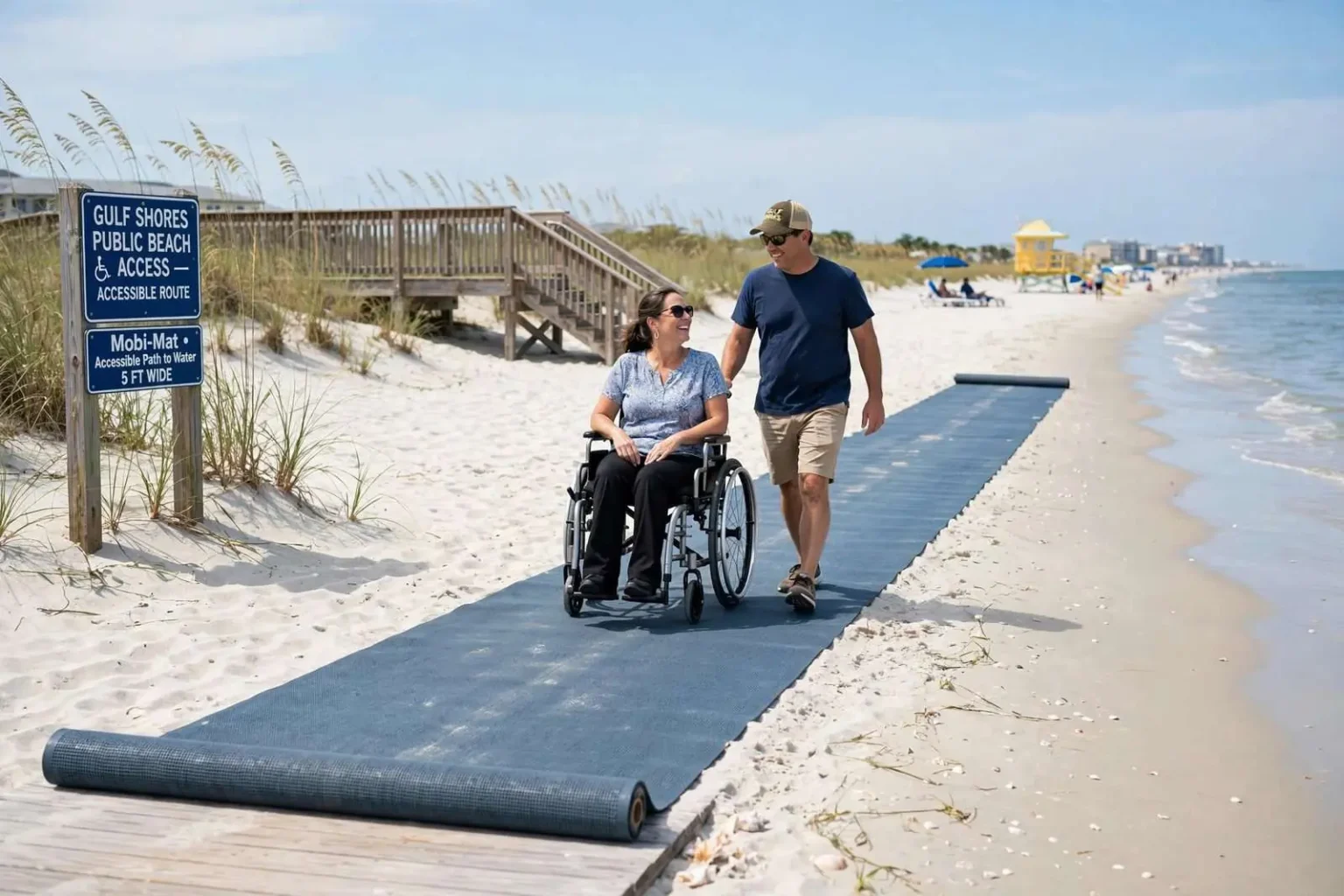
National Geographic has named Gulf Shores and Pensacola Beach among the top five most wheelchair-friendly beaches in the United States, a recognition that puts two Gulf Coast destinations in the company of the nation’s most accessible shorelines.
The honor came more than a year after Gulf Shores rolled out its first public beach access mat to help visitors in wheelchairs or with difficulty walking reach the shore. Pensacola Beach installed its mat this summer, and both communities have since become reference points for accessible beach design along the Gulf.
The five-foot-wide plastic “access mat” was the first of its kind on Baldwin County beaches when it debuted in February 2018, unrolling across the sand like a durable pathway from the boardwalk to the water’s edge. The Mobi-Mat, as the product is known, was brought to Pensacola Beach in June 2019, extending the same kind of access across the state line.
What the mat does
Beach access mats solve a problem that has kept wheelchair users away from the sand for generations. Loose, soft sand is effectively impassable for standard wheelchairs and a major struggle for walkers and canes, which means that without some kind of surface, a trip “to the beach” ends at the parking lot or boardwalk. A mat laid over the sand creates a firm, rollable pathway all the way to where the sand firms up near the waterline.
The Gulf Shores mat is five feet wide, wide enough for two people to travel side by side — a wheelchair user and a companion, or a parent walking with a child in a stroller, since the mats serve families with small children and older visitors as well. The plastic material is designed to stand up to sun, salt and foot traffic, and crews can reposition or remove it as storms and tides reshape the beach.
Why the recognition matters
National Geographic’s list spotlighted beaches that go beyond the legal minimums for accessibility, and the magazine’s reach put the Gulf Coast’s efforts in front of a national travel audience. For Gulf Shores — a city whose economy is built on beach tourism — the recognition is both a marketing win and a signal to travelers with disabilities that the community has invested in making a visit practical.
Accessible tourism is a significant market. Millions of American travelers have disabilities, and destinations that remove barriers often find those visitors return year after year and bring families with them. A mat that costs a community comparatively little can open the city’s core attraction — the beach itself — to a population that previously could only look at it.
Gulf Shores’ investment in access
The mat that debuted in February 2018 marked the first installation of its kind on the Baldwin County beachfront. Gulf Shores’ public beach access points draw enormous seasonal crowds, and city officials have steadily upgraded them over the years with restrooms, showers, boardwalks and dune walkovers. The access mat extended that work from the boardwalk down onto the sand itself, closing the last gap between parking and the water.
City crews maintain the mat as part of regular beach operations, repositioning it after storms and adjusting it seasonally. Visitors will find it at the city’s main public beach area, where the combination of parking, facilities and now the mat makes the site one of the most complete accessible beach experiences on the Alabama coast.
Beyond the mat, Gulf Shores and neighboring Orange Beach have expanded beach wheelchair offerings through rental programs and lifeguard services, giving visitors options beyond the fixed pathway. Beach wheelchairs with balloon tires can go where mats end, and the two tools together cover most of the shoreline experience.
Pensacola Beach follows
Pensacola Beach brought its Mobi-Mat to the sand in June 2019, a season after Gulf Shores’ debut and just in time for the summer crowd. The Escambia County island’s famous white sand is among the softest and most difficult terrain on the Gulf, which made the mat’s arrival especially consequential for visitors who had previously watched the water from the boardwalk.
The two installations, spanning the state line within about a year of each other, reflected a regional shift. Communities along the northern Gulf Coast compete fiercely for beach tourism, and accessibility features that once seemed specialized have become part of the standard amenity set travelers compare — alongside restrooms, parking and lifeguards.
The law behind the trend
Public beaches occupy a complicated place in accessibility law. Title II of the Americans with Disabilities Act requires state and local governments to make their programs and services accessible, and federal guidance developed over the past two decades has increasingly addressed outdoor recreation, including beach access routes. Guidelines developed for shared-use paths and beach access have given coastal communities a clearer target than the vague standards of earlier decades.
Most Gulf Coast communities have historically relied on boardwalks and dune walkovers to meet their obligations, but those structures stop at the dune line. Access mats extend the accessible route across the sand itself, which is why they have become the visible symbol — and practical substance — of beach accessibility efforts nationwide.
Advocates note that accessibility features rarely serve only their intended audience. A firm pathway over sand helps parents pulling wagons, travelers dragging coolers, older visitors with walkers and anyone recovering from an injury. The universal design principle — one route that works for everyone — is exactly what a five-foot mat provides.
Planning a visit
Travelers planning a trip to either destination can contact the city or county for current details on mat locations and seasonal placement, since beach conditions change with the weather. Gulf Shores’ public beach areas are served by paid and free parking depending on the season, and the city’s tourism resources list accessible features across its beach parks.
Visitors who need beach wheelchairs are advised to reserve ahead during peak season, when rental inventory goes quickly. Both destinations’ summer weekends draw enormous crowds, and mornings offer the calmest conditions on the mat and the easiest parking for visitors with mobility equipment.
A national list with local impact
Being named among the country’s top five most wheelchair-friendly beaches by a publication with National Geographic’s audience gives both communities a story to tell far beyond the region. For the families who have visited the Alabama and Florida coasts for generations and for first-time travelers choosing a destination, the message is that the Gulf Coast’s most famous beaches are now reachable for nearly everyone — from the parking lot, down the boardwalk, across the mat, and all the way to the water.
The Mobi-Mat technology
The Mobi-Mat product line has been deployed at beaches, parks and campgrounds around the world. Made from recycled and recyclable polyester in a three-dimensional weave, the matting is lightweight relative to its coverage, resistant to salt water and UV exposure, and designed to be anchored so wind and wave run-up do not shift it. Crews roll it out in sections, and the material drains and dries quickly after rain or splash-over.
Manufacturers describe the rollout process as a two-person job measured in minutes rather than hours, which is what makes the technology practical for municipal crews. Unlike fixed concrete ramps, which are expensive and vulnerable to storm damage, a mat can be moved seasonally as the shoreline shifts — a real consideration on barrier islands where sand moves constantly.
The broader accessibility picture on the Alabama coast
Gulf Shores’ mat arrived amid a wave of accessibility improvements along Alabama’s coast. Baldwin County’s beach communities have added accessible parking, ramps, boardwalks and observation areas across their public parks in recent decades, and area attractions — from the state park trails to the wharf districts — have progressively widened their accessible offerings as the region’s visitor base has aged and diversified.
The timing also coincided with growth in adaptive sports and recreation programs along the Gulf Coast, which use the beaches for events and introduce many first-time visitors to the shoreline. Organizations serving veterans and children with disabilities have been among the loudest advocates for beach access improvements, and city officials have credited such groups with pushing the projects forward.
What visitors say the mat changes
For wheelchair users, the difference between staring at the Gulf from a boardwalk and sitting beside it with the waves at eye level is hard to overstate. Families report being able to return to traditions — beach days, photo sessions at sunset, a grandchild’s first look at the ocean — that had been impractical or impossible for years.
Those stories are ultimately what lists like National Geographic’s measure. The hardware matters, but the ranking reflects the outcome: two Gulf Coast beaches where the classic American beach experience is open to visitors of every ability, from the moment they arrive until the water’s edge.