Gulf State Park’s Oct. 3 Dive Against Debris Offers Free Tanks and Snorkel Gear to Clear the Saltwater Pier
Gulf State Park and Down Under Dive Shop will host a Dive Against Debris cleanup at the Saltwater Pier on Oct. 3 from 8 to 11 a.m., with free rental tanks for certified divers and free snorkel gear while supplies last.
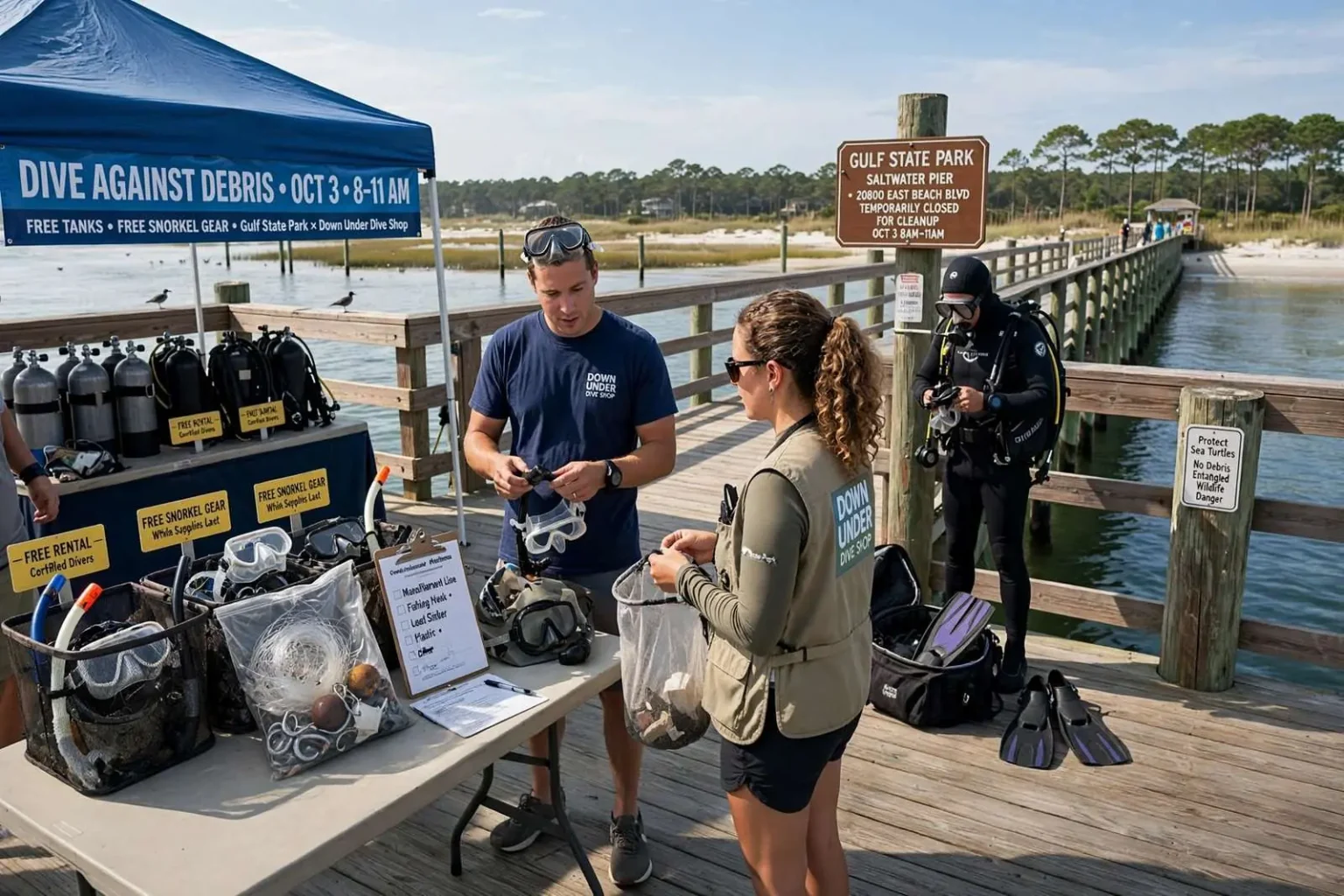
GULF SHORES, Ala. — Gulf State Park will host its fall Dive Against Debris cleanup at the Saltwater Pier on Saturday, Oct. 3, from 8 to 11 a.m., in partnership with Down Under Dive Shop.
The event is open to scuba divers, snorkelers and other water enthusiasts. Certified divers will receive free rental tanks, and non-divers can pick up free snorkel gear while supplies last.
The pier, at 20800 East Beach Blvd., will be temporarily closed to the public during the cleanup.
What Comes Out of the Water
The goal is to remove trash, discarded fishing gear and old fishing line from the waters around the pier — items that pose a serious threat to the sea turtles, fish and shorebirds that inhabit Gulf State Park.
Fishing line deserves particular attention, because it is the most consequential item recovered in cleanups of this kind and the least obvious to a casual observer.
Monofilament line is nearly invisible in water and takes hundreds of years to break down. When it snags on structure beneath a pier, it stays. Sea turtles, birds and fish become entangled in it, and entanglement in fishing line is a documented cause of injury and death in all three groups. A bird with line wrapped around a leg or wing typically does not survive. A sea turtle entangled underwater can drown.
Discarded hooks and lead sinkers compound the problem. Lead is toxic and does not degrade, and hooks remain sharp indefinitely.
Fishing piers concentrate this debris by their nature. They are exactly where line gets snagged and cut, where tackle is lost, and where the structure beneath provides the snag points that hold it all in place.
What Happens to the Debris
Once collected, all debris will be sorted and cataloged by volunteers. Recyclable materials, including lead recovered from old fishing gear, will be set aside for proper recycling.
The data collected during the event may also be used to track pollution trends in local waters.
That cataloging step is what separates a Dive Against Debris event from a general cleanup. The Dive Against Debris framework, developed within the diving community, asks participants to record what they find by type and quantity rather than simply hauling it away.
The resulting data serves purposes that picking up trash alone does not. It establishes what kinds of debris accumulate at a given site, which supports targeted prevention — monofilament recycling stations at piers, for example, are a response to data showing line as a dominant category. Repeated surveys at the same location show whether conditions are improving. And aggregated across many sites, the data contributes to a picture of marine debris that informs policy.
Free Gear, and Why
The free rental tanks for certified divers and free snorkel gear for everyone else are provided to encourage as many people as possible to participate.
The barrier being removed is real. A day of diving with rented equipment carries a cost that discourages casual participation, and snorkel gear is a purchase many people who would happily spend a Saturday morning helping have never made.
Organizers want the event accessible to both experienced divers and beginners — and the snorkel option matters for that. Debris around a pier is not confined to depth. Shallow-water and shoreline material is within reach of anyone comfortable with a mask and fins, which means participation does not require certification.
Organizers encourage participants to arrive early, because free gear is available only while supplies last.
The Partnership
Down Under Dive Shop has partnered with the park to help organize and support the cleanup, and the two organizations have collaborated on similar efforts in the past.
Dive shops are natural partners for underwater cleanup work. They have the equipment, the trained staff, the safety protocols and, critically, the relationship with the local diving community that turns an announcement into attendance.
Gulf State Park officials say the event is part of a broader effort to keep Alabama’s coastal waters clean and healthy.
Gulf State Park’s Conservation Role
Gulf State Park spans thousands of acres along the Alabama coast, encompassing beach, dune, freshwater lake, marsh and maritime forest habitat within a single protected property.
That combination makes it unusual. Much of the developed Gulf Coast has lost the transition zones between beach and inland habitat. The park preserves that gradient, which is why it supports species — including nesting sea turtles and the endangered Alabama beach mouse — that have limited habitat elsewhere in the region.
Sea turtles nest on Alabama beaches during the summer months, with hatchlings emerging through the late season. Debris in nearshore waters is a direct hazard to hatchlings making their way offshore and to adults returning to nest.
Practical Details
What: Dive Against Debris cleanup
When: Saturday, Oct. 3, 8 to 11 a.m.
Where: Gulf State Park Saltwater Pier, 20800 East Beach Blvd., Gulf Shores
Who: Certified divers, snorkelers and other water enthusiasts
Gear: Free rental tanks for certified divers; free snorkel gear while supplies last
Note: The pier will be temporarily closed to the public during the cleanup
Information: Gulf State Park, 251-948-7275, extension 62093
For Anglers
The most effective contribution to this problem is made before debris enters the water. Anglers can reduce line entering the marine environment by using monofilament recycling receptacles where they are available, cutting snagged line as short as possible rather than leaving long trailing lengths, and retrieving tackle when it can be done safely.
Every foot of line that does not go in is a foot no one has to dive for in October.