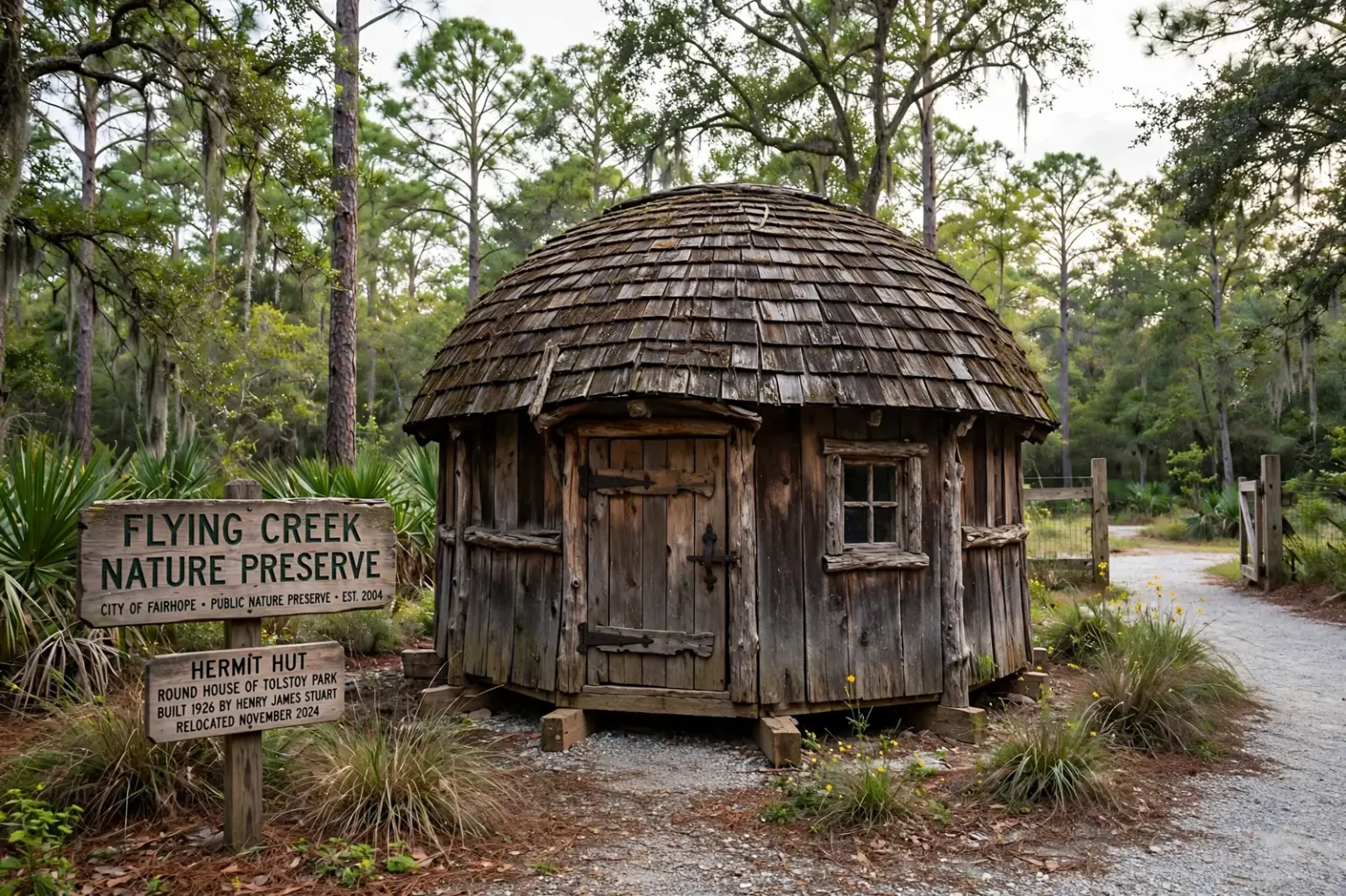
FAIRHOPE, Ala. — After a century on the Montrose homesite where it was built, the Hermit Hut, also called the Round House of Tolstoy Park, has a new and permanent address. The hand-built, dome-roofed structure was carried less than a mile this week to the City of Fairhope’s Flying Creek Nature Preserve, where it is expected to open to the public once again.
The trip itself lasted only a couple of hours. Getting to that point took about four years of planning, fundraising and negotiation by residents, city leaders and the property owner who agreed to part with the building.
The Hermit Hut Finds a Public Home
The relocation answers a question that had hung over the little round house for some time: what would become of it? With its future uncertain on private land, a group of residents organized to move and preserve it, and the effort ultimately landed the structure on public property where it can be cared for and visited.
The hut will sit just inside the main gate at Flying Creek Nature Preserve. Preserve officials said the new location will allow the building to be properly maintained and woven into the preserve’s educational and historical programming, so future generations can learn about the man who built it and the era he lived in.
Supporters who watched the move praised the City of Fairhope and the moving company for the care they took at every stage. One supporter said she would breathe easier once the building was settled firmly in the ground at its new site.
Who Built the Round House
The building is the work of Henry James Stuart (1858-1946), a Fairhope-area resident who built the circular structure by hand in the mid-1920s, completing it in 1926. Stuart named his property Tolstoy Park, a nod to the Russian writer Leo Tolstoy, whose ideas about simple living and self-reliance attracted admirers around the world in that era.
Stuart’s solitary life on the property earned him the nickname of the hermit, and the round, dome-topped house became a well-known landmark on the Eastern Shore. Its history has been documented through the National Register of Historic Places, and Stuart’s diaries and related materials have been preserved by local history organizations.
Now 100 years old, the building is closely tied to the story of Fairhope, a city founded in 1894 as a single-tax colony inspired by the economic ideas of Henry George.
A Cup of Coffee and Two Conditions
The path to preservation began with a conversation over coffee. Several years ago, the owner of the land where the house stood agreed to give the Round House to a Fairhope author and historian. The gift came with two conditions. First, the recipient had to pay for the cup of coffee over which they hammered out the deal. Second, he had to find a piece of public land where the house could be relocated.
The City of Fairhope put forward several possible sites. After weighing the options, all parties agreed on the Flying Creek Nature Preserve location. The author and historian, along with his dog, was on hand to watch the hut eased into its new spot.
The property owner said the number of people who stepped forward to help, from city staff to individual residents, made the long effort deeply rewarding.
Paying for the Hermit Hut Relocation
Moving a century-old, hand-built structure without damaging it is neither simple nor cheap. The relocation cost more than $400,000.
The bulk of the funding came from a grant from the Fairhope Single Tax Corporation, the organization that grew out of the city’s founding colony and still holds land and supports community projects. Citizens raised matching money through their own fundraising campaigns.
That blend of institutional and grassroots support is typical of historic preservation work in smaller communities, where a single landmark often depends on a coalition of donors, volunteers and local government to survive.
Why Flying Creek Fits Stuart’s Story
Supporters say the new site is more than convenient; it is connected to Stuart himself. A Fairhope City Council member noted that the preserve lies between Rock Creek and Flying Creek, in country Stuart would have crossed many times during his life. Rather than moving the house out of the area, the relocation keeps it close to where it was built and to the land that sustained its builder.
Another supporter pointed out that Stuart frequently walked into Fairhope from his homestead and almost certainly passed through the very ground where the house now stands. To those who championed the move, that gives the building a sense of returning to familiar territory rather than being uprooted.
What Comes Next
With the move complete, work turns to settling the structure at its new location just inside the preserve’s main gate. Once that is done, the Round House will again be open to visitors.
For a community that prizes its quirky, independent-minded history, the arrival of the Hermit Hut at Flying Creek adds a new chapter to a story that began in 1926. Residents and visitors alike will soon be able to step inside and see how one man built a home, and a way of life, with his own hands.
For more on Eastern Shore heritage, visit our local history coverage and the latest Fairhope news on South Alabama News.