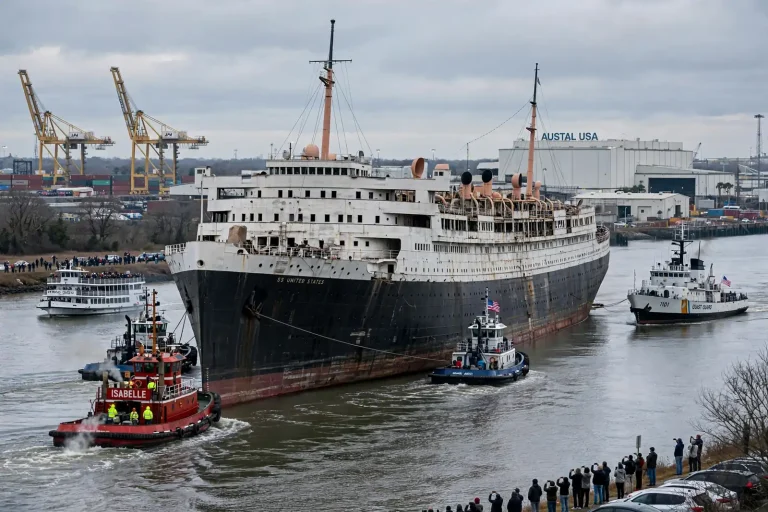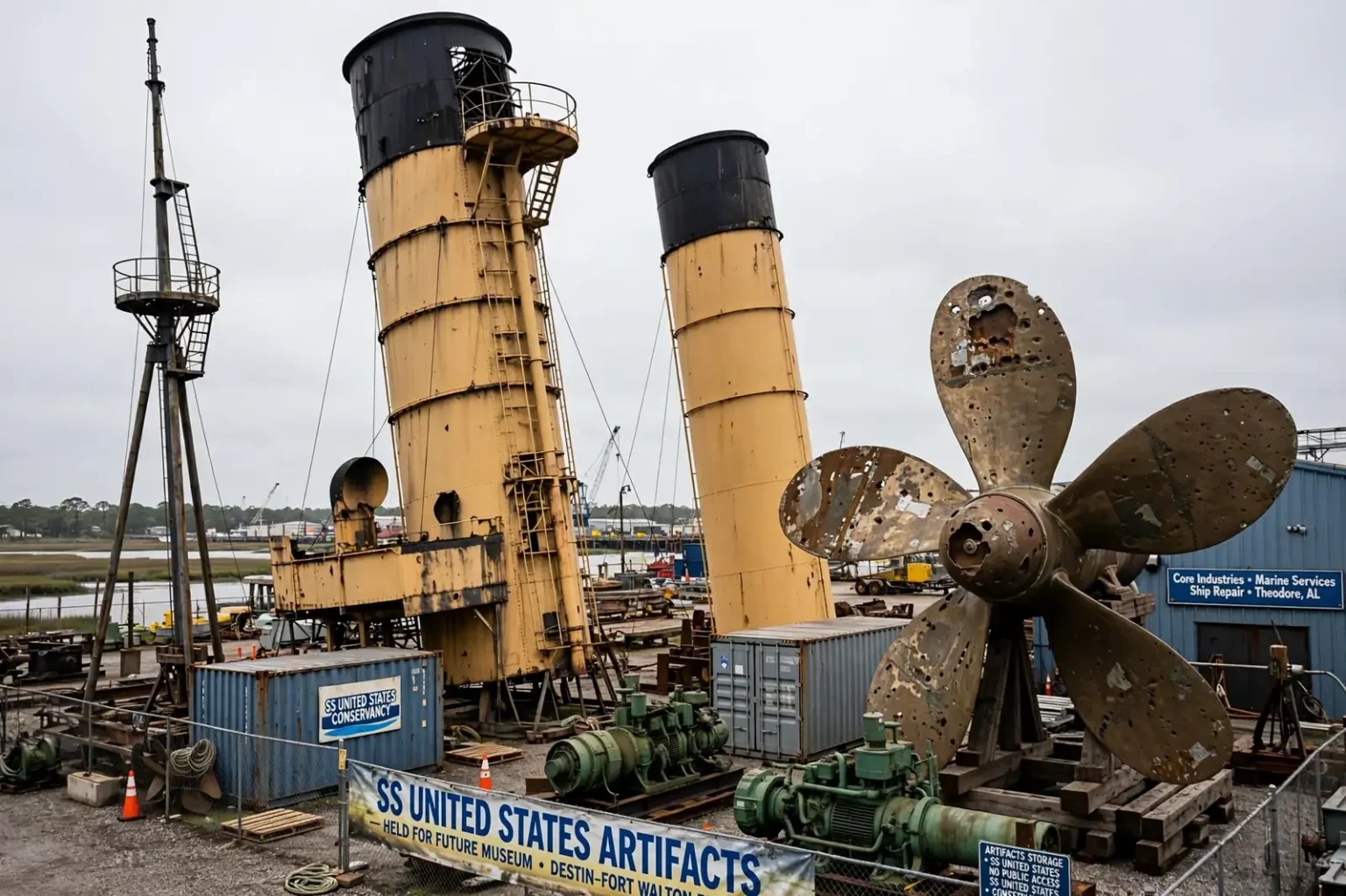
THEODORE, Ala. — The SS United States has sailed out of Mobile Bay, but some of the most recognizable SS United States artifacts are staying put for now. Two of the ocean liner’s towering smokestacks, a propeller, a mast and a pair of crow’s nests are among the pieces being kept at a waterfront industrial yard in Theodore until they can go on display in a museum planned for the Destin-Fort Walton Beach area.
The SS United States Conservancy, the nonprofit that has worked for years to preserve the ship’s legacy, intends to make the salvaged components centerpieces of that museum. In the meantime, they are being held at Core Industries, a Theodore site that serves the maritime industry with a broad range of services.
A Closer Look at the SS United States Artifacts
Even sitting in the open air or packed in shipping containers, the pieces give a sense of the scale of a vessel that was once the pride of American shipbuilding. Conservancy representatives showed the collection to members of the media on Tuesday, a day after the ship itself departed Mobile Bay on Monday.
The items being stored in Theodore include:
- The stacks: The ship’s distinctive funnels, each roughly six stories tall, were central to its sleek profile. One of them still has part of the superstructure attached at its base and weighs 113 tons, according to the conservancy.
- A mast and two crow’s nests: One crow’s nest sat on a mast forward of the stacks, while another once offered a lookout from the top of one of the stacks.
- A propeller: A massive five-bladed propeller from the ship’s propulsion system.
- Machinery: Two pumps driven by large diesel engines and an electrical control panel, among other components.
Inside one of the stacks, a network of catwalks, ladders and steps leads to the top. A conservancy representative who spent considerable time volunteering aboard the ship during its years at a Philadelphia pier recalled that climbing to the top of the forward stack was a favorite experience.
What the Propeller Reveals About Ocean Liner Engineering
The propeller may turn out to be one of the most instructive pieces in the collection. Its huge blades show heavy pitting from cavitation, a process in which zones of extremely low pressure form tiny bubbles in the water around a spinning propeller. When those bubbles collapse, they do so violently, striking the metal with bursts of shock and heat. Over time, that repeated pounding eats away at the surface.
Conservancy representatives emphasized that the wear was not a sign of poor design. Cavitation damage was common in large, high-performance propulsion systems of the era. In fact, Elaine Kaplan, who led the engineering of the ship’s propulsion system, is credited with developing an approach that reduced the problem compared with other major passenger liners of the day.
In the right light, the propeller also shows patches of slightly different metal where earlier damage was repaired. During the ship’s years in regular passenger service in the 1950s and 1960s, the conservancy said, the liner had two full sets of propellers. When the ship went into drydock for annual maintenance, its set of four propellers would be removed for repair, and a freshly refurbished set would be installed in its place. That rotation kept the ship running at top speed while the worn set was restored.
As a museum exhibit, a single propeller could help explain fluid dynamics, metallurgy, maintenance practices and the engineering race that defined transatlantic travel in the mid-20th century.
A Ship With a Remarkable History
The SS United States was designed by naval architect William Francis Gibbs and built at Newport News, Virginia. It entered service in 1952 and on its maiden voyage set a transatlantic speed record for passenger liners. The ship carried passengers between the United States and Europe until it was withdrawn from service in 1969.
For decades afterward, the liner sat idle, eventually spending many years docked on the Delaware River in Philadelphia, where volunteers and preservationists worked to keep its story alive. In 2024, Okaloosa County, Florida, acquired the ship with plans to sink it as an artificial reef in the Gulf, paired with a land-based museum to tell its story. The vessel was brought to Mobile to be prepared for that next chapter, and the artifacts now in Theodore were removed during that work.
Plans for a Museum in Northwest Florida
The conservancy hopes to open its planned SS United States museum, at least in an initial first phase, within roughly two years. Moving objects as large and heavy as the stacks presents real logistical challenges, conservancy representatives acknowledged, and getting them from Theodore to a permanent home along the Florida Panhandle will take careful planning.
The pieces in Theodore are only part of the collection. The conservancy has artifacts stored in locations across the United States and is now working to bring them together in one place. Some items have already been restored to showpiece condition.
Restored throttle boards
Among the restored items are components of the ship’s throttle boards, the control stations used to manage the ship’s engines. The liner had four throttle boards, each fitted with large wheels, gauges and dials. Most of those attachments have been refurbished and look new, and the conservancy now has one complete throttle board that is expected to be displayed in the museum. Representatives said they expect it to draw plenty of curiosity from visitors.
Why the Theodore Connection Matters
For Mobile County, the ship’s stay and the artifacts left behind are a reminder of the area’s deep ties to maritime work. Theodore’s waterfront businesses support shipbuilding, repair and marine services that serve vessels throughout the Gulf region, and the yard where the stacks now rest is part of that working coast.
The arrangement also links south Alabama to a project centered in Okaloosa County, where local leaders hope the reef and museum together will draw divers, history enthusiasts and tourists. More information about the ship’s preservation is available from the SS United States Conservancy, and details about the county’s reef and museum plans can be found through Okaloosa County.
What Comes Next
Until the museum is ready, the stacks, propeller and other components will remain in storage in Theodore while the conservancy consolidates its collection and works out how to move the largest pieces. When they are eventually put on display, visitors will be able to stand beside the same funnels that once defined the silhouette of America’s fastest ocean liner.
For more stories about the region’s past, visit our history coverage, and for local news from the area, see our Theodore news page.