Heroin Seizure, Human Smuggling Case Unfold Along I-10 and I-65 in Mobile County
Border Patrol and Mobile County deputies seized five pounds of heroin on I-10 and broke up an apparent human smuggling attempt on I-65.
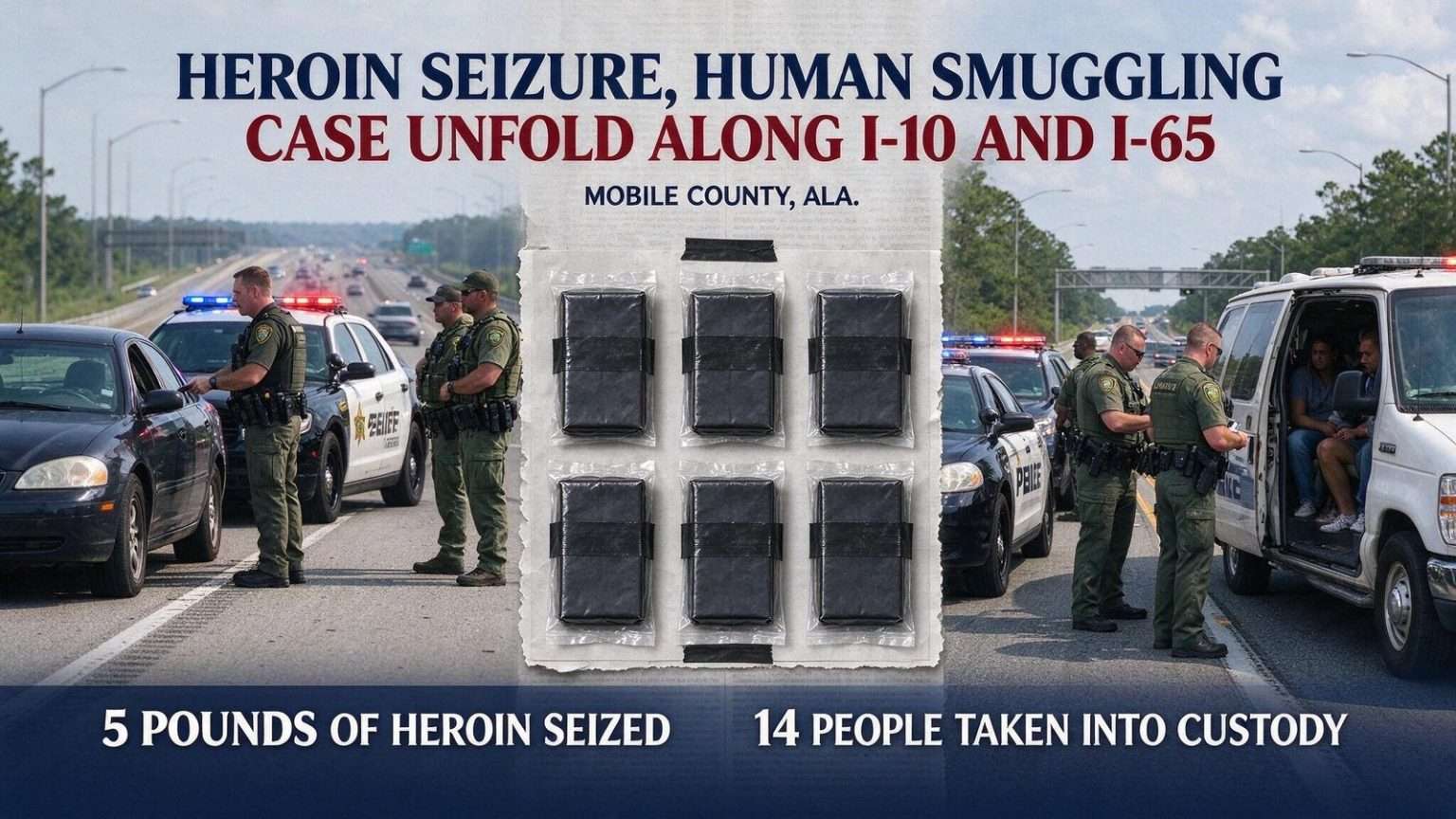
MOBILE COUNTY, Ala. — Back-to-back highway stops in Mobile County netted five pounds of heroin and 14 people taken into custody Tuesday in what authorities describe as an attempted human smuggling operation. Two separate traffic encounters on the county’s interstate corridors — one on Interstate 10, one on Interstate 65 — unfolded hours apart and drew in federal partners from the U.S. Border Patrol and Homeland Security Investigations, turning routine patrol work into two open federal cases in a single day.
The first case began when a Mobile County Sheriff’s Office special operations deputy spotted a vehicle drifting across lane lines on Interstate 10. With help from Border Patrol agents, the deputy stopped the vehicle and noticed the smell of alcohol, prompting a search. Hidden behind a compartment near the dashboard, deputies found six bricks wrapped in black electrical tape. A test of one of the objects came back positive for heroin, and the driver and the drugs were turned over to the Mobile County Sheriff’s Office.
Later that day, a Saraland police officer conducting a routine stop on Interstate 65 found a second vehicle packed far beyond its normal capacity with passengers carrying no U.S. identification. Border Patrol agents responded and determined all 13 passengers had entered the country illegally. The passengers and the driver — who claimed to work for a transportation service — were taken into Border Patrol custody, and Homeland Security Investigations is now handling the case.
A Drifting Vehicle on I-10
The heroin case began with the kind of driving behavior patrol deputies are trained to flag: a vehicle drifting across lane lines on Interstate 10. The deputy who made the stop was assigned to the Sheriff’s Office’s special operations detail, a unit that concentrates on interdiction and enforcement work along the county’s major corridors. What started as a possible impaired-driving stop became something much larger once the smell of alcohol prompted a closer look and a hidden compartment near the dashboard gave way to six bricks wrapped in electrical tape.
Field testing of one of the bricks came back positive for heroin, a result that transformed a traffic stop into a felony drug seizure. In all, authorities put the haul at five pounds of heroin — a quantity far beyond personal use, consistent with distribution weight. The driver and the narcotics were turned over to the Mobile County Sheriff’s Office, which took over the drug case while the Border Patrol agents who assisted remained part of the response.
Hidden dashboard compartments — often after-market modifications designed to defeat a casual search — are a known feature of drug transportation along interstate corridors. Deputies who find one describe the discovery as the hinge point of a stop: once a compartment is located, the contents become the case, and the initial reason for the traffic stop fades into the background of the eventual charges.
The sequence of a stop like the first one shows how quickly a routine encounter can escalate. The deputy observed the drifting vehicle and initiated the stop with Border Patrol agents assisting — a normal cooperative stop on a corridor where the agencies cross paths daily. The smell of alcohol inside the vehicle gave legal grounds for a search, the search revealed the hidden compartment, and the compartment held six bricks of what field testing confirmed was heroin. Each step built on the last, and the combination turned an impaired-driving investigation into one of the county’s larger drug seizures.
An Overloaded Van on I-65
The second case unfolded later that day, on Interstate 65 north of the city. A Saraland police officer conducting a routine traffic stop came upon a vehicle packed far beyond its normal capacity — more passengers than the vehicle was designed to carry, none carrying U.S. identification. The officer’s call brought Border Patrol agents to the scene, and after agents questioned the occupants, they determined that all 13 passengers had entered the country illegally.
The van’s driver claimed to work for a transportation service, an account investigators treat as a central thread of the smuggling case rather than a defense. Both the driver and the 13 passengers were taken into Border Patrol custody. The case has since passed to Homeland Security Investigations, the federal agency responsible for investigating human smuggling networks, which will work to establish who organized the transport, where the passengers were being taken, and whether the van’s run was part of a larger operation.
Overloaded vehicles with undocumented occupants are a recurring pattern on the interstate corridors that converge on Mobile County. I-65 runs north from Mobile toward Montgomery and the Midwest, while I-10 crosses the country east to west along the Gulf; the two highways intersect on the city’s western side, making Mobile County a junction point for traffic moving in every direction. For patrol officers and deputies, that geography means the region’s interstates see a steady flow of both legal travelers and, periodically, transports like the van stopped Tuesday.
Why the Interstates Draw This Traffic
Mobile County’s position on the map explains a great deal about days like Tuesday. The county is the western gateway to Florida for interstate traffic, the southern terminus of I-65, and home to the Port of Mobile — a combination that puts a constant, high-volume flow of vehicles through its corridors. Smuggling operations of both the drug and human varieties favor exactly that kind of junction: a place where long-haul traffic can change direction, where loads can be transferred, and where a transport moving between major markets passes through local jurisdictions rather than around them.
Law enforcement agencies respond with their own geography. The Sheriff’s Office special operations unit concentrates interdiction resources on the interstates; Saraland’s officers patrol the stretch of I-65 that passes through their city; and the Border Patrol stations agents where they can respond quickly when a local stop turns up an immigration question. The result is a layered net that Tuesday’s cases illustrate well — each stop caught by whichever layer happened to be on duty, then handed up the chain as its nature became clear.
Federal Partnerships in the Crosshairs
“We can never overstate the importance of relationships amongst local agencies,” Border Patrol New Orleans Sector Chief Greg Bovino said, crediting the partnerships for keeping dangerous drugs and criminals out of local communities. The quote reflects the operational reality of a day like Tuesday: neither of the cases belonged to a single agency. The I-10 stop combined a county special operations deputy with Border Patrol agents; the I-65 stop started with a Saraland municipal officer and ended in federal custody; and the smuggling case now sits with Homeland Security Investigations.
The Border Patrol’s New Orleans Sector covers the Gulf South, including the Alabama coast, and its agents routinely back up local officers on stops where immigration status comes into question. That arrangement cuts both ways: local agencies gain federal resources and detention authority they do not themselves possess, and federal agencies gain the street-level presence of deputies and municipal officers who patrol the corridors every day. Tuesday’s back-to-back outcomes are the kind of result those partnerships are designed to produce.
What Happens Next in Each Case
The two cases now follow separate tracks. The heroin seizure remains with the Mobile County Sheriff’s Office, which will present the drug case as charges against the driver move through the court system. The quantity involved — five pounds tested positive for heroin — suggests distribution-scale trafficking rather than personal use, and trafficking cases of that size typically involve coordination between local investigators and federal prosecutors who can pursue the enhanced penalties that larger quantities carry.
The smuggling case, meanwhile, sits with Homeland Security Investigations. Agents there will interview the 13 passengers — both as subjects of immigration processing and as potential sources of information about who arranged the transport — and work to identify the network behind the van’s run. Smuggling investigations often extend well beyond the vehicle that was stopped, tracing payment structures, staging houses, and the routes that moved the passengers toward Mobile County in the first place.
Heroin seizures of this size carry particular weight for the Gulf Coast. The drug’s presence in the region’s illicit market has been a persistent concern for law enforcement and public health officials alike, and five pounds arriving in a single hidden compartment represents a volume measured in tens of thousands of individual doses rather than a user’s supply. Interdictions like Tuesday’s remove that product from circulation before it reaches the streets, which is why agencies publicize the seizures when they happen.
For Mobile County, the day stands as an example of the volume that moves quietly along its interstates — and of the layered enforcement, from a municipal officer’s routine stop to a federal investigation, that sits between the corridors and the communities around them.
Neither case had produced additional public details as of the announcements, and both remain active investigations.