

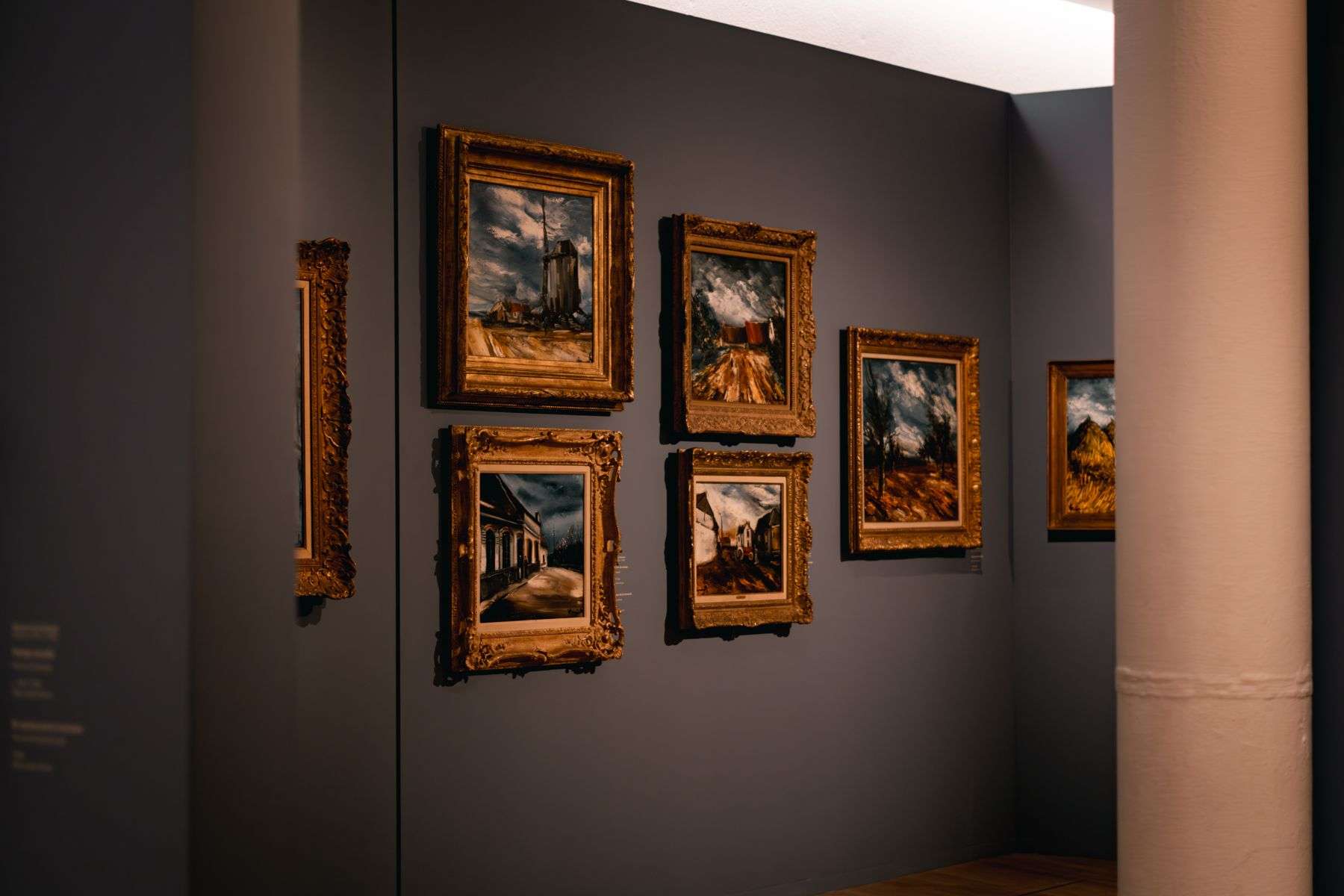
Long before downtown Mobile’s current wave of restaurant openings and streetscape improvements, a handful of local business owners were already experimenting with a simple idea: turning everyday commercial spaces into informal art venues. One clear example has played out at The Blind Mule, a Southern and Cajun-Creole restaurant and bar on North Claiborne Street, where local artists have found wall space, foot traffic and an audience that might never set foot inside a traditional gallery.
Regulars simply call it “the Mule.” Beyond its food and drink menu, the restaurant has built a reputation as a gathering point for the city’s creative community, with rotating artwork and live music helping give the space an identity distinct from a typical downtown eatery. That combination — good food, a relaxed bar atmosphere and original artwork on the walls — has made it one of several small businesses in Mobile’s historic core that double as informal exhibition spaces for artists who might otherwise struggle to find a place to show their work.
A Gallery Run From Behind the Bar
At The Blind Mule, that role has fallen to Zach Depolo, who has curated and run the in-house gallery, giving emerging Mobile artists a rotating platform for their work. Among the artists whose pieces have hung at the restaurant are Ryan Jetten, Sol Davis and Ashelea Penquite, a cross-section of the kind of working local artists who make up much of the city’s visual arts scene — painters, printmakers and mixed-media artists who often balance day jobs with studio time and rely on informal, low-barrier venues to get their work seen.
Arrangements like the one at the Mule are common in small and mid-sized cities where formal gallery space is limited or expensive. Rather than paying commission or rental fees to a traditional gallery, artists showing in restaurants, coffee shops and bars typically work out an informal consignment or flat-hang arrangement with the business owner, sometimes splitting sale proceeds and sometimes simply trading wall space for exposure. For business owners, hosting rotating art offers a low-cost way to refresh the atmosphere of their space and draw in customers who come specifically for an opening or a themed art night. For artists, particularly those early in their careers, it offers something a commercial gallery often cannot: a built-in audience of regulars who already trust the venue and are inclined to look closely at whatever is on the walls that month.
Part of a Broader Downtown Pattern
The Blind Mule’s approach fits into a broader pattern that has defined downtown Mobile’s slow-building arts and entertainment revival over the past few decades. As the city’s historic core lost some of its retail base to suburban shopping centers in the late 20th century, many of downtown’s storefronts sat vacant or underused for years. Restaurants, bars and small businesses that moved into those buildings — often taking over structures dating to the 19th and early 20th centuries — have frequently doubled as informal cultural venues, hosting live music, trivia nights and art shows alongside their primary business.
That pattern is especially visible in the Lower Dauphin Street district, commonly known as LoDa, the historic downtown neighborhood where North Claiborne Street sits just a block off Dauphin Street itself. LoDa traces its roots to Mobile’s earliest days as a French colonial port city, and its surviving architecture spans building styles from the Civil War era through the early Industrial Revolution. The district is anchored by landmarks including Bienville Square and the Cathedral Basilica of the Immaculate Conception, and it has become the connective tissue between Mobile’s downtown business district, its restaurant and nightlife scene, and its visual and performing arts community.
LoDa has for years hosted a monthly Second Friday Art Walk, in which downtown businesses — galleries, boutiques, restaurants and bars among them — stay open late and coordinate around a shared theme, drawing residents downtown after dark on a night when many storefronts would otherwise be closed. Events like the Art Walk have helped normalize the idea that a night out downtown might mean browsing a restaurant’s rotating wall art as easily as it means ordering dinner, and they have given small, informally run galleries like the one at The Blind Mule a built-in audience and a recurring reason for people to come back.
Why Nontraditional Venues Matter for Emerging Artists
Organizations such as the Mobile Arts Council have long worked to support the city’s artist community through grants, exhibition space and coordination of citywide arts events. The nonprofit, established in 1955 by the Junior League of Mobile and formally organized as a 501(c)(3) in 1962, was originally created to help fund local artists and cultural groups directly; over time, as many of those groups grew self-sufficient, it shifted toward its current role as an advocate, resource hub and connector for the region’s arts community. That evolution mirrors, on a citywide scale, the same dynamic playing out storefront by storefront in places like the Mule: formal institutions and informal, grassroots venues each filling a different part of the gap between an artist making work in a studio and that work reaching an audience. Even with a dedicated arts council in place, though, the reality for most emerging visual artists is that formal gallery representation is difficult to secure early in a career. Commercial galleries typically take a substantial commission on sales and are selective about whose work they show, both because wall space is limited and because a gallery’s reputation is tied to the artists it represents. That selectivity, while it helps maintain a gallery’s brand, can also shut out artists who haven’t yet built a sales record or a following.
Nontraditional venues — restaurants, bars, coffee shops, even barbershops and retail stores — have increasingly filled that gap in cities across the country, not just in Mobile. These spaces typically operate with far less formality than a commercial gallery: there is often no application process, no long waiting list and no expectation of gallery-standard framing or presentation. An artist might simply approach an owner they already know, or be introduced through a mutual friend in the local music or restaurant scene, and the arrangement can be as simple as an understanding to rotate pieces every month or two. For many artists, that informality is the entire appeal — it lowers the barrier to showing work publicly for the first time, lets them gauge how audiences respond to new pieces, and can lead to studio visits, commissions or eventually representation by a more traditional gallery.
The tradeoff is that these venues rarely offer the same visibility, insurance or professional handling that an established gallery provides, and sales, when they happen, are usually negotiated informally between the artist and a buyer rather than processed through a gallery’s established systems. Even so, for a city the size of Mobile, where the number of dedicated commercial galleries has historically been limited compared to larger metro areas, restaurants and bars willing to hand over wall space have played an outsized role in keeping local visual art visible to the public.
Live Music as a Companion Draw
Art is only part of what has drawn people to The Blind Mule. Like many of its downtown Mobile peers, the restaurant has also served as a small live-music venue, another common pairing in the world of informal, artist-friendly businesses. Live music and visual art often travel together in these spaces: both rely on a business owner willing to share some control over their space’s atmosphere in exchange for the cultural cachet and foot traffic that comes with being known as a place where local creative talent gathers. A restaurant that hosts a singer-songwriter one night and rotates a local painter’s canvases on its walls the same month is, in effect, running two informal cultural programs at once, each reinforcing the other’s audience.
For downtown Mobile specifically, that kind of layered programming — food, drink, music and art under one roof — has been part of what distinguishes the Lower Dauphin Street corridor from more conventional commercial strips. Visitors are as likely to remember a restaurant for the local artist whose work hung on its walls during a given visit as they are for a particular dish, and that blurring of categories has become something of a signature for the neighborhood’s smaller, independently owned businesses.
A Model That Has Endured
The basic model behind pairings like the one at The Blind Mule has proven durable in Mobile and in similar mid-sized Southern cities: independent restaurants and bars continuing to double as low-stakes exhibition space for artists building their careers, while arts organizations, formal galleries and citywide events like the Second Friday Art Walk provide the more structured side of the local arts ecosystem. Together, they form a layered support system that gives artists multiple ways into public view, from a single canvas on a restaurant wall to eventual representation in a dedicated gallery space.
For residents and visitors alike, that means a walk through downtown Mobile’s historic core can turn up original local art in places that might not advertise themselves as galleries at all — a reminder that in a city with deep architectural and cultural history, some of its most active creative spaces are hiding in plain sight, tucked behind a restaurant’s bar or above a booth in a corner banquette.