Irvington Man Killed on Half Mile Road, Driver Faces Murder Charge
A 53-year-old Irvington man died after being struck while walking on Half Mile Road, and Alabama State Troopers have charged the driver with murder.
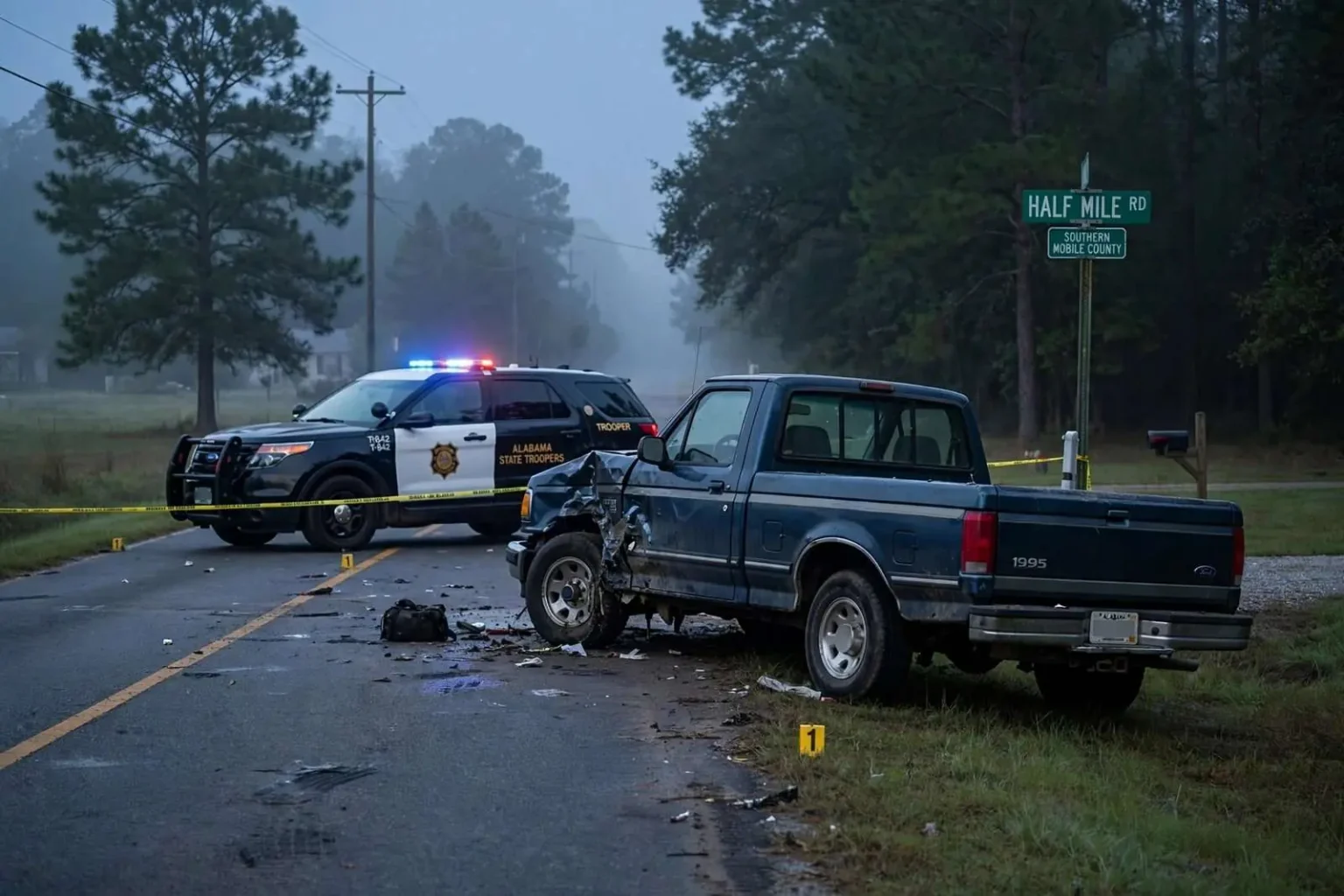
A quiet stretch of Half Mile Road in southern Mobile County became the scene of a fatal collision that has left an Irvington man dead and a young driver facing a murder charge, according to Alabama State Troopers. Investigators say 53-year-old Joseph Miller was walking along the roadway, roughly seven miles outside Mobile, early in the morning when he was struck by a pickup truck. Miller, an Irvington resident, was pronounced dead at the scene.
The Crash and the Driver
Troopers identified the driver as 27-year-old David Muir, who was behind the wheel of a 1995 Ford Ranger at the time of the crash. Muir was taken to a nearby hospital with injuries described as non-life-threatening.
According to the State Troopers Traffic Homicide Investigators unit, toxicology findings indicated Muir was under the influence of a controlled substance when the crash occurred. Once he was released from medical care, investigators charged him with murder rather than a lesser traffic offense, a decision that reflects how seriously officials treated the impairment behind the wheel.
The choice of charge is significant. Under Alabama law, a driver involved in a fatal crash while impaired can face homicide charges when prosecutors conclude the conduct showed a wanton disregard for human life, rather than the lesser vehicular offenses that cover ordinary negligent collisions. The distinction turns on the driver’s state: an impaired driver who kills is treated not as someone who made a traffic error but as someone who put others at mortal risk by choice.
Muir was booked into the Mobile Metro Jail following his release from the hospital. The case now moves through the Mobile County court system, where prosecutors will need to build out the circumstances of the early morning crash for a grand jury. The grand jury will hear the toxicology results, the reconstruction of the crash and witness accounts before deciding whether to return an indictment that sends the case forward to trial.
The Road and the Community
Half Mile Road runs through a rural section of southern Mobile County near Irvington, an unincorporated community that sits between Mobile and the Mississippi state line. Pedestrians walking along the shoulder of two-lane rural roads in the area have long faced risks from limited lighting and narrow shoulders, and residents in small communities like Irvington often rely on walking or biking along these routes for transportation.
The geometry of rural roads compounds the danger. Shoulders that are narrow or unpaved leave little room between a pedestrian and passing traffic, curves and darkness limit sightlines, and traffic that moves at highway speeds on roads that function as neighborhood streets. An early morning hour multiplies every one of those factors, when darkness is deepest and drivers are most likely to be tired or impaired.
The case is a reminder of the danger impaired driving poses on rural roads throughout Mobile County, where speed limits are higher and there is often little separation between vehicle traffic and anyone traveling on foot. Traffic safety advocates in the region have repeatedly pointed to the combination as a lethal one: the county’s rural roads see fatal crashes at rates that alarm state highway safety officials, and pedestrians are among the most vulnerable people on them.
How the Investigation Proceeds
The State Troopers Traffic Homicide Investigators unit handles fatal crashes across Alabama with a forensic approach that goes far beyond a typical accident report. Investigators document the scene with measurements and photographs, reconstruct vehicle speeds and trajectories from physical evidence, download data from the vehicles where possible, and obtain toxicology samples from everyone involved. The findings become the backbone of any criminal case that follows.
In this crash, the sequence ran from the scene to the hospital to the jail: Muir received treatment first, and the murder charge came once he was released from medical care, a reflection of both his injuries and the priority of completing the medical evaluation before booking. The toxicology results that formed the basis of the charge would have come back from the state lab in the days after the crash, converting an initially unexplained fatality into a criminal case.
Alabama’s grand jury process adds another stage. In Mobile County, prosecutors present the evidence from the homicide investigation to a grand jury of citizens, which decides whether probable cause exists to indict. An indictment is not a finding of guilt, but it is the constitutional gate the case must pass before trial, and in impaired-driving death cases the toxicology and reconstruction reports are typically the central exhibits.
Impaired Driving as a Homicide Charge
Alabama is among the states that treat impaired driving deaths with genuine homicide charges, and Mobile County prosecutors have not hesitated to seek them. The logic is deterrence as much as punishment: when a fatal crash caused by impairment can result in a murder conviction with a prison term measured in decades, the gap between driving drunk or high and staying off the road becomes as stark as the law can make it.
The charge also reflects the fatal arithmetic of impairment. Controlled substances and alcohol degrade exactly the faculties that keep a two-ton pickup away from a pedestrian on a dark rural shoulder: reaction time, judgment, lane keeping and speed control. When those faculties fail where a person is walking, the margin between a near miss and a death is measured in inches and split seconds that an impaired driver cannot manage.
Pedestrian Safety on Rural Mobile County Roads
For the communities along Half Mile Road and the surrounding rural stretches of southern Mobile County, the crash underscored a daily reality. In unincorporated areas without sidewalks, streetlights or transit, walking along the road shoulder is not recreation — it is how people get to work, to stores and to family when no other option exists. Irvington sits along the corridor between Mobile and the Mississippi line, and its residents share the roads with commuter and commercial traffic that moves fast and rarely stops.
Safety engineers classify such roads as lacking positive separation between pedestrians and vehicles, the design feature most associated with pedestrian fatalities. Where no sidewalks exist, the shoulder is the walkway; where no lighting exists, dusk to dawn is the high-risk window. Advocates have called for wider shoulders, better lighting at known walking routes and enforcement attention on rural corridors, but for small communities the changes tend to come slowly and often only after a death.
Miller’s death adds to that ledger — a 53-year-old man walking near his home community, killed in the early morning by a driver now alleged to have been under the influence. The grand jury’s decision will determine whether the case proceeds to trial, but for the people who live and walk along Half Mile Road, the danger it illustrates needs no verdict to be understood.
The People Behind the Statistics
Fatal crashes on rural roads arrive with a routine — the trooper’s report, the charge, the court date — but for the Irvington community they land as the loss of a neighbor. Miller was 53, a resident of a small unincorporated town where families know one another across generations, and his death while walking near home is the kind of loss that reshapes how a community uses its own roads. Residents who walked the same stretch will weigh every trip differently now.
The case also places two lives in the balance: the victim’s family, seeking accountability through the courts, and a 27-year-old driver facing a murder charge that could define the rest of his life. Mobile County’s courts will now mediate between those stakes, with prosecutors presenting the toxicology and reconstruction evidence and the defense answering whatever indictment the grand jury returns.
Enforcement Patterns in Mobile County
Law enforcement agencies across Mobile County — state troopers on the rural highways, county deputies and municipal police in the communities — run sustained enforcement against impaired driving, from checkpoints to saturation patrols funded through federal highway safety grants. The rural southern end of the county presents particular challenges for that enforcement: long distances, few alternative routes and roads where a patrol car may pass only minutes apart.
Prosecutors in the county district attorney’s office have historically taken a hard line on impairment-related deaths, and the decision to file murder charges in this case fits that pattern. The charge signals to drivers across the county that the question after a fatal crash will not be whether impairment mattered but whether it will be treated as what the law calls it — conduct that shows a wanton disregard for life.
What Comes Next
The procedural road ahead runs through the grand jury, and if an indictment follows, through arraignment, motion practice and eventually trial in Mobile County Circuit Court. Cases of this kind turn on the toxicology evidence, the crash reconstruction and the testimony of anyone who saw the truck or the pedestrian in the minutes before the collision. The defenses available to Muir will depend on the details of the state’s evidence, and the timeline will run in months, not weeks.
For the family of Joseph Miller, the process is the state’s answer to a question no family wants to ask — how a man walking along a road near his home came to be struck and killed before daylight. The murder charge represents the legal system’s judgment that the answer lies not in an accident of geometry or timing but in a driver’s choice to be on the road under the influence of a controlled substance.
And for the rural roads of southern Mobile County, the case joins the long list of warnings that safety advocates repeat after each death: narrow shoulders, darkness, speed and impairment are a combination that kills, and until either the roads or the driving habits change, the people who walk them remain the most exposed travelers in the county.