Irvington Woman, 45, Dies After Mobile County Crash on Murray Hill Road
ALEA says 45-year-old Mary Wescovich of Irvington died after her car left Murray Hill Road in Mobile County, hit a culvert and caught fire.
MOBILE COUNTY, Ala. — A 45-year-old Irvington woman has died from injuries she suffered in a single-vehicle crash in western Mobile County, according to the Alabama Law Enforcement Agency. The victim was identified as Mary Wescovich. The crash occurred on Murray Hill Road, a two-lane route that winds through the rural communities west of Mobile, and it adds Mobile County to the list of Alabama counties where run-off-the-road collisions continue to claim lives on lightly traveled country roads.
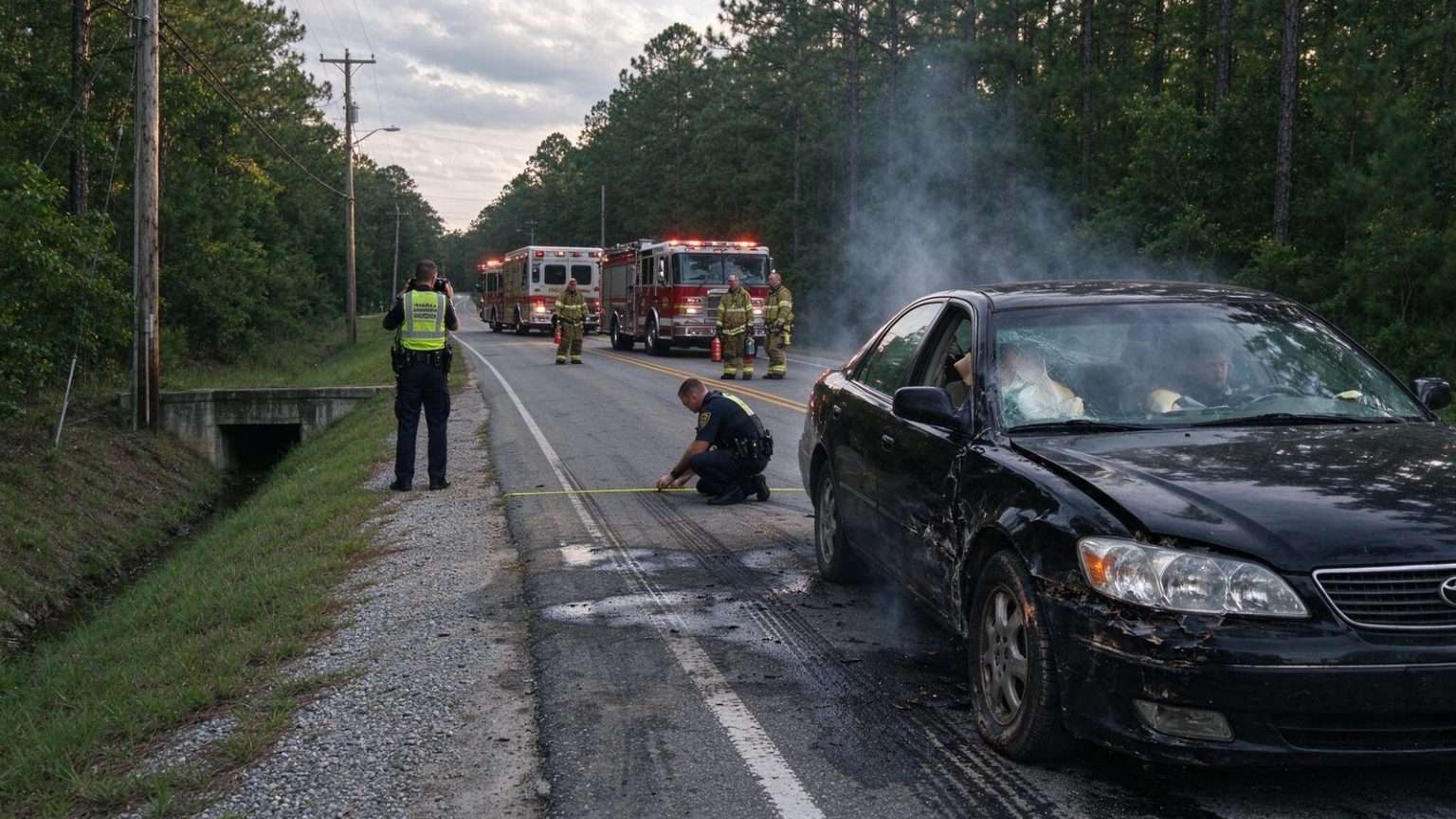
Troopers said Wescovich was driving a 2000 Toyota Avalon when the sedan left the roadway on Murray Hill Road. The vehicle struck a culvert, a drainage structure that channels water beneath or alongside the road, and then caught fire. Emergency crews responded to the scene, and Wescovich was transported to University Hospital in Mobile, the region’s major trauma center, where she later died of her injuries.
The sequence described by troopers — a vehicle departing the travel lane, striking a fixed drainage feature and then burning — is the kind of chain of events that safety officials have long warned turns a brief moment of inattention or a tire dropping off the pavement into a fatal collision. Culverts and drainage ditches line long stretches of the rural roads in western Mobile County, and while they are essential to keeping those routes passable in the Gulf Coast’s heavy rains, they also present unforgiving fixed objects close to the edge of the pavement.
No other vehicles were reported involved in the crash, and troopers said the investigation remains active. ALEA’s Highway Patrol Division continues to work to determine what caused the Avalon to leave the road, a process that in crashes like this one typically involves examining the vehicle, the roadway and any available evidence to rule in or out factors such as speed, mechanical failure, a medical event or driver distraction.
How ALEA investigates fatal rural crashes
When a crash involves a fatality, responsibility for the investigation falls to the Alabama Law Enforcement Agency, the state agency formed in 2015 that consolidated the former state troopers and several other law enforcement and public safety functions under one umbrella. Within ALEA, the Highway Patrol Division handles traffic crash reconstruction and investigation across Alabama’s 67 counties, including the unincorporated stretches of Mobile County that lie outside city police jurisdictions.
In a fatal single-vehicle crash, troopers document the scene in detail: the path the vehicle traveled before leaving the road, the point of departure from the pavement, the impact with the culvert, and the condition of the car afterward. Investigators also look at the vehicle itself. A 2000 Toyota Avalon, by the time of this crash, was a roughly two-decade-old sedan, and the age and mechanical condition of vehicles involved in rural crashes is a routine part of ALEA’s review. Findings from the investigation are typically used to complete the crash report and can be referred to the Mobile County District Attorney’s Office if the evidence points to any violation of law.
Because no other vehicles were involved, there is no second driver to provide an account of what happened, which often makes these investigations slower. Investigators may await results of any toxicology testing and vehicle inspection before closing out the case file. ALEA has not released a determination of cause, and troopers typically do not comment on the likely factors in a crash while the investigation is ongoing.
The road and the community it serves
Murray Hill Road runs through a rural, heavily wooded part of western Mobile County, connecting neighborhoods and family properties between the communities of Irvington and the surrounding crossroads settlements that grew up along the old north-south and east-west farm routes west of Mobile. The area is characterized by long, straight stretches interrupted by curves, pine and hardwood timber close to the shoulder, and an extensive network of drainage ditches and culverts built over decades to carry off the region’s frequent heavy rainfall.
Irvington itself is an unincorporated community southwest of Mobile, best known to many area residents as the home of the Greater Gulf State Fairgrounds, which hosts the Greater Gulf State Fair each fall and a series of other events through the year. The surrounding area remains largely residential and agricultural, with many residents commuting into Mobile or Pascagoula, Mississippi, for work. That daily commuting pattern means rural routes such as Murray Hill Road carry steady local traffic even though they sit far from the interstate corridors.
Roads of this type present a particular set of hazards that traffic safety officials have described for years. Lighting is minimal or absent outside settled corners, shoulders are often narrow, and the proximity of ditches, culvert headwalls and trees to the pavement means there is little recovery room once a vehicle drops its right-side wheels off the asphalt. At rural operating speeds, the time between a run-off-the-road event and a fixed-object impact can be measured in seconds, and occupants may have little opportunity to regain control.
Why culvert strikes are so dangerous
Culverts are among the most common fixed objects struck in rural Alabama crashes. A culvert crossing typically presents a concrete or metal headwall and an abrupt drop at the inlet, both of which can cause a vehicle to trip, vault or stop suddenly rather than slide. Traffic engineers classify such objects as fixed hazards, and modern road design practice favors shielding them with guardrail, flattening slopes or installing traversable drainage where traffic volumes and crash history justify the cost. On low-volume rural roads, however, many drainage structures remain unshielded, and crews prioritize resurfacing and ditch maintenance over protective hardware.
The fire that followed the impact in this crash compounded the danger. Vehicles that strike hard fixed objects at speed can suffer fuel system damage, and any fire that follows leaves occupants with only seconds to escape, particularly if the impact has disabled doors or left the driver incapacitated. State troopers and local fire departments in rural Mobile County regularly respond to crashes where the vehicle fire, rather than the initial impact, produces the fatal injury, and the combination of the two is among the deadliest scenarios responders face on two-lane roads.
Emergency response times in the unincorporated western part of the county are shaped by geography. Volunteer and county fire departments staff stations spread across a wide rural area, and ambulance transport from a crash scene west of Mobile typically runs to University Hospital, the teaching hospital and Level I trauma center in the city that serves as the destination for the region’s most serious injuries. Even with a well-practiced trauma system, the distance from a rural crash scene to definitive care is measured in miles that an injured patient travels while firefighters work to stabilize the scene and any fire.
What the crash means for area drivers
Troopers and county officials have long urged drivers on rural routes like Murray Hill Road to treat the edge of the pavement as a boundary to be respected. The standard guidance is familiar from driver education: if a vehicle’s wheels drop off the pavement, drivers are advised to ease off the accelerator, hold the wheel steady and gently bring the car back onto the road rather than braking hard or yanking the wheel, either of which can send the vehicle across the roadway or into the ditch line on the opposite side.
Seat belt use remains the single most effective protection in a run-off-the-road crash, according to state highway safety officials, because the majority of fatal single-vehicle collisions involve ejection or severe interior contact that belts are designed to prevent. Alabama has enforced a primary seat belt law for front-seat occupants for years, meaning a trooper may stop a vehicle solely for an unbelted driver, a policy adopted after the state recorded some of the lowest belt-use rates in the nation in earlier decades. Rural counties have historically lagged urban ones in belt use, a gap that safety offices attribute in part to the short, familiar trips that make up most rural driving.
Speed relative to conditions is the other recurring factor on roads like this one. A two-lane route that is passable at the posted limit in dry conditions can behave very differently in the Gulf Coast’s frequent afternoon downpours, when standing water collects along the shoulder and hydroplaning risk rises. Maintenance crews with the Mobile County Public Works Department grade shoulders and clear ditches on a rotating schedule, but the fundamental geometry of the old rural routes — narrow pavement, close-in drainage, timber near the right of way — changes slowly, if at all.
For the close-knit communities along Murray Hill Road and in Irvington, a fatal crash on a familiar route lands with particular force. Rural churches, volunteer fire departments and school communities across western Mobile County frequently become gathering points in the days after a resident is lost, and the sight of the crash scene — where the damaged drainage structure and scorched shoulder mark the spot — remains part of the daily drive for neighbors until repairs are made.
The investigation by ALEA’s Highway Patrol Division continues, and troopers have not announced a determination of what caused the Avalon to leave the roadway. The Mobile County Coroner’s Office handles the formal determination of cause of death in fatal crashes in the unincorporated county, and the findings of the troopers’ reconstruction will accompany the case file. As with any active investigation, officials have said further details would be released only as the review is completed.