Irvington’s Forward Church Unveils Rebuild Plans Two Years After Fire Gutted Sanctuary
Two years after a fire gutted its sanctuary, Forward Church in Irvington unveiled rebuild plans under a new name, aiming to break ground within a month.
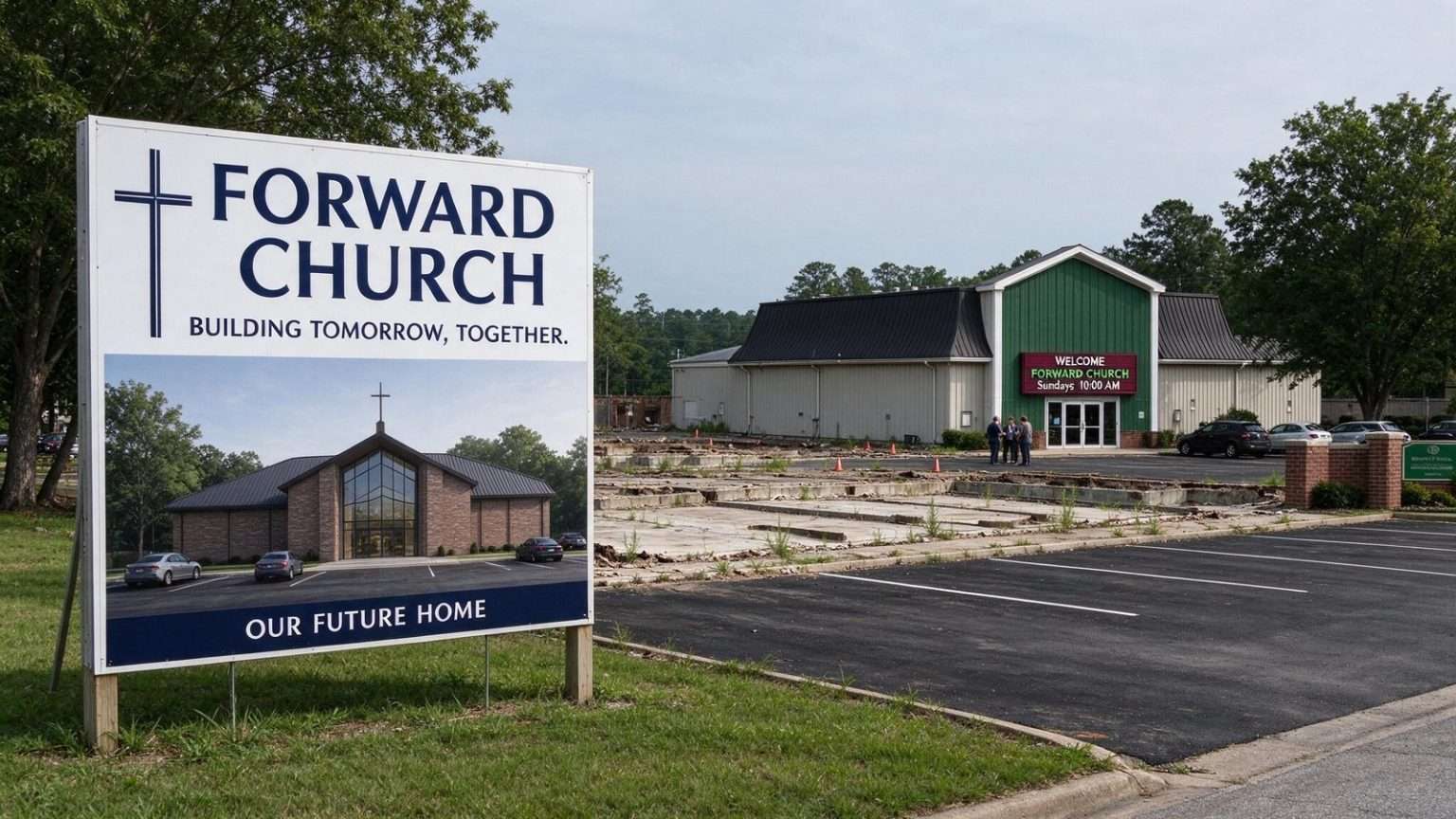
IRVINGTON, Ala. — More than two years after flames gutted its main sanctuary, a south Mobile County congregation is officially moving ahead with a fresh start — and a new name. The church formerly known by several names across its long history in the bayou community unveiled rebuilding plans Sunday under its new identity: Forward Church, drawing members, neighbors and well-wishers to see the future of a congregation that refused to stop meeting after the fire.
An April 2017 fire left the sanctuary a smoking shell, and the old building’s foundation is still visible in the parking lot. For members who had worshipped in the building for decades, the ruins became a daily reminder of what was lost — and, increasingly, of the patience it would take to build something new in its place.
Since then, the congregation of more than 200 members has kept worshipping without interruption, holding services and church functions in its gym. The gym — a modest building by the standards of the sanctuary it replaced — has served as sanctuary, classroom space and fellowship hall all at once, its pews and folding chairs carrying the congregation through two and a half years of Sundays.
‘From a fire on Thursday to church on Sunday’
Longtime members say the church remains a vital part of the community, and that its spirit never wavered after the blaze. In small south Mobile County communities like Irvington, a church is more than a Sunday destination: it hosts funerals and weddings, organizes help after storms, and anchors the social calendar for families who have farmed, fished and raised children along the bayous for generations.
“We went from a fire on Thursday to church on Sunday and never stopped giving God the glory,” said Rosa Zirlott, a longtime member. Her line — already retold around the community — captures the timeline that members still recount with wonder: flames gutted the building before the weekend, and the congregation gathered anyway, two days later, with nowhere to meet but the gym.
Cassie Driver, the pastor’s wife, called the unveiling significant both for newcomers like her family and for members who have attended their entire lives. The blend of longtime families and recent arrivals has shaped the congregation’s character through the rebuilding period, as older members carried institutional memory and newer ones brought energy for the work ahead.
Lead Pastor Justin Driver said the past two and a half years have been about healing as much as construction. “We understood this church had to go through a healing process and it took time,” he said. “I feel we’re at a place where we move forward together.” His words doubled as an explanation for the church’s new name, chosen to mark the moment the congregation turns from recovery to building.
Rebuilding in the bayou community
The congregation hopes to break ground on the new building next month, with a finished structure possible sometime next year. Members who attended the unveiling saw plans for a sanctuary designed to restore what the fire erased — a proper worship space after years of gym-floor services — along with the practical rooms a growing church needs.
Rebuilding a church is rarely a simple construction project. Congregations typically piece together insurance proceeds, designated savings and fundraising drives, and south Alabama’s bayou communities have watched neighboring churches navigate that arithmetic after fires and hurricanes alike. The two and a half years between the blaze and the groundbreaking reflect that reality as much as any indecision on the members’ part.
The old foundation that still shows in the parking lot will give way to the new footprint, closing a chapter that members have walked past every Sunday since 2017. For some, the unveiling was the first time they allowed themselves to picture Sunday services in a real sanctuary again rather than under the gym’s rafters.
Irvington and the communities around it
Irvington sits in the stretch of south Mobile County between Theodore and the fishing towns of Bayou La Batre and Coden, an unincorporated community where churches, schools and seafood businesses form the backbone of local life. The area has weathered more than its share of trials in recent decades — hurricanes, the BP oil spill’s toll on the seafood economy and the slow economic shifts that have hollowed out many rural communities — and congregations have been among the institutions that held those places together.
In communities of this size, a church fire ripples far beyond its membership rolls. Neighboring congregations offered space and support after the 2017 blaze, and residents who attend other churches followed the rebuilding effort with the familiarity of people who have traded help across denominational lines for generations. Volunteer labor, donated materials and benefit meals are the customary currency of church rebuilding in south Alabama.
The gym that carried the congregation through the rebuilding years reflects that same practical streak. Many south Alabama churches built fellowship gyms in decades past for basketball leagues and suppers, never imagining one would serve as a sanctuary — yet the arrangement kept more than 200 members worshipping together every week rather than scattering to other congregations.
A new name for a long history
The church formerly known by several names across its long history now carries one chosen for the moment ahead. Renaming a congregation is a weighty step in any community, particularly one where family names and church names intertwine across generations, and the leadership’s decision to move forward under “Forward Church” signals that the rebuild is framed as a new beginning rather than a restoration of the past.
Members say the identity change has helped newcomers and lifelong attendees meet as equals in the same chapter. For families who have attended their entire lives, the name honors what the congregation became through the fire; for those who joined recently, it marks the church they joined rather than one they only heard about.
Pastor Justin Driver’s emphasis on healing before construction reflects a philosophy that rebuilding committees often learn the hard way: walls go up quickly compared with the time it takes a congregation to grieve a loss, settle on a vision and commit to the cost. The unveiling, in that sense, was as much a milestone of the heart as of the building schedule.
What comes next
If the groundbreaking happens next month as planned, construction will begin just as south Alabama enters the cooler months that favor building schedules, with a finished structure possible sometime next year. Church construction of this scale typically runs through foundation, framing and roofing before interior work begins, and congregations often celebrate each stage with small ceremonies that double as fundraising milestones.
The sanctuary will return the congregation’s worship to the center of its property, but members expect the gym to keep its supporting role for youth programs, meals and community events — the work it has quietly done for two and a half years under extraordinary conditions.
For now, the congregation’s attention turns to the ground next door to the old foundation. Sunday services continue as they have every week since the fire, and the members who gathered for the unveiling left with a date to watch on the calendar: the morning shovels finally go into the earth, and the church that never stopped meeting begins, at last, to build.
Fires and the fragile fabric of rural churches
Church fires strike rural Alabama communities with painful regularity, and each one tests the same network of support that Forward Church has drawn on. Lightning, electrical faults and aging wiring are frequent culprits in older sanctuaries, and congregations that lose their buildings often discover how much of their identity was tied to the structure itself — the pews, the baptistery, the piano that played at every wedding.
The response to those losses follows a familiar Gulf Coast script. Sister churches open their doors, volunteer builders organize weekends of work, and community fundraisers fill the gaps that insurance leaves behind. South Mobile County’s network of small congregations has played that role for each other repeatedly, through hurricane damage and fire alike.
What distinguishes Forward Church’s story is the continuity. Congregations that lose a sanctuary commonly shrink while members drift to nearby churches during years of displacement, and some never regather. This congregation’s more than 200 members held together in a gym, sustained giving and attendance through the disruption, and emerged with a plan — and a name — for the future.
The old foundation in the parking lot will disappear under new construction in the coming months, but members say its lesson is already fixed in the congregation’s memory: worship never depended on the walls. From a fire on a Thursday to church on Sunday, and now to a groundbreaking — the congregation that unveiled its plans this week has made continuity its defining habit, and the new sanctuary will stand as the most visible evidence of it.