

Spot the Barber Motorsports Park license tag on a beautifully restored 1954 Jaguar XK-120 at a Mississippi car show and you would assume the owner was from Birmingham. Jeff Herndon is not. “No, I just thought the tag was cool. I live in Mobile.”
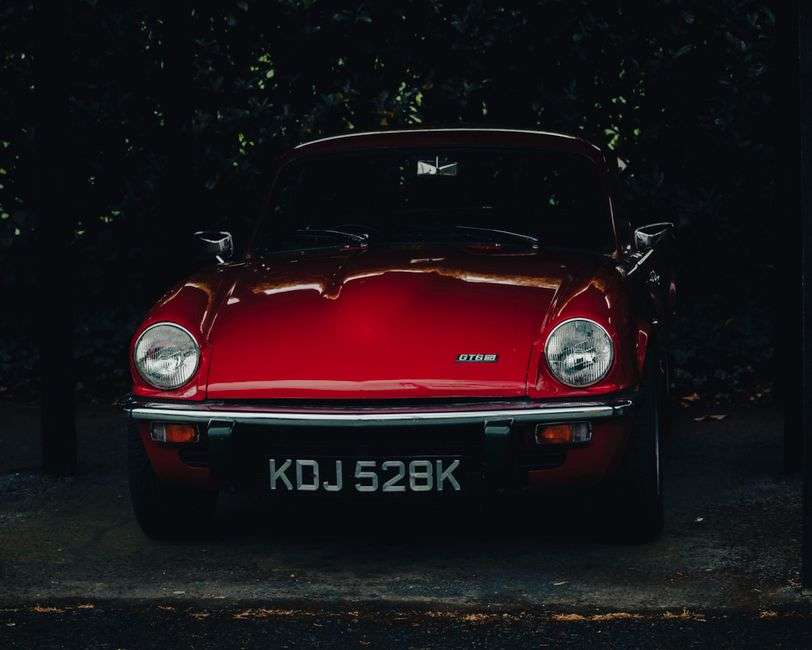
That introduction led, in time, to a look at one of the Gulf Coast’s most impressive private restoration stables: a 1954 Jaguar XK-120, a 1970 Jaguar XKE, and a Triumph TR3 that has been through a full restoration twice — all of them rebuilt, in a very literal sense, by hand in Mobile.
A $4,000 Dream in the Tenth Grade
Herndon’s thing for British sports cars started young. In the tenth grade, the object of desire was a Triumph TR6, priced at $4,000 — hopelessly out of reach. So a high school senior in Ocean Springs, Mississippi settled for a 1970 MGB priced at $800, which would not crank and had wiring issues. “I pretty much rebuilt the engine outside on a shell driveway in the heat of the summer,” he says. By 1978, a college freshman, he finally owned the TR6 he had always wanted — one that needed nothing at all.
Then came the classic collector’s tragedy: marriage and furniture. He sold both the MGB and the TR6 at the same time to buy bedroom furniture, and the hobby went dormant for years until the restoration bug returned for good.
The Hurricane-Drowned E-Type
His first full restoration was a Triumph TR3. But the project that defined him was a 1970 Jaguar XKE he found advertised after a hurricane left it underwater in Gulfport. He made an offer, the owner called the next day to accept, and Herndon drove over immediately — “before he could change my mind,” he says.
The rebuild took five years. “I’d wake up in the middle of the night thinking about a problem I needed to solve and start Googling for answers,” he says. “Taking a car apart is not hard, but if you can’t put 1,000 parts back in the right way, you have a mess.” He finished the car with a nonstandard 5-speed conversion for better performance — an upgrade that once drew the attention of Jay Leno, the comedian whose car knowledge is nearly as famous as his garage. “Jay knows cars and likes to work on them himself,” Herndon says. “He wanted to know all about the 5-speed I added to the XKE when he was at the Cruisin’ the Coast event. He enjoyed talking cars and was very approachable.”
The XK-120 came next, spotted on eBay as a bare chassis with its shell body sitting in the corner. He trailered it home from Lebanon, Tennessee and turned it around in a year — including a set of contoured matching luggage that fits the trunk’s shape exactly. “It’s like jewelry for the car,” he says.
The Honest Economics of Restoration
Herndon is refreshingly blunt about the hobby’s finances. A restorer who pays a professional to bring a car back to show condition can easily spend $75,000 on a car worth $30,000 when the work is done. “I’m in it because I enjoy doing the work myself and love driving classic British cars.” He sorts enthusiasts into three camps: the do-it-yourself restorers who love the process (roughly a quarter of the crowd), the dreamers who buy the car they always wanted and pay someone else to fix it (about half), and the auction-goers bidding at the high end (the rest).
He should know the market’s ceiling: at Pebble Beach, the sport’s pinnacle, a vintage Ferrari 250 GTO — only 36 ever built — sold for $56 million. Closer to home, the annual Amelia Island show at the Ritz-Carlton is his favorite on the East Coast. His day job, running Belzona Alabama, a regional supplier of repair compounds and industrial coatings, keeps him around the very materials the restoration world runs on — and introduced him to Impatient Creations in Birmingham, the shop he trusts for paint work.
The Family Business
His sons grew up in the shop and love the cars — especially taking them out with a date in tow. Herndon still remembers a blowout on the twin-span bridge across Lake Pontchartrain in the early days, blankets wadded in the back where the boys rode, because “the old cars broke down a lot. You better know how they work if you are going to drive them.”
That is the hobby’s real secret, and the reason the South Alabama British Car Club’s shows in Fairhope and along the coast keep drawing families: a classic car is a machine you learn by repairing, and the pleasure is at least as much in the wrenching as in the wave from a stranger at a stoplight. When you next see a Triumph or a Jaguar idling down Scenic 98, there is a decent chance the driver rebuilt every inch of it — and would be happy to tell you how.