Jazz Studio Youth Musicians to March in Mobile’s Conde Cavaliers Parade
Mobile's Jazz Studio, a youth program run by the Excelsior Band, will march in Friday's Conde Cavaliers parade to keep the city's brass band tradition.
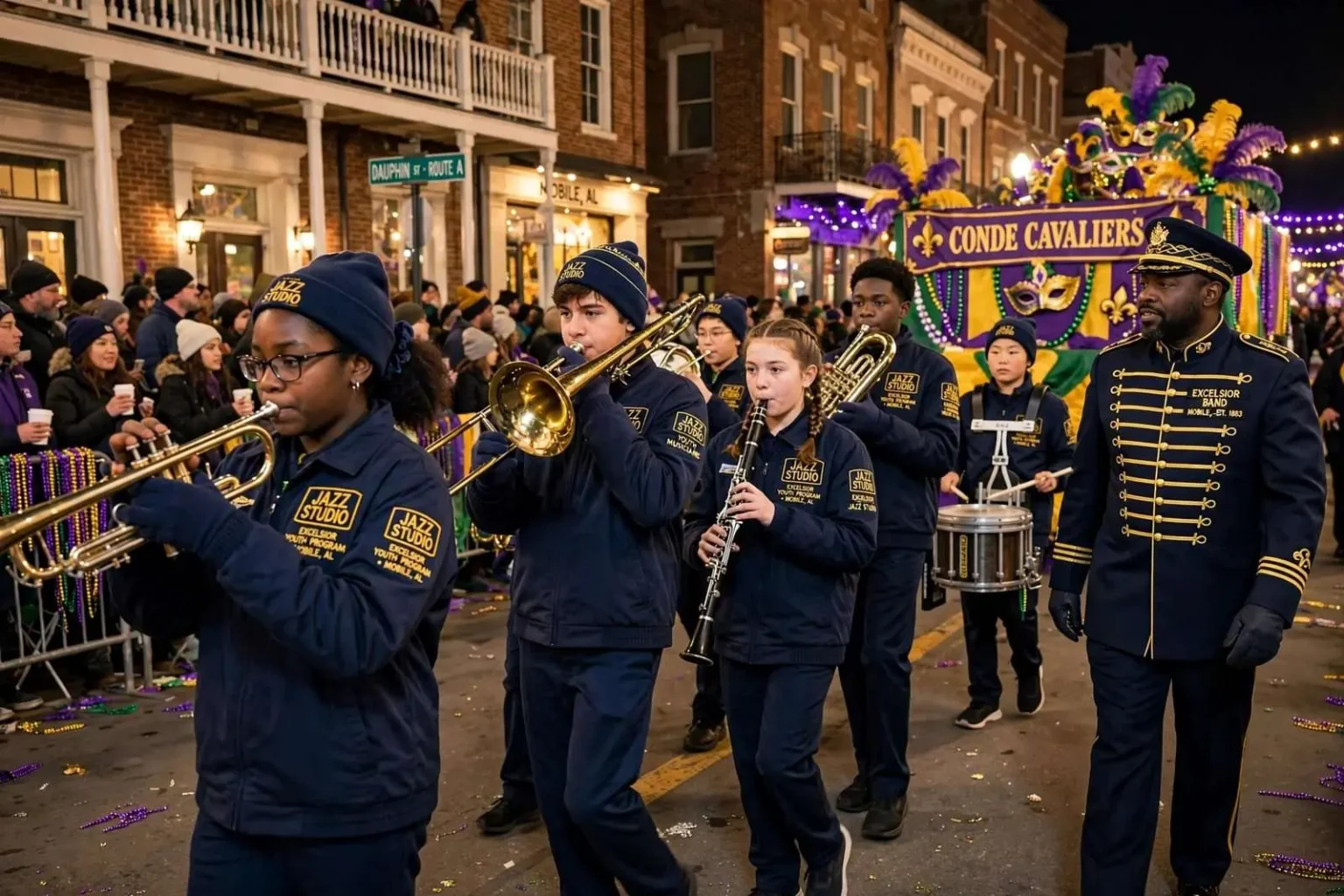
Young musicians from Mobile’s Jazz Studio will take to the streets Friday night, marching and playing in the Conde Cavaliers parade as part of an ongoing effort to keep one of the city’s most storied musical traditions alive. For the students, it is a chance to perform in front of the biggest crowds of their young careers — and to do it in the middle of Mobile’s signature season.
The Jazz Studio is a music instruction program run under the guidance of the Excelsior Band, one of Mobile’s longest-running brass bands and a fixture of the city’s Mardi Gras season for generations. The band has been a soundtrack for Mardi Gras in Mobile for well over a century, appearing at parades, balls, and community events across the downtown footprint each Carnival season.
The program trains students in grades six through 12 who have at least a year of musical experience, giving them hands-on instruction rooted in the Excelsior Band’s own style and repertoire. Rather than learning strictly from method books, the students study the marching-band and brass traditions that Mobile’s Carnival celebrations were built on — music passed down player to player, generation to generation.
Friday’s performance will not be the students’ first turn in the spotlight. The Jazz Studio previously performed at the “Keep the Music Playing Inaugural Gala” in mid-November, an event that showcased the talents of the program’s young musicians to the broader community. That appearance gave the students their first taste of performing for a Civic audience beyond school concerts and recitals.
Marching in a Mardi Gras parade is a different challenge altogether. Parades move; the music never stops for long; and the crowds along the route — families camped out with chairs and coolers, children reaching for moon pies and beads — expect the kind of energetic, unbroken brass sound Mobile has heard for generations.
Passing the torch
For the members of the Excelsior Band who lead the program, passing the music down to a new generation is about more than a single parade appearance. The instructors see the Jazz Studio as the next chapter of a tradition that stretches back through the band’s long history in Mobile, when brass players taught their successors the same way they had once been taught.
LaDarrel Bell of the Excelsior Band said the effort is about ensuring the band’s legacy continues long after its current members are gone. “We know that physically we won’t be here. Eventually one day everyone is going to pass away,” Bell said. “We want the music to live on and carry on, so we want to instill it into our young people and make sure they pick up the torch where we leave off and continue this legacy. And so the Excelsior Band doesn’t fade away and the music doesn’t fade away.”
That philosophy shapes how the program operates. Students are not treated as visitors to the tradition but as its future members — learning not only the notes but the marching style, the crowd interaction, and the sense of occasion that comes with playing for Mardi Gras crowds in the city where the American Carnival season began.
Music educators point to programs like the Jazz Studio as a model for keeping school music programs connected to their communities. Between school bands, church programs, and independent instruction, opportunities to perform in real civic settings are limited, and a parade slot in front of thousands of Mardi Gras spectators is an opportunity few student musicians anywhere get to experience.
Friday night on Route A
The Conde Cavaliers parade steps off at 6:30 p.m. Friday, Jan. 30, along Mobile Route A, giving the Jazz Studio’s young performers another opportunity to march in front of the crowds that turn out for Mobile’s Mardi Gras season. Route A carries the parades through the heart of downtown, past the rows of historic buildings and the packed sidewalks that define Mobile’s Carnival nights.
The Conde Cavaliers are among the mystic societies that open Mobile’s parade season each year, and their Friday night procession traditionally draws families downtown for the first big night of the Carnival calendar. For many Mobilians, the sight and sound of a brass band turning the corner onto the route is the moment the season truly begins.
Mobile’s Mardi Gras heritage predates New Orleans by years, with the city’s Carnival celebrations dating to the early 18th century and its modern mystic societies organizing parades and balls since the 1800s. Brass bands have been central to that story, providing the soundtrack for parade floats, second lines, and the street celebrations between stops.
The Excelsior Band’s place in that history has made it a cultural institution in its own right. Longtime Mobilians associate the band’s sound with Mardi Gras the way they associate moon pies with parade throws, and the group’s appearances extend beyond Carnival season to festivals, funerals, weddings, and civic events across the region.
For the students, marching Friday night means stepping into that lineage. Several of the program’s participants have grown up watching the Excelsior Band from the sidewalk; now they will be on the other side of the barricade, carrying the horns and playing the arrangements they have spent months rehearsing under the band’s guidance.
What it takes to march and play
Marching in a parade while playing an instrument is one of the harder skills in music education. Players must keep formation, stay in step, watch the drum major, and maintain tone quality — all while walking a route that can stretch well over a mile and while catching the inevitable parade-day distractions flying from the floats alongside them.
The Jazz Studio’s instructors spend weeks preparing students for those demands, holding rehearsals that combine music instruction with marching fundamentals. Breath control, endurance, and the ability to keep playing through fatigue are emphasized as much as scales and repertoire, because a parade is as much an athletic event as a musical one.
January nights in Mobile can be cold by Gulf Coast standards, and a 6:30 p.m. step-off means the students will be playing in evening temperatures that are hard on brass instruments and fingers alike. It is all part of the education — learning what the adults in the Excelsior Band have done every Carnival season for generations.
A tradition with a future
Programs like the Jazz Studio also address a practical concern for Mobile’s musical institutions: continuity. The city’s brass band tradition depends on young players coming up through the ranks, and the instructors’ message to their students is that the torch Bell described is theirs to pick up whenever they are ready.
Friday’s parade appearance is a step in that direction — a public statement that the tradition is being passed on, note by note, from the musicians who have carried it to the students who will carry it next. The Conde Cavaliers’ 6:30 p.m. step-off on Route A will give Mobile’s Mardi Gras crowds the first look at the next generation of the Excelsior Band’s sound.
As the season continues in the weeks ahead, the Jazz Studio’s students will carry Friday’s experience forward — and the Excelsior Band’s leadership says that is exactly the point. The parade will end, the crowds will go home, and the music will keep going, played this time by a generation that learned it on Mobile’s own streets.
Parents of the Jazz Studio students say the program has done more than sharpen their children’s musicianship. Participants learn accountability — showing up to rehearsal on time, maintaining an instrument, and representing a beloved institution in public — along with the confidence that comes from performing before a crowd of thousands.
The connection to the broader Mobile music scene matters as well. Students in the program meet working musicians, learn how the city’s musical institutions fit together, and see a possible future for themselves in the local scene, whether as performers, educators, or simply lifelong supporters of the tradition they grew up in.
Community support has played a role in keeping the instruction going, with families and Mardi Gras organizations recognizing that the marching bands along the route do not appear by accident. Behind every brass line at a Carnival parade is years of lessons, loaner instruments, weekend rehearsals, and instructors who volunteer their experience to the next class of players.
Friday’s Conde Cavaliers parade will be one night on the Mardi Gras calendar, but for the young musicians stepping off at 6:30 p.m. on Route A, it is the kind of night that determines whether a student stays with music for life. The Excelsior Band’s members know that from experience — and they will be marching alongside, watching the torch they described being carried a little further down the route.