MOBILE, Ala. — A judge has ruled that prosecutors have presented enough evidence for the murder case against Del-Juan Thomas to move forward, in connection with a fatal shooting outside a Mobile nightclub last month.
Thomas is charged with murder in the death of 43-year-old Brandon Shute. Prosecutors allege that Thomas shot and killed Shute after a fight in the parking lot of Poinse’s Bar and Lounge on Navco Road.
The judge also turned down a request from Thomas’ defense attorney to lower his bail, which remains set at $300,000.
Thomas has not been convicted of any crime. Like anyone charged with an offense, he is presumed innocent unless and until the state proves its case in court.
What the ruling means
A finding that the state has enough evidence to proceed is an early step in a felony case, not a decision about guilt. In Alabama, this kind of determination is typically made at a preliminary hearing, where a judge hears testimony, often from an investigating officer, and decides whether there is probable cause to believe a crime was committed and that the accused committed it.
Probable cause is a far lower standard than the one required for a conviction. At trial, prosecutors must prove a defendant’s guilt beyond a reasonable doubt to a jury. At a preliminary hearing, the question is only whether the evidence is strong enough to justify sending the case to the next stage.
Preliminary hearings also give the defense an early look at the state’s evidence. Defense attorneys may cross-examine witnesses and test the prosecution’s account, though the hearing does not resolve disputed facts.
What comes next
When a judge finds probable cause in a felony case in Alabama, the case is generally bound over to a grand jury. In Mobile County, a grand jury made up of local residents reviews the evidence in private and decides whether to return an indictment, the formal charging document that allows a felony case to proceed to circuit court.
If Thomas is indicted, he would be arraigned in Mobile County Circuit Court, where he would enter a plea. The case could then move toward pretrial motions, possible plea negotiations and, if no resolution is reached, a jury trial. A grand jury may also decline to indict, which would end the case unless prosecutors later present it again.
No date for grand jury consideration has been announced.
Bail stays at $300,000
The Alabama Constitution guarantees most defendants a right to bail before trial, with exceptions for capital offenses in certain circumstances. Judges set the amount and conditions of bail with the goal of ensuring a defendant returns for court dates and does not pose a danger to the community. Under Alabama’s rules of criminal procedure, judges may consider factors such as the seriousness of the charge, the defendant’s ties to the community, criminal history and any risk of flight.
Defense attorneys commonly ask judges to reduce bail amounts they consider too high for a client to afford. In this case, the judge denied that request, leaving the $300,000 bail in place. Defendants may ask the court to revisit bail later in a case if circumstances change.
The charge and possible penalties
Murder is a Class A felony in Alabama, the most serious category of felony short of capital murder. A conviction carries a sentence of 10 to 99 years or life in prison, and when a firearm or other deadly weapon is used in the commission of the offense, state law sets a minimum of 20 years.
Any sentence would depend on the outcome of the case and, if there is a conviction, the judge’s decision at sentencing. The facts prosecutors have alleged — a fight that ended in gunfire — have not been tested at trial.
About the case
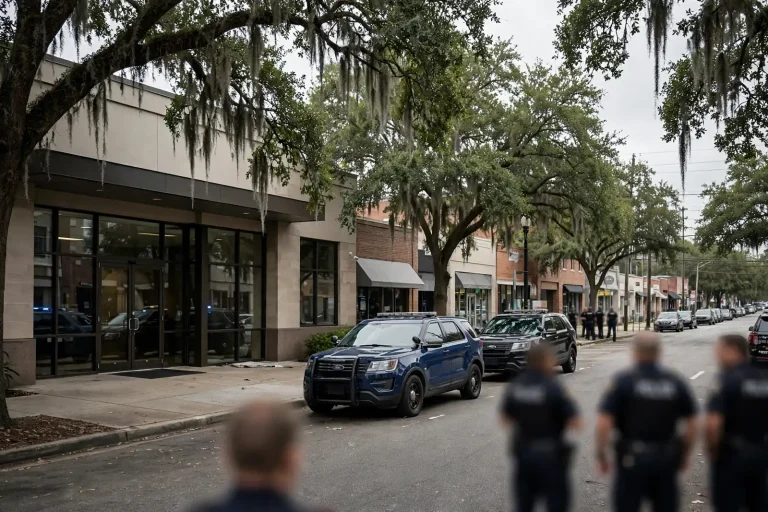
The shooting happened last month in the parking lot of Poinse’s Bar and Lounge on Navco Road in Mobile, according to prosecutors. Shute, 43, died in the shooting. Prosecutors have said the shooting followed a fight, but further details about what led to the confrontation have not been made public.
Anyone with information about a crime in Mobile can contact the Mobile Police Department or submit an anonymous tip through Mobile County Crime Stoppers.