Kirk Herbstreit Recalls Two Frightening Fan Incidents That Reshaped ‘College GameDay’
Longtime ESPN analyst Kirk Herbstreit revisited two dangerous run-ins with objects thrown from opposing crowds at LSU and Michigan State that changed how 'College GameDay' operates on the road.
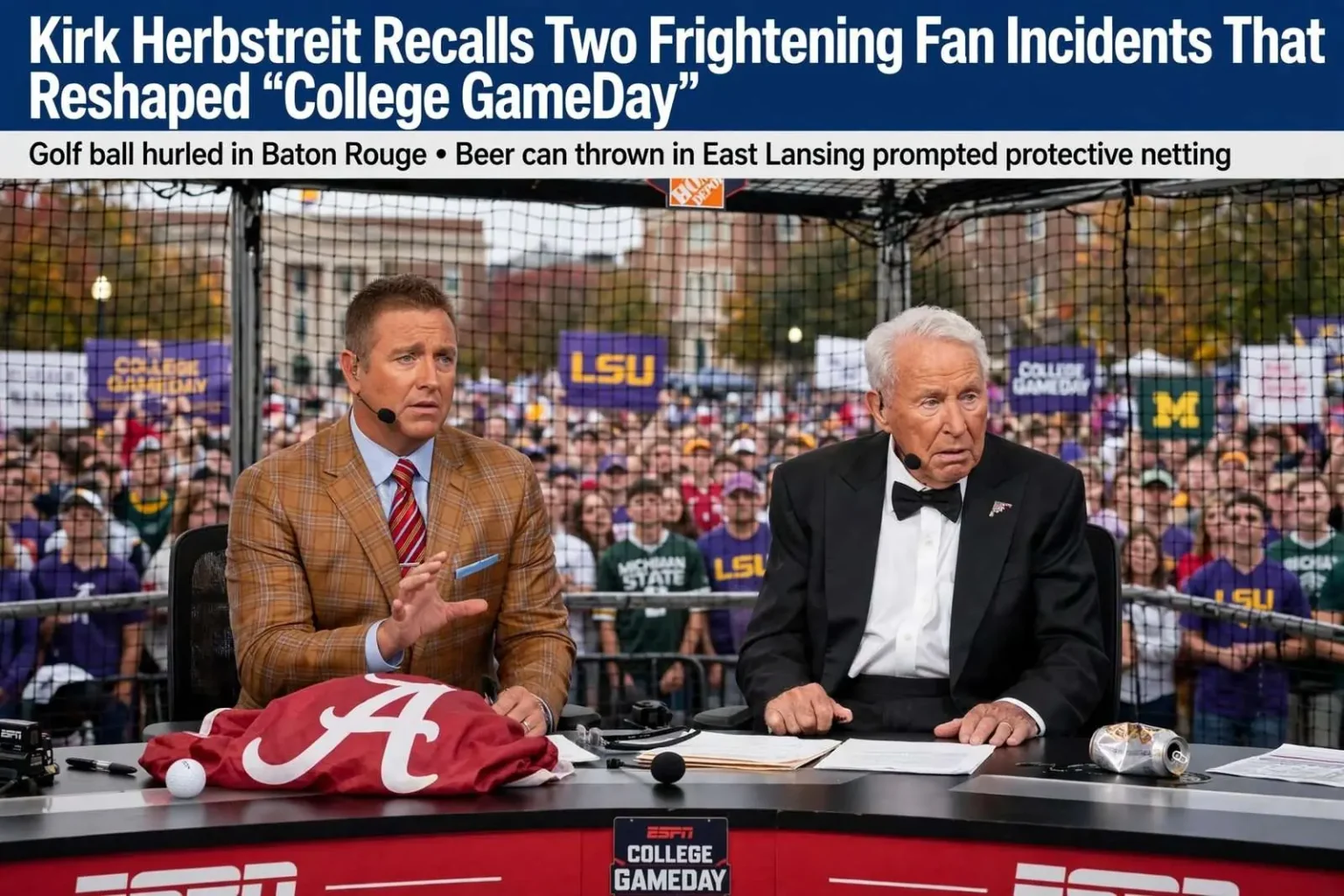
Kirk Herbstreit has spent nearly three decades traveling the country as the lead analyst for ESPN’s “College GameDay,” the traveling pregame show that has become as much a part of college football Saturdays as the games themselves. In a recent appearance on “The Press Box” podcast, Herbstreit pulled back the curtain on two specific moments from that run that were frightening enough to change how the show is produced on the road — one involving a golf ball hurled from a crowd in Baton Rouge, and another involving a full beer can thrown in East Lansing that narrowly missed hitting him or longtime co-host Lee Corso in the head.
“I remember two different occasions,” Herbstreit said. “We were at LSU doing an LSU-Alabama game and Corso picked Alabama. And he put on an elephant hat. This is before he did the helmets. And he had a massive Alabama red or crimson flag with an ‘A’ on it and he’s picking Alabama right in the heart of Baton Rouge. And here comes a golf ball flying from I don’t know, 30 yards out, and it just happened to hit the flag that he was waving and it landed right on the desk.”
A Show Built on Enemy Territory
Part of what has made “College GameDay” a weekly television institution since its debut in the early 1990s is its willingness to set up shop on the campus of that week’s marquee matchup, often surrounded by thousands of partisan fans just feet from the broadcast desk. That proximity is central to the show’s appeal — it captures the pageantry, tailgating culture, and rivalry intensity of college football in a way a studio show never could. But it also means the on-air talent, including Corso’s famous headgear picks, are performing their jobs in the middle of what is effectively an opposing team’s home crowd, week after week, in stadiums and campus squares from the Deep South to the Big Ten.
Corso’s tradition of ending each broadcast by putting on the mascot head of whichever team he predicts will win a given matchup has long been one of the show’s signature moments, drawing loud cheers when he picks the home team and just as loud jeers — or worse — when he picks the visitors. Herbstreit’s recollection of the LSU incident captured just how literally that reaction can turn physical: a golf ball thrown from roughly 30 yards away struck the crimson Alabama flag Corso was waving and landed on the anchor desk in front of the broadcast crew.
A Scarier Moment in East Lansing
The second incident Herbstreit described took place at Michigan State, during a broadcast the analyst placed around 1997, the season Michigan won a share of the national championship. With Herbstreit and Corso both having picked Michigan to beat rival Michigan State on the road in East Lansing, the crowd reaction went beyond boos.
“Another time, this was a scary one, we were in East Lansing,” Herbstreit said. “And this is what brought the net on. We were at East Lansing, I think in ’97 when Michigan won the national title. And we both picked Michigan in East Lansing to beat Michigan State. And somebody threw a full beer can from way back and it came, just whizzed right between Lee and I, and when it landed it exploded on the floor of the set. And that one, if it would have hit me in the back of the head or Corso on the back of the head, that would have been national news. We would have been probably knocked out or at the very least probably had a concussion.”
Herbstreit’s account directly ties that East Lansing incident to a tangible change in how “College GameDay” operates each week: the addition of a protective net around the set, a now-familiar feature of the broadcast that fans watching from home may not think twice about, but which traces back to a full, unopened can flying at head height between two of the show’s most recognizable personalities.
The Physical Risks Behind a Beloved Tradition
College football’s rivalry culture is part of what makes the sport’s Saturday rituals so compelling to millions of fans, but Herbstreit’s story is a reminder that the line between passionate fandom and dangerous behavior can be thin, particularly in the emotionally charged atmosphere surrounding a broadcast crew that has just publicly picked against the home team. Objects thrown from stands — whether a golf ball, a beer can, or debris of any kind — carry real risk of injury, a fact that has periodically forced athletic departments, conferences, and broadcasters across the sport to reassess fan-facing security measures at high-profile games.
For “College GameDay” specifically, the show’s format puts its talent in a uniquely exposed position compared with broadcasters who call games from enclosed press boxes. Sitting on an open-air set surrounded by tens of thousands of fans, often only a short distance from the front rows of a student section or general-admission crowd, exposes hosts to a level of physical proximity — and, occasionally, projectiles — that few other sports broadcasts entail.
A Show That Keeps Coming Back
Despite the risks Herbstreit described, “College GameDay” has continued to travel to campuses across the SEC, Big Ten, and every other major conference each fall, remaining one of ESPN’s signature college football properties and a coveted honor for host schools, which often see the broadcast as a marketing showcase in its own right. Corso’s mascot-head picks remain a fixture of the show, now performed behind the protective netting that Herbstreit traced back to that East Lansing beer can.
Herbstreit’s comments arrived as the sport heads into another high-stakes fall slate, with SEC and Big Ten programs once again drawing national attention — and, if history is any guide, another season of raucous campus crowds ready to make their voices, and occasionally their arms, felt when the GameDay bus rolls into town.
The Origins of a Traveling Institution
“College GameDay” first launched in 1987 as a studio-based highlights show before evolving into the traveling, on-campus format fans know today, a shift that began in earnest in the mid-1990s. That transition to broadcasting live from a different campus each week transformed the program from a highlights recap into appointment viewing in its own right, with the show’s location choice each Saturday often treated as a marker of which game ESPN considers the week’s premier matchup nationally.
Lee Corso’s mascot-headgear tradition, which began in the mid-1990s, quickly became the show’s signature closing moment and one of the most recognizable rituals in American sports broadcasting. The tradition has evolved over the years from simple team hats to increasingly elaborate custom mascot heads built specifically for the segment, a production investment that reflects how central the pick has become to the show’s identity and to the home crowd’s emotional reaction each week.
Rowdy Environments Are Part of the Draw — and the Risk
Part of what makes “College GameDay” compelling television is precisely the volatility Herbstreit described: broadcasting live from the middle of a passionate, often hostile crowd generates an authentic, unscripted energy that a studio show could never replicate. Student sections in the SEC and Big Ten in particular are known for elaborate, sometimes contentious reactions to visiting broadcasts, ranging from good-natured heckling and creative signage to, in rarer cases, the kind of thrown-object incidents Herbstreit described from LSU and Michigan State.
Sports leagues and broadcasters have had to balance that authenticity against genuine safety concerns for on-air personalities working in close proximity to tens of thousands of fans with no barrier beyond a broadcast set. The protective netting Herbstreit traced to the East Lansing incident represents one of relatively few physical safety modifications ESPN has made to the show’s format over its multi-decade run, suggesting the network has otherwise been willing to accept a certain level of exposure as the tradeoff for the show’s signature atmosphere.
A Fixture Heading Into Another Season
Herbstreit’s recollections arrive as “College GameDay” prepares for another full season of Saturday broadcasts from campuses across the country, continuing a tradition that has outlasted multiple conference realignments, coaching eras, and shifts in the broader made-for-television college football landscape. For all the risk inherent in setting up a live broadcast desk in the middle of a rival fan base, the show’s continued popularity suggests neither ESPN nor its talent have any intention of retreating to the safety of a studio.
Conferences Have Increasingly Cracked Down on Thrown Objects
Herbstreit’s account of projectiles landing near the “College GameDay” set echoes a broader problem that conferences across college sports have moved to address more aggressively in recent years. The Southeastern Conference, the Big Ten, and other major leagues maintain fan conduct policies that allow them to fine member institutions when spectators throw items onto the field of play or at officials, players, or visiting personnel, with penalties that can escalate for repeat incidents at the same venue. Those rules were written primarily with basketball courts and football sidelines in mind — moments when an unpopular call or a game-ending shot has historically drawn debris from student sections — but they reflect the same underlying tension Herbstreit described: environments built around raw, partisan emotion occasionally produce fans willing to turn that emotion into something physical. Athletic departments have responded with a mix of measures, including expanded camera coverage aimed at identifying and banning individual offenders, tighter restrictions on what fans are permitted to bring into stadiums, and, at some venues, adjustments to alcohol sales policies following incidents involving thrown objects. Because “College GameDay” sets up its desk in high-traffic areas immediately outside the stadium gates rather than inside a controlled venue, the broadcast operates somewhat outside the reach of those in-stadium conduct policies, leaving ESPN to rely on its own security presence and physical safeguards, like the protective netting Herbstreit credited to the East Lansing incident, rather than conference disciplinary rules that apply once fans pass through the turnstiles.