Kratom Sold as ‘Energy Shots’ Raises Alarm Over Teen Use on Gulf Coast
The Drug Education Council warns that kratom, an addictive drug banned in Alabama, is being sold as energy shots and used increasingly by Mobile and Baldwin County teens.
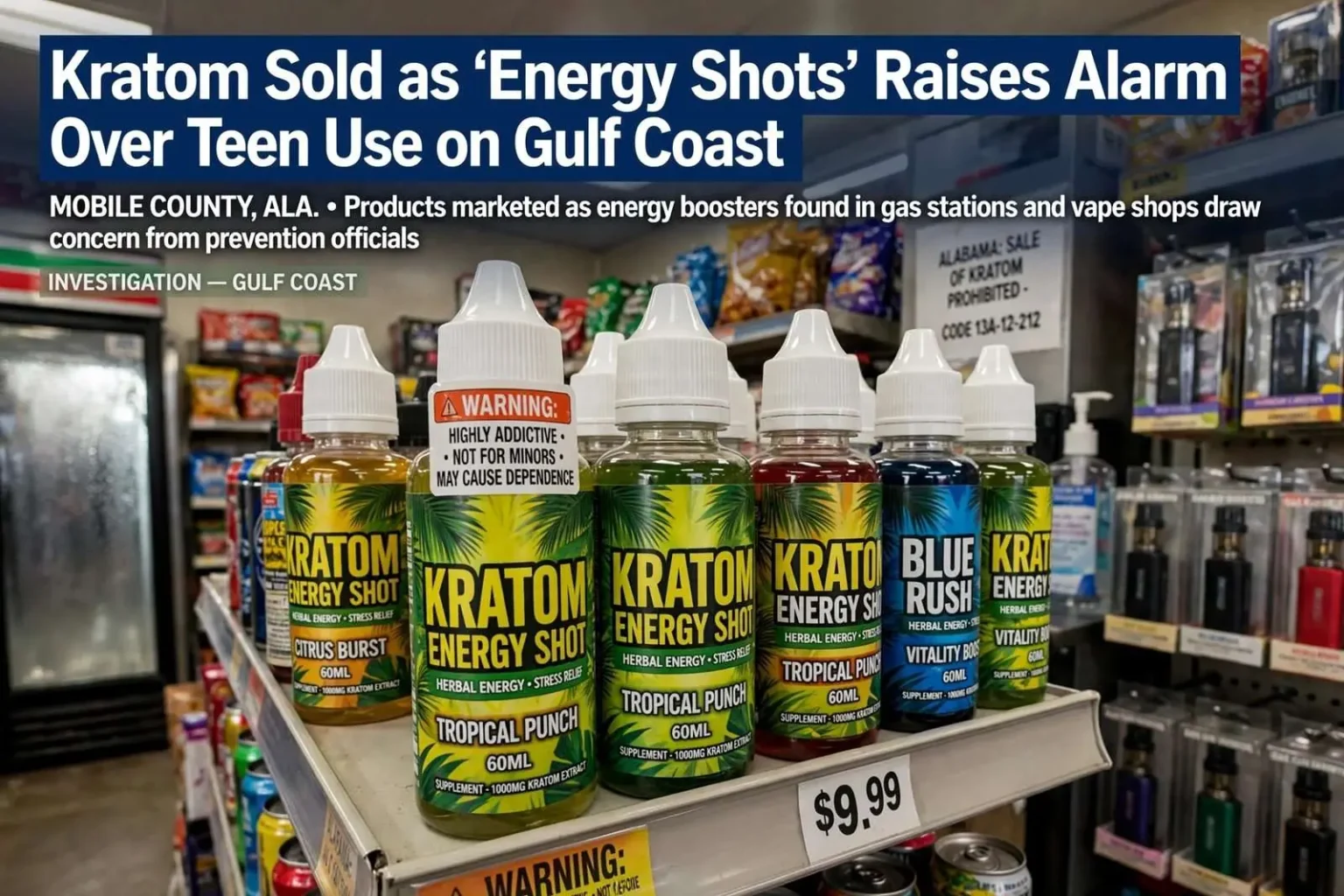
MOBILE COUNTY, Ala. — A drug that is illegal in Alabama and described as highly addictive is turning up on shelves at gas stations and vape shops, often marketed as an “energy shot.” The substance is called kratom, and the bottles claim to help with stress and provide an extra boost of energy.
Virginia Guy, executive director of the Drug Education Council, said the products can be found throughout Mobile and Baldwin counties. “In high doses, it has almost an opioid like effect. So, you know, it rides on the pain receptors in the brain the same way opioids do. It’s not an opioid,” Guy said.
Kratom originally comes from a plant, but Guy said manufacturers are now producing a synthetic version that is far stronger. She warned that the addictive nature of the drug is not reflected in how the products are packaged and sold. “It’s really the long-term effects that are the most harmful. You know, it can cause cardiac problems, that can cause a tremendous amount of anxiety and psychological problems,” Guy said. “If you start using any kind of substance by the age of about 14 or 15, you have about a 47% chance of developing addiction at some point in your life.”
Rising Use Among Teens
Over the past few years, Guy said, there has been an increase in the number of 12- to 17-year-olds using kratom. She pointed to social media as one driver of that trend. “It’s become very popular on social media among some influencers who are promoting the use of kratom and that’s caused young people to have an interest in it,” Guy said.
She said the drug also appeals to teens because it is difficult to detect. “It’s not easily detected on drug screens. It doesn’t have a lot of odors. It can be easily used without parents or educators really knowing,” Guy said.
The combination of easy access and invisibility is what worries prevention workers along the Gulf Coast. A teenager who would have to arrange a drug deal for most illegal substances can pick up a colorful bottle at a convenience store counter, pay with cash and consume it without any of the signals that normally alert adults — no smoke, no odor, no standard positive result on the screenings many schools and parents rely on.
What Kratom Is and Where It Comes From
Kratom comes from a tropical tree native to Southeast Asia, where its leaves have traditionally been chewed or brewed as a tea for their stimulant and pain-relieving properties. At low doses it acts as a stimulant; at higher doses its compounds bind to opioid receptors in the brain, producing effects that resemble narcotic painkillers. That dual nature is central to the concern Guy describes: users seeking an energy boost may be exposed to an opioid-like dependency without realizing what they are taking.
The versions sold in American stores bear little resemblance to the raw leaf of Southeast Asia. Manufacturers grind leaves into powders, concentrate them into capsules and extracts, and — as the energy-shot packaging shows — blend them into ready-to-drink bottles sold under brand names that emphasize vitality and stress relief. Guy said synthetic formulations being produced now are far stronger than the natural plant, multiplying the risk in each serving and leaving users with no reliable way to know the strength of what they are drinking.
Federal regulators have flagged kratom for years. The U.S. Food and Drug Administration has warned that compounds in kratom act on the same brain receptors as opioids and has linked the substance to overdose deaths nationally, while the agency has repeatedly taken action against sellers marketing kratom products as treatments for pain, anxiety or opioid withdrawal. Because kratom is not an approved drug and its supplements are not regulated for purity or dose, testing has found products whose actual contents vary widely from the label — a problem that overlays the synthetic formulations Guy described.
Legal Elsewhere, Banned in Alabama
Kratom is legal in Mississippi and most of Florida. While it is banned in Alabama, Guy said misleading marketing that obscures the ingredients helps keep the products on store shelves. “The owners and the managers of those stores may not even realize it’s kratom because it’s not regulated. So, it’s being marketed under all kinds of things,” Guy said.
Alabama moved kratom into its most restrictive drug category years ago, making possession and sale a criminal matter in the state. But the patchwork of laws across state lines creates a practical problem for the Gulf Coast: a product that a Baldwin County retailer cannot legally stock is displayed openly at shops across the state line, and shipping and social media sales blur the boundary further. Local teens who learn about kratom online may have little sense that the substance sits on the illegal side of the Alabama line.
The labeling problem compounds the legal one. Because bottles are branded as energy shots, herbal supplements or relaxation drinks rather than as kratom, store employees stocking shelves may not recognize what is inside, and buyers cannot easily tell which products contain the banned substance. That gray zone is how Guy said the products continue to appear on shelves in a state where the drug itself is prohibited.
The Message for Parents
Her advice to parents is to warn their children of the dangers before they encounter the drug. Prevention specialists emphasize that conversations begun before adolescence carry the most weight, particularly given the statistic she cited: a person who begins using any substance around age 14 or 15 faces roughly a 47 percent chance of developing an addiction at some point in life.
The Drug Education Council, based in Mobile, has spent decades on substance-abuse prevention and education across the Gulf Coast region, working with schools, parents and community groups on everything from tobacco and alcohol to the newer wave of synthetic and unregulated products. Its warnings about kratom place the substance alongside other over-the-counter items — such as certain herbal supplements and inhalants — that evade the mental picture most families have of dangerous drugs.
For parents, prevention specialists suggest a practical checklist: know what is sold at the stores and vape shops your teenager visits, read the ingredient labels on energy and supplement products that come home, and treat unfamiliar branded bottles with the same suspicion as any controlled substance. Because standard drug screenings may not detect kratom, the burden of awareness falls heavily on adults rather than on testing.
The social media dimension presents a different challenge. Short videos promoting kratom shots as a legal, natural way to boost energy or ease stress reach young viewers without any of the context about dependency, cardiac effects or Alabama law. Guy’s organization urges parents to recognize that exposure now happens on the phone rather than in the store aisle, and that a teen’s first encounter with the product may be an influencer video months before a purchase.
Health officials along the Gulf Coast continue to monitor kratom’s spread alongside other emerging substances, and Guy’s message is consistent: the packaging may say energy, but the pharmacology says opioid-like, the long-term effects say cardiac and psychological harm, and in Alabama the law says illegal. For families in Mobile and Baldwin counties, the first line of defense remains a conversation at home — before the bright-colored bottle ends up in a backpack.
Kratom’s trajectory mirrors earlier waves of unregulated substances that have moved through Gulf Coast convenience stores in recent years, from synthetic cannabinoids sold as potpourri to designer drugs sold as bath salts. In each case, the gap between the packaging and the pharmacology delayed public awareness until use was already widespread. Prevention groups say kratom has followed that pattern closely, arriving on shelves as a wellness product and only later earning attention as an addictive substance.
The numbers cited by the Drug Education Council underscore why the teen angle matters so much. Adolescence is the highest-risk window for developing substance dependency, and the earlier first use occurs, the greater the lifetime risk. A product that a student can consume between classes without odor, without paraphernalia and without a positive drug screen removes nearly every tripwire that normally prompts an adult intervention, which is why Guy and her colleagues push education before enforcement does the work.
Local health educators have also noted that the energy-shot format specifically targets habits teens already have. Energy drinks and shots are a normalized part of teenage life, purchased routinely at gas stations on the way to school and practice, so a bottle that looks like a familiar energy product requires no explanation, no stigma and no second look from a cashier. That seamless fit into an existing routine is precisely what distinguishes the current marketing from earlier generations of drug warnings.
Advocates in Mobile and Baldwin counties say the appropriate response combines several tracks: parent education about the products and their labels, retailer awareness so store owners know what is actually inside the inventory they stock, and continued support for keeping kratom restricted under Alabama law even as neighboring states take different approaches. Until the labeling catches up with the contents, Guy’s advice — warn children before they encounter the drug — remains the guidance she offers most often to Gulf Coast families.