Lucedale Spearfisherman Lands State-Record Red Hind
A Lucedale angler's spear-caught red hind, weighing 4 pounds 7.36 ounces, has been certified as a Mississippi state record by marine resources officials.
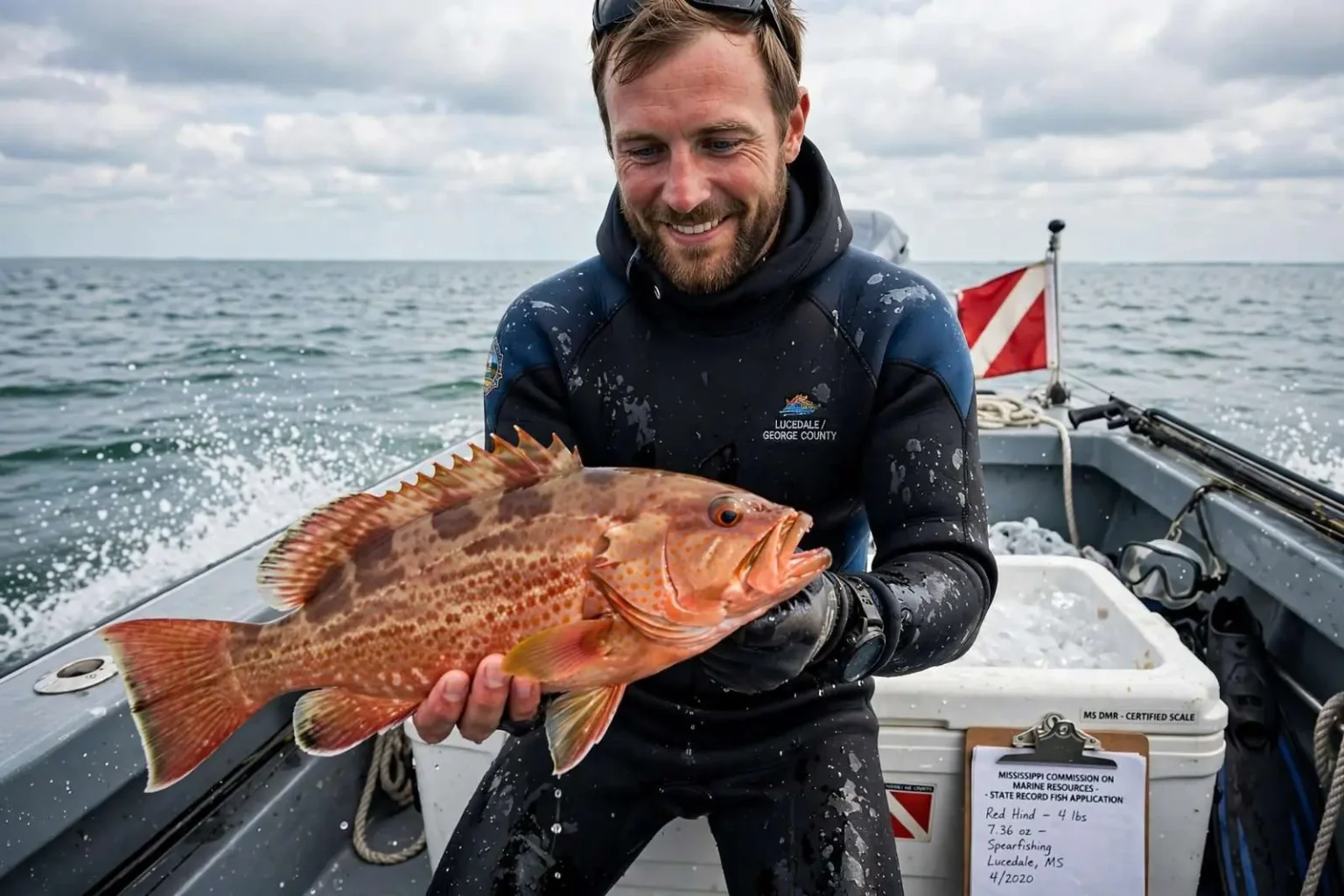
A Lucedale man has turned a day of socially distanced fishing into a place in the Mississippi record books. Harley Havard caught a red hind weighing 4 pounds, 7.36 ounces while spearfishing, and the Mississippi Commission on Marine Resources has certified the catch as a state record for the species.
Red hind are a grouper-like reef fish found in the Gulf of Mexico, and records for them are typically set by divers who take the fish underwater rather than on hook and line. The species, known for its reddish coloring and the male’s habit of defending territories where females gather to spawn, inhabits rocky bottom and artificial reef structure well offshore, at depths that put it beyond the reach of most casual fishing trips. Havard’s record-setting outing came as health officials were encouraging outdoor recreation as a way to stay active safely during the early weeks of the covid-19 pandemic, when fishing from a boat or in open water allows plenty of distance from others.
The certification adds George County to the list of South Mississippi communities producing record-class catches from Gulf waters. For the state’s saltwater record program, the red hind entry filled in a species where the previous record book had room to grow, and for Havard it converted a pandemic-season dive trip into a permanent line in the state’s fishing records.
The Fish and the Record
The red hind, sometimes called by anglers by its old market nickname, is one of the smaller groupers of the Gulf, typically running a few pounds, which is why a fish of more than four and a half pounds stands out. The species is caught commercially in small volumes and sought by spearfishermen who work the offshore reefs and rigs where the fish shelter. Its flesh is prized, and the species supports a modest but dedicated fishery in the northeastern Gulf.
State record programs along the Gulf Coast work on the same basic structure: a certified scale, a witness to the weighing, species verification by a marine fisheries biologist, and an application reviewed by the state’s marine resources agency. Mississippi’s Commission on Marine Resources maintains the state’s saltwater records, and the verification process exists precisely so that a claim like Havard’s — a fish that outweighs anything previously documented in state waters — can stand on solid paperwork. The 7.36-ounce precision in the certified weight reflects the care the program requires: records in this sport are sometimes separated by fractions of an ounce.
Spearfishing records occupy their own niche in the record books. Taking a fish by free diving or scuba demands close-quarters accuracy and a different set of skills than rod and reel, and the fish that fall to divers tend to be the ones holding territory on deep structure. Record-keeping bodies track spear and tackle records separately in many categories, acknowledging that the two methods bear little resemblance to each other. Havard’s fish was certified in the spearfishing category, where red hind records are most commonly set.
Diving the Offshore Reefs
The habitat where a red hind is taken tells the story of the hunt. The species holds to hard bottom, ledges, and wrecks in federal waters well south of the Mississippi coast, generally beyond sight of land, where clear blue water and structure combine to make spearfishing productive. Divers working that structure descend on anchor lines, work the ledges where groupers ambush passing bait, and take their shots in water that can run dozens of feet deep. It is a sport that demands experience, dive training, and a seaworthy boat, and its practitioners on the Gulf Coast form a small, dedicated community.
Lucedale, the George County seat, sits inland on the Pascagoula River system, but its anglers and divers are within reasonable trailer range of the Mississippi Gulf Coast’s launches. From the coast’s boat ramps, it is a long run south to the blue water and structure where reef species live — a run that takes dedicated planning for fuel, weather, and dive safety. The fact that a record fish came from a George County spearfisherman reflects how far the Gulf’s sporting reach extends into south Mississippi’s inland towns, where a substantial share of the coast’s offshore anglers actually live.
Fishing in a Pandemic Spring
The timing of the record made it a period piece. In the early weeks of the covid-19 pandemic, when the record was set, public health guidance pushed people outdoors and away from crowds, and state wildlife agencies across the Gulf region reported surging interest in fishing and boating as among the few recreations still practical under social distancing. Boat ramps stayed busy, tackle shops did steady business, and fisheries managers noted that the pandemic spring produced one of the strongest waves of new participation in years.
Spearfishing fit the moment almost perfectly. The sport is inherently small-group — a dive boat carries a limited crew, and the work happens underwater, apart from everyone else. While team sports, gyms, and indoor venues closed, the offshore reef fishery remained open, and divers who kept their boats maintained and their weather windows clear found the ocean as available as ever. Havard’s record trip was, in that sense, exactly the kind of outing health officials had in mind when they encouraged outdoor recreation: isolated, active, and a long way from anyone else.
The pandemic also changed the rhythm of the record season itself. With tournaments canceled and charter schedules disrupted, individual anglers and divers had more open days on the water, and record applications along the Gulf reflected the extra effort. A record red hind taken in that window carried a story beyond the fish — a marker of what Gulf Coast sportsmen did with a spring when the usual calendar was suspended.
The State Record Program
Mississippi’s record-keeping system gives the state’s saltwater anglers a way to compete with history rather than with each other. The Commission on Marine Resources certifies records by species and tackle category, and the verified list covers everything from trophy red snapper and cobia down to the smaller reef species that most anglers never specifically target. For the smaller species, records fall more often — the fish are less pressured, and a skilled diver or angler who sets out after a specific species has a genuine chance of writing a new line into the book.
That is the practical significance of the red hind record: it is attainable in a way that a record cobia or tuna is not. A diver who learns the red hind’s habits, finds the right structure, and waits out the weather can realistically take a fish of record weight, because few people have tried. Records for overlooked species are among the most accessible in saltwater fishing, and agencies encourage anglers to pursue them as a way of building participation and documentation alike.
The certification process also protects the integrity of the list. Every record application depends on the same unglamorous details — the certified scale, the witnessed weighing, the species identification, the completed form — and the commission’s review ensures that the state’s record book means what it says. When a fish like Havard’s red hind is certified at 4 pounds, 7.36 ounces, the number carries the program’s authority behind it.
George County on the Map
The record also put a rural county’s name into the state’s saltwater annals. George County, population roughly twenty-four thousand, sits in the piney woods north of Pascagoula, and its connection to the Gulf runs through the rivers that drain toward the coast and through the residents who trailer their boats south to the ramps. Communities like Lucedale supply a large share of the coast’s offshore fishermen, and their successes ashore-and-afloat tend to be recorded in the coastal papers’ fishing columns rather than in hometown news.
A state record changes that for a moment. The certified catch gives the local angler a claim to statewide standing, and it hands the county a line in the official record book that will stand until someone takes a bigger fish. For South Mississippi’s fishing towns, such records are small badges of legitimacy — evidence that world-class Gulf fishing starts in driveways and boat sheds a hundred miles inland from the water.
Havard’s red hind now sits in the Mississippi record book alongside the state’s marquee fish, taken by a diver from Lucedale during a spring when the whole coast was looking for safe ways to be outdoors. The fish weighed 4 pounds, 7.36 ounces on a certified scale, and the commission’s certification made it official.
Groupers of the Northern Gulf
The red hind belongs to a grouper family that includes some of the Gulf’s most familiar names — gag, red grouper, scamp, and the goliath — and it shares the clan’s traits: a mouth built for ambush, a taste for live bait and crustaceans, and a loyalty to a home patch of structure. Mature males are recognizable by the reddish-orange wash that gives the species its name, and the fish’s territorial spawning behavior, in which males aggregate females at cleaning stations on the reef, is one of the better-documented stories in Gulf fish biology.
Those aggregation habits matter to both the fishery and the diver. A spearfisherman who finds a productive ledge can expect the resident hinds to hold to it, and the species’ relatively small home range makes it more predictable than wide-roaming pelagics. Federal management of red hind is folded into the grouper complex managed in the Gulf, with size limits and seasons designed to keep the recreational and commercial takes sustainable. For record-seeking divers, the management structure means a legal fish must also be a compliant fish — taken within the open season and above the minimum size.
The species’ modest maximum size is what makes the record line achievable. Red hind rarely exceed ten pounds even in the deeper waters of their range, and along the northern Gulf a fish in the four-to-five-pound class is a genuinely good one. Havard’s 4-pound, 7.36-ounce fish represents exactly the upper tail of what the habitat produces — which is why the certification matters, and why the next challenger knows roughly what weight will be required.
How a Record Catch Gets Certified
The path from a good dive to a certified state record runs through paperwork. The angler or diver must have the fish weighed on a scale certified for commercial use, with the weighing witnessed, and then submit the application with photographs and the species identification confirmed by a fisheries professional. Mississippi’s program routes those applications through the Department of Marine Resources, and the commission’s certification is the final step that fixes the fish, the weight, the date, and the location into the official record.
Witnesses, scales, and photos sound bureaucratic until the moment they matter, because records are frequently disputed and the certification requirements exist so that the angler holding the record does not have to defend it with memory alone. In close cases — records separated by ounces — the documentation is the record. The precision of Havard’s certified weight, down to the hundredth of an ounce, shows the program’s standard in action.
A Record with Local Roots
Every certified record carries a set of place names with it — the hometown of the angler, the waters where the fish was taken, the agency that signed the certificate. Havard’s entry reads Lucedale, George County, and the Gulf of Mexico, tying an inland pineywoods town to the offshore reefs through a single certified fish. South Mississippi’s saltwater records have long carried such inland signatures, from the Hattiesburg and Laurel anglers who run south to the coast, and each one reinforces the same point about where the region’s fishing culture actually lives.
The record’s timing gives it a second layer of local meaning. Certified during a spring when the region’s usual entertainments were shut down, the catch stands as a document of what Gulf Coast outdoorsmen did with the empty calendar — went fishing, kept their distance, and came home with a state record. The Mississippi Commission on Marine Resources has the certificate, the record book has the line, and Lucedale has a spearfishing record it can call its own.